
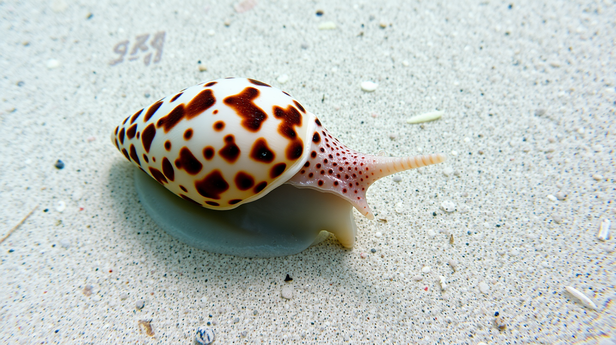
A Shell That Can Kill You
Pick up a cone snail on a beach and it will not wait. The animal fires a hollow, harpoon-like tooth called a radula through its flesh, through yours, and injects venom in under a second. There is no antidote. In documented fatalities, death from respiratory paralysis has followed within hours. The Conus geographus species, the geography cone, carries a lethality rate high enough that marine biologists estimate roughly 70% of recorded human stings from that species alone have been fatal when untreated. These animals live across Indo-Pacific waters, including along India's Andaman coast and in the shallow reefs off Lakshadweep, sitting camouflaged in sand, looking like collector's prizes.

The venom is not a single compound. It is a library. Each cone snail species produces a unique mixture of short protein chains called conotoxins, sometimes hundreds of distinct peptides in a single animal. Conus geographus alone is estimated to carry over 100 different conotoxin variants. Each peptide is engineered, through millions of years of predation, to hit a specific molecular target in the nervous system of prey.
What Conotoxins Actually Do Inside a Body
Most poisons work bluntly. Conotoxins work with precision. Different peptides in the venom block different ion channels, the molecular gates in nerve cells that control how electrical signals travel. Some block sodium channels, stopping nerves from firing at all. Others block calcium channels, cutting off the signal that tells muscles to contract. A third class targets potassium channels. The combined effect on a fish, the cone snail's primary prey, is near-instant paralysis. The fish cannot swim. The snail swallows it whole.
This specificity is exactly what makes conotoxins medically interesting. Most pain drugs work by flooding the entire nervous system with a broad chemical signal. Conotoxins can be designed to hit one channel type, in one tissue, with minimal effect elsewhere. That is a pharmacologist's dream, and it sat undiscovered in a shell for decades.
The Scientist Who Listened to the Venom
Baldomero Olivera, a biochemist at the University of Utah, began studying cone snail venoms in the 1970s. His lab spent years isolating individual conotoxin peptides and testing what each one did. One peptide, eventually named omega-conotoxin MVIIA, caught particular attention. It blocked a specific calcium channel, the N-type voltage-gated calcium channel, that sits on pain-transmitting neurons in the spinal cord. Block that channel, and pain signals from the body cannot reach the brain. The compound worked in animal models where opioids had already failed.
The path from that observation to a drug took over two decades. Elan Pharmaceuticals synthesised the peptide, renamed it ziconotide, and ran it through clinical trials in patients with severe chronic pain, many of them with cancer or AIDS-related nerve pain that had stopped responding to morphine and other opioids. The US Food and Drug Administration approved ziconotide in 2004 under the brand name Prialt. It remains the only FDA-approved drug derived directly from cone snail venom.
Why Ziconotide Is Not a Simple Substitute for Morphine
Ziconotide cannot be swallowed. Because it is a peptide, the digestive system breaks it down before it reaches the bloodstream. It must be delivered by intrathecal pump, a device implanted near the spine that delivers the drug directly into the cerebrospinal fluid. This limits its use to patients with severe, refractory pain who have not responded to other treatments. The dose window is narrow. Too little and it has no effect. Too much produces serious neurological side effects including hallucinations and cognitive impairment.
For the patients it is designed for, though, ziconotide does something opioids cannot: it does not cause tolerance. The body does not adapt to it the way it adapts to morphine, meaning the effective dose does not need to keep climbing. It also carries no addiction risk, because it does not act on opioid receptors at all. In a global pain medicine landscape struggling with opioid dependency, that distinction matters.
What the Cone Snail's Library Still Holds
Ziconotide is one peptide from one species. Researchers estimate there are roughly 700 to 800 cone snail species worldwide, and each carries its own unique conotoxin library. The vast majority remain chemically uncharacterised. Olivera's lab and others have since identified conotoxin peptides that target receptors linked to epilepsy, cardiovascular disease, and even some forms of depression. A 2020 study published in Science described a conotoxin from Conus geographus that mimics human insulin, a finding with potential implications for diabetes research.
The challenge is synthesis and delivery. Many conotoxin peptides are too fragile to survive standard drug formulation, and the intrathecal delivery requirement that applies to ziconotide is a significant barrier for widespread use. Researchers are now working on modified versions of conotoxin peptides that retain their target specificity but can survive oral delivery, essentially trying to replicate the precision of the venom without the venom's fragility.
The cone snail did not evolve its venom for human medicine. It evolved it to catch fish in the dark. The fact that the same molecular precision that paralyses a reef fish also, with the right delivery, silences a pain pathway in a cancer patient's spine is not a coincidence of chemistry, it is a reminder that the nervous system of a fish and the nervous system of a human share more architecture than either would prefer to admit. Every unexplored species in those Andaman reefs carries a compound library we have not yet opened.