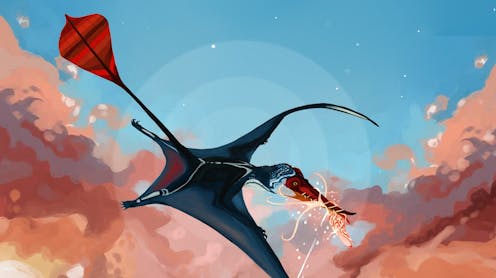
Scientists have long puzzled over how pterosaurs became the first vertebrates to master flight. Some pterosaur species, such as the Quetzalcoatlus were the largest known animals to ever take to the skies, with wingspans of over ten meters (on par with military aircraft like the Spitfire). My team’s new study may help solve the evolutionary mystery, revealing how a vane on the tip of their tails may have helped these ancient animals fly more efficiently.
It took some time for active flight to evolve in the natural world. The first flying animals were insects similar to dragonflies, which flapped their wings over swampy forests of the Carboniferous period (over 300 million years ago). Around 100 million years later (in a period known as the Triassic), the first bony animals, vertebrates, took to the skies. These vertebrates were pterosaurs, which dominated the skies of the Mesozoic era som 251-66 million years ago, swooping over the heads of dinosaurs.