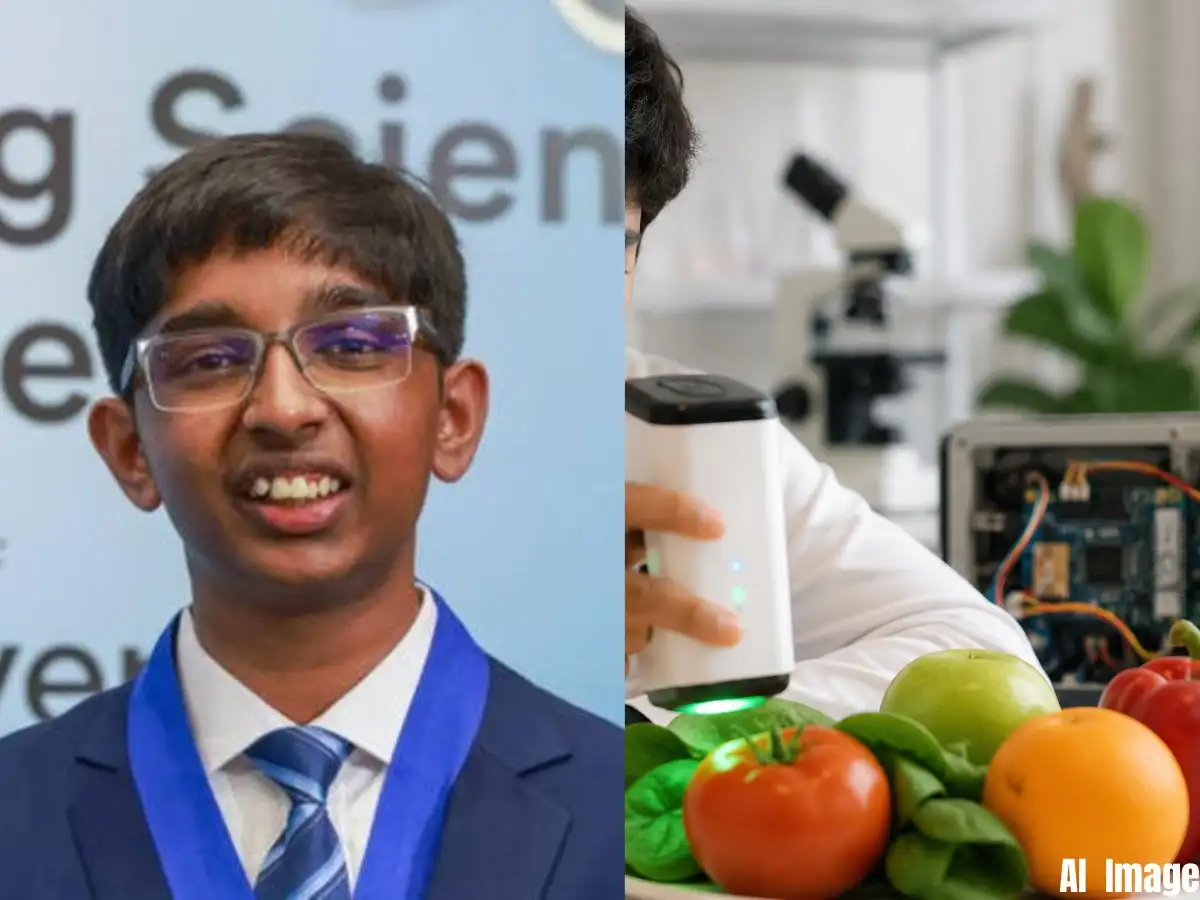
A 14-year-old student from Georgia has won a national science competition for creating a handheld device that could help consumers detect pesticide residues on fruits and vegetables. Sirish Subash, a ninth grader from Snellville, developed PestiSCAND, an AI-powered device that was tested on spinach and tomatoes and achieved more than 85% accuracy, according to 3M. His project won the title of America’s Top Young Scientist in October 2024 and came with a $25,000 prize.

Subash began working on the idea after thinking about a simple problem faced by people buying fresh produce: washing fruits and vegetables may remove some residues, but consumers cannot easily tell what remains afterward.
How PestiSCAND works
PestiSCAND is designed as a portable detector that can be used outside a laboratory. Subash tested the device on spinach and tomatoes, using artificial intelligence to identify pesticide residues.
According to 3M, the device recorded an accuracy rate of more than 85%. The project was also developed with practical use in mind, with Subash working to make the technology smaller and easier to carry.
The teenager does not suggest that people stop washing their produce. Instead, the device is meant to be used after washing as an additional way of checking what may remain on the food.
That makes the project less about replacing an everyday kitchen habit and more about giving consumers another source of information about their food.
Why Subash focused on pesticides
The idea grew from questions about how much consumers know about pesticide residues on produce. People can wash fruits and vegetables, but they generally cannot see whether traces of pesticides remain.
Subash's project drew on information from the US Food and Drug Administration's pesticide residue monitoring work. The FDA reported that 70.6% of samples produce items.
The project also considered concerns surrounding possible health effects linked to pesticide exposure. Subash referred to conditions including certain cancers and neurological diseases while explaining the motivation behind his work.
However, PestiSCAND was designed specifically as a detection tool. It was not developed as a medical device and does not diagnose or prevent diseases.
The device started out much bigger
PestiSCAND did not begin as the compact device presented at the competition. Subash initially worked with a larger setup before trying to reduce its size and make it easier to use.
The later version included Bluetooth connectivity, allowing the device to communicate wirelessly. That shift was important because Subash was not only trying to demonstrate that the concept worked. He was also exploring whether it could become something that could be used away from a laboratory or school setting.
The handheld design gives the project a more practical direction. Instead of requiring a large setup, the concept is built around a device that could potentially be carried and used at home.
Subash had conducted multiple trials before entering the competition. The results helped the project meet the performance targets set for the competition, although PestiSCAND remained an experimental invention rather than a commercially established consumer product.
How the young scientist won $25,000
Subash's project was entered in the annual America’s Top Young Scientist competition organised by 3M and Discovery Education.
The competition gives middle school students an opportunity to develop science and technology projects aimed at solving real-world problems. Hundreds of students apply, while 10 finalists are selected in June.
Those finalists then work virtually with 3M scientists for around four months. The scientists mentor the students as they develop and refine their projects.
The final stage took place in Minnesota, where the students presented their work. Their projects were assessed on factors including creativity, communication and ingenuity.
Subash won the competition after the final was held on October 14 and 15, 2024. Along with the America’s Top Young Scientist title, he received a $25,000 prize.
The competition can also open doors beyond the prize money. According to 3M, some previous participants have gone on to pursue patents, launch companies and earn recognition on lists such as 30 Under 30.
For Subash, however, the project began with a much more everyday question: how can people know what may still be on their fruits and vegetables after they wash them? PestiSCAND is his attempt to find a technological answer.
(Source: TOI)