Get all your news in one place.
100's of premium titles.
One app.
Start reading
Bangkok Post
Bangkok Post
Business

Hong Kong tourism sector urges action with visitor spending 44% below 2018 level

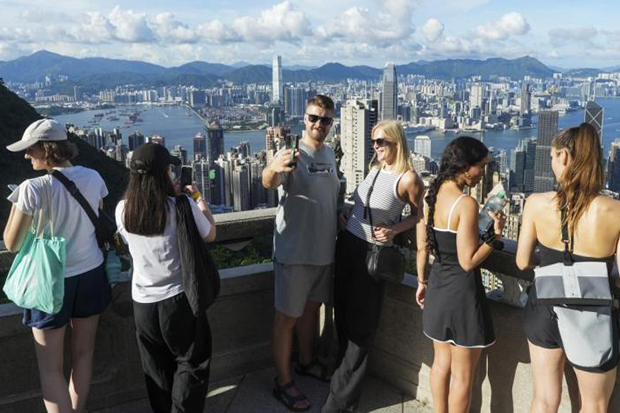
Visitor spending in Hong Kong remains 44% below its 2018 level, prompting calls for more events and cross-border tourism cooperation. (Photo: South China Morning Post)

Hong Kong's tourism industry has called for more experiential events, enhanced transport measures and closer cross-border cooperation to draw overnight visitors, after tourist spending fell to HK$197.5 billion (830 billion baht) last year, 44% below its 2018 level.

Lawmaker Perry Yiu Pak-leung, chairman of China Travel Service (Hong Kong), said on Friday that the fall reflected changing travel patterns, with tourists placing greater value on experiences and in-depth exploration than on shopping.

Yiu made the call after the latest Legislative Council research found that visitor spending had fallen 44%, from about HK$353 billion in the pre-pandemic year of 2018.

Yiu said some tourists still had strong purchasing power, but their spending depended on whether Hong Kong could encourage them to stay longer and offer a wider variety of events.

"The tourism industry is very much affected by the external environment, such as weather, flight prices and transport costs, among others," he said.

"While we cannot control these factors, providing more and different travel experiences, and strengthening connections and synergy are some important directions to bring an upgrade to our industry, enhance tourists' travel experience and boost their spending."

According to the research, the gap between visitors' spending in Hong Kong and Hong Kongers' expenditure abroad narrowed significantly in recent years.

While visitor spending in the city fell, Hong Kong residents' non-local expenditure rose 10% from 2018 to HK$191.1 billion last year.

The research also showed that spending per overnight visitor in Hong Kong fell from HK$6,614 in 2018 to HK$5,503 last year. Spending per same-day visitor dropped by more than 48% over the same period, from HK$2,202 to HK$1,139.

The city recorded 49.9 million inbound visitor arrivals last year, about three-quarters of the 2018 peak of 65.1 million.

Meanwhile, Hong Kongers made 117.5 million outbound trips last year, up 28% from 2018. Northbound travel through cross-border land checkpoints accounted for 88% of all departures.

Speaking on Friday, Yiu said the city had received more same-day visitors, who tended to spend less, as they transferred flights in Hong Kong or passed through cross-border checkpoints to mainland China.

While the city had hosted exhibitions to attract high-spending overnight business travellers, Hong Kong could also organise and promote more experiential events to appeal to visitors from different countries, he said.

He cited the example of working with the city's Thai community and retailers to celebrate the Songkran festival, with the aim of attracting tourists from Southeast Asia.

Yiu also said industry practitioners had observed that more foreign travellers were reaching Hong Kong via the mainland, thanks to China's 240-hour visa-free transit scheme.

The policy allows individuals from 55 eligible countries who are travelling from China to a third country or region to enter visa-free through designated ports and stay within permitted areas for up to 240 hours.

"Many travellers first travelled to the mainland and tried taking the high-speed rail to Hong Kong … If we step up cooperation with mainland cities, we can benefit from mutual tourist sourcing," he said.

"We can lure foreign travellers and achieve multi-stop travel. I believe it will help increase visitor arrivals."

He added that Greater Bay Area cities could also work together on promotion and tourism products to appeal to international travellers.

Timothy Chui Ting-pong, executive director of the Hong Kong Tourism Association, noted that the city had organised many events to attract tourists but lacked incentives to keep them in the city longer.

He suggested that providing free transport and shuttle services between tourist spots could be an incentive, as it would make travelling within the city more convenient.

He pointed out that Macau hotels have been providing free shuttle services to connect key attractions and border checkpoints.

Sign up to read this article
Read news from 100's of titles, curated specifically for you.
Already a member? Sign in here
Related Stories
Top stories on inkl right now
One subscription that gives you access to news from hundreds of sites
Already a member? Sign in here
Our Picks
Fourteen days free
Download the app
One app. One membership.
100+ trusted global sources.