Get all your news in one place.
100's of premium titles.
One app.
Start reading
Reason
Reason
Matthew Petti

Homeland Security Admits To Watchlisting Americans Based on 'Potential Inaccuracies'

The Department of Homeland Security (DHS) acknowledged in court filings on Monday that "potential inaccuracies were identified" in the database it is using to look for illegal foreign voters—and that its investigation process carries the risk that "in rare circumstances U.S. citizens might be incorrectly identified as aliens."

The department's lawyers told the court that "there are various safeguards in place to prevent mistakenly contacting a U.S. citizen" for interrogation, but its filings do not say what happens to U.S. citizens placed on a watchlist.

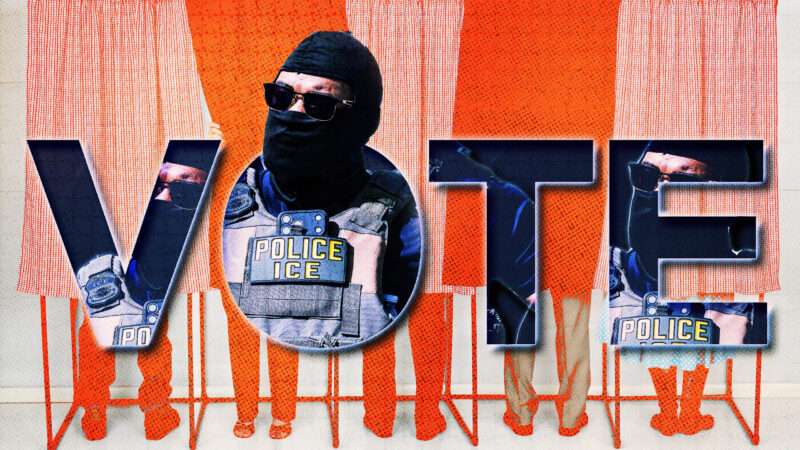
The lawsuit by several local governments and organizations in California accuses the DHS' new Unlawful Voter Initiative of intimidating Americans. It is based on a report from a U.S. Citizenship and Immigration Services (USCIS) whistleblower, who provided excerpts from a training video introducing the initiative.

USCIS officials were ordered to cross-reference voter rolls against an immigration database—which the training video admitted includes foreign-born U.S. citizens and even the American-born spouses of foreigners—and add any matches to TECS, a federal law enforcement watchlist, for further investigation by Homeland Security Investigations (HSI) agents.

And the process picked up quite a few Americans. The DHS initially told the state of Nevada that it found 15,903 noncitizens on the state's voter rolls, then provided a list of 185 noncitizens, then found out that every single one of them was actually a U.S. citizen.

"When potential inaccuracies were identified in the USCIS lists, DHS sought further resources to prevent inaccuracies and developed a new model for generating leads for HSI's unlawful voting investigations," an anonymous HSI agent wrote in a declaration to the court, without explaining what that "new model" is.

The DHS didn't say what happened to the U.S. citizens who were already put on the TECS watchlist by mistake either. Instead, the department's lawyers downplayed the significance of the watchlist, arguing that HSI agents would check their work before knocking on doors, and that the mere "creation of the TECS record does not make any final decision and does not create any legal consequence."

But a TECS entry does have real-life consequences. The platform is used to screen anyone crossing a U.S. border and is shared with tens of thousands of officers from other "federal, state, local, and tribal government agencies, as well as with international governments and commercial organizations," according to the DHS' own privacy assessment. (TECS originally stood for Treasury Enforcement Communications System, before it was moved to DHS.)

Indeed, the anonymous HSI agent argued that the court shouldn't restrict the database in any way, because it is needed to "quickly identify subjects who for instance, are making entry into the United States as an illegal alien." Asked whether the DHS had a way of removing mistaken TECS entries on U.S. citizens, a department spokesperson told Reason that "this matter will be litigated in court, not through the media."

The plaintiffs are asking the court to force the DHS to turn over more information before making a preliminary ruling. A hearing on that motion is scheduled for Wednesday.

The post Homeland Security Admits To Watchlisting Americans Based on 'Potential Inaccuracies' appeared first on Reason Magazine.

Sign up to read this article
Read news from 100's of titles, curated specifically for you.
Already a member? Sign in here
Related Stories
Top stories on inkl right now
One subscription that gives you access to news from hundreds of sites
Already a member? Sign in here
Our Picks
Fourteen days free
Download the app
One app. One membership.
100+ trusted global sources.