
It’s a summer evening in 1976, and this writer is sitting in a BBC studio watching his teenage hero John Peel stoke the coming punk revolution by playing several tracks from the Ramones’ recently released debut album. On meeting the DJ who soundtracked the previous decade’s counterculture uprising for the first time, the humble legend confesses he was initially as frightened by the Ramones’ intensity as the first time he heard Little Richard.
“The songs are all the same but they’re all different, if you know what I mean?” he says. He is already anticipating the negative abuse he will receive from old-guard listeners, he says, with a mischievous gleam.

Peel’s support crystallised and consolidated the huge impact Ramones had on British rock – more than anything since David Bowie’s The Rise And Fall Of Ziggy Stardust four years earlier.
Although much has since been written about Ramones, which arrived in April 1976 like a cluster-bomb blueprint for the burgeoning UK punk movement, it’s still hard to convey the scale of the album’s arrival to those who didn’t experience it first-hand.
Notwithstanding Patti Smith’s Horses, Ramones was setting punk’s templates, tempos and attitude, along with its eternal uniform, before any of their CBGB contemporaries started making their presence felt on vinyl. The album’s initial impact in the UK was like a joyful earthquake, thrusting a red-hot poker up rock’s tired arse and igniting a revolution.
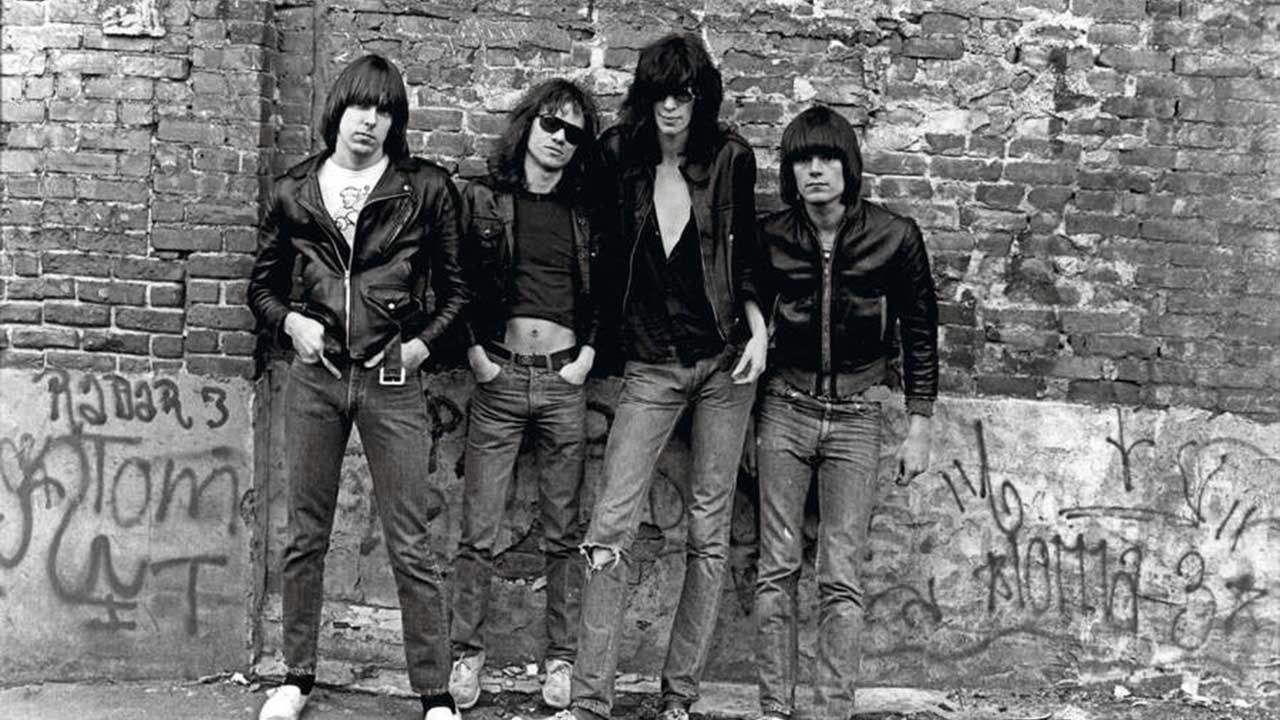
I still remember the May morning 50 years ago when my copy of Ramones arrived from Sire Records in New York. Opening the package revealed Roberta Bayley’s striking monochrome cover shot of Johnny, Tommy, Joey and Dee Dee, skulking like a street gang against a wall (in the community garden on Second Street between Bowery and Second Avenue, now rechristened Joey Ramone Place). No sleeve or band had looked so brazenly different since the first Rolling Stones album. It set the tone perfectly for the thrills to come.
The opening triple header of Blitzkrieg Bop, Beat On The Brat and Judy Is A Punk have been part of punk’s DNA for half a century, but hearing the Ramones hurtling out of the speakers for the first time hit like an express train, every stop an epiphany.
Startlingly direct, stripped of excess flab and even guitar solos; Joey’s mutant NY street-jive vocals rode the band’s blazing block-chord powerriffing, continuing through Now I Wanna Sniff Some Glue, Loudmouth and I Don’t Wanna Go Down To The Basement (its longest track at 2:38).
Yearning slowie I Wanna Be Your Boyfriend and a breakneck cover of the Chris Montez 60s hit Let’s Dance affirmed the band’s incisive referencing of classic pop, from 50s doo-wop to Herman’s Hermits – stripped down and sped up in a cartoon world of psycho killers, glue sniffers and endangered rent boys on 53rd & 3rd. The glorious home stretch of I Don’t Wanna Walk Around With You and Today Your Love, Tomorrow The World put the cap on one of the landmark rock’n’roll debuts.
Even on that first day blasting the album, it was obvious nothing was going to be the same again. The approaching long, hot summer of ’76 already had its scorching soundtrack.
At a time when the music papers could ignite cultural movements, Nick Kent’s lengthy NME review proclaiming: “If you love hard-ass retard-rock you’ll bathe in every groove” set the Ramones ball rolling. Reviewing for Zigzag, I wrote: “From the opening call to action of Blitzkrieg Bop to the last strung-out power chord of Today Your Love, Tomorrow Your World, this is a high-energy sizzler with enough power to light up New York City for a week! It only lasts 29 minutes – but if you travel at double the speed you get there in half the time.”
Ramones sent shock waves through the UK’s burgeoning punk community, notably in its London epicentre. In October 1976, Joe Strummer told me Ramones made him decide to accept Mick Jones and Paul Simonon’s invitation to join the band they were forming. “It can’t be stressed enough how great the Ramones’ first album was to the scene in London,” he reflected later. “It was simple enough to be able to play. Me and Paul would spend hours, days and weeks playing along to the record.”
That same October, I sat up all night with Sid Vicious at his Shepherd’s Bush squat while he attempted to teach himself bass playing along to Blitzkrieg Bop on repeat. Ramones also had a profound effect on Lemmy, vindicating and further revving up the early Motörhead.
“When that album came out, all the English bands tripled speed overnight,” said Generation X bassist Tony James. “Before the Ramones, bands might sound like the MC5, but punk rock is totally down to the Ramones.” Now I Wanna Sniff Some Glue also gave Mark Perry the name for his original punk fanzine, Sniffin’ Glue.
The album’s inestimably influential effect was compounded by the Ramones making their UK debut, at London’s Roundhouse then Dingwall’s, over July’s American Independence weekend. Finally, these mysterious black leather aliens were here in the flesh, like cartoons come to life.
In the 50 years since, the Ramones’ unbelievably dysfunctional back story has been told many times, including Joey’s crippling OCD, Johnny’s military-style operational regime, Dee Dee’s drug-guzzling battles with mental health problems, and original leader Tommy’s vision of the band as a conceptual art piece with him as producer.
All that would emerge later. But when Ramones appeared in 1976, followed closely by the band amping it up on stage, there was an almost innocent charm about the four disparate misfits from Forest Hills, Queens, who came together in the wake of the glam-punk uprising sparked earlier that decade by the New York Dolls.
Ramones made their live debut in March 1974 at the Performance Studio on 20th Street, which Tommy ran with future Ramones tour manager Monte Melnik. Dee Dee found it impossible to sing and play guitar at the same time, Joey made a flailing cacophony on drums, and the three stopped during songs to argue. At Tommy’s suggestion, Joey took over vocals. He ended up playing drums himself, after showing the beats to auditioning hopefuls.
Joey told me his songs were inspired by horror movies (such as Chainsaw’s Texas Chainsaw Massacre tribute), trash culture and “our frustrations and feelings of alienation and isolation”, along with The Dictators’ locker-room anthems and the Bay City Rollers’ terrace-pop formula, Saturday Night influencing his chorus on Blitzkrieg Bop and its release as the Ramones’ first UK single. Having said that, Beat On The Brat was written after witnessing an obnoxiously noisy kid in a local playground.
For Tommy, Joey’s Judy Is A Punk clinched the Ramones’ potential to become the band he envisioned. “Once I heard that, I saw this was totally different and unique,” he said. “They were so original – we had something incredible. These guys didn’t know what they were doing. They weren’t just doing a song, but inventing a whole new genre together.”
The leather jacket, ripped jeans and sneakers image came from Marlon Brando’s The Wild One, Henry Winkler’s Fonz in Happy Days, and The Dictators; puddingbowl haircuts courtesy of Brian Jones and garage bands like The Seeds. “We concocted a unique sound and style, all our own trademark,” Joey told me, with great pride.
Needing their own Cavern-like club to develop and hone their sound, on the recommendation of scene dynamo Wayne (later Jayne) County, the band tried out at Hells Angel and homeless-favoured Bowery bar CBGB, opened by Hilly Kristal the previous year. According to Joey, Kristal said: “Nobody’s gonna like you guys, so I’ll have you back.” He booked them 24 more times that year.
Making their official debut that August supporting the pre-Blondie Angel & The Snake, their 15-minute set dissolved into chaos as they crashed through I Don’t Wanna Walk Around With You, Now I Wanna Sniff Some Glue, I Don’t Wanna Go Down To The Basement, Judy Is A Punk and I Don’t Care. Suicide’s Alan Vega told me: “I caught their first gig and I laughed my ass off. I thought it was great. It was the best thing I’d seen since The Stooges. The intensity was astonishing.”
“At first we played to five people,” said Johnny. “Six months later we were playing to thirty people. It was really slow. It didn’t seem like the writers were going out to discover new talent. Finally, [Hit Parader editor] Lisa Robinson came to see us. She went and told other people, and everybody came for the second set. In between sets we got more people. After that, everything started building.”
After loving the CBGB debut, local artist Arturo Vega became Ramones’ artistic director and lighting man for the rest of their career, and designed their famous logo around the US presidential seal. Tommy approached former Dolls manager Marty Thau, who had produced the band’s first demo in February 1975. He declined doing that again, but organised the recording of Judy Is A Punk and I Wanna Be Your Boyfriend at an upstate studio.
The Ramones continued playing CBGB, Arturo’s loft, Performance Studio and Max’s promoter Peter Crowley’s Mother’s with Blondie through 1975. Every gig tightened their sound into the fullpelt onslaught that would be unveiled on the album.
“Guitar solos slow us up and bog us down,” Johnny told me in 1976. “The chords are doing everything. I’m driving away where the guitar breaks would be. The way that came about was we would write a song and it would end up being two minutes. The songs end up being short. We don’t do any stopping. If we stopped and talked to the audience that would add another ten minutes to the set. We really feel that what we are doing should be done in half an hour.”
“They were jaw-dropping,” says Talking Heads drummer Chris Frantz. “Joey was a true original outsider artist who never failed to deliver his all. Even in the early days when he couldn’t hear himself, Joey’s singing was pitch-perfect. He performed with complete conviction and with a seriousness that defined the Ramones’ on-stage presence. He rocked the crowd without moving around at all, and he did this with the power of his voice.”
Feeling their way into regular gigging and honing their sound, igniting punk revolutions was never on the Ramones’ agenda. Internally, they weren’t together enough for that anyway.
“CBGB wasn’t punk in the way it got heavily defined,” says Patti Smith guitarist Lenny Kaye. “In the little soupçon cauldron that was CBGB there was what you would call a punk sensibility, but the bands were so different from each other. When the Ramones came, this idea of punk provided a template for what would be British punk with very simple hard songs and kind of nihilistic lyrics. To me they were just one of the seven or eight characteristic bands out of CBGB. When punk became Punk with a capitol ‘P’, Ramones would be the template. A Ramones song is remarkably easy to play.”
Sire Records A&R man Craig Leon first saw the Ramones in the summer of ’75. He had to convince label boss Seymour Stein to sign them, until Stein’s wife Linda loved them so much that she became their co-manager along with a similarly smitten Danny Fields, the former Elektra A&R man who signed the MC5 and the Stooges.
With the band eventually signing in January 1976, Leon and Tommy produced Ramones in one February week at New York’s Plaza Sound studio on the top floor of Radio City Music Hall for an incredible $6,400 (about $36,000 now). The 1930s Art-Deco spread with huge rehearsal space, originally used by Arturo Toscanini and the NBC Symphony Orchestra, also boasted a pipe organ, which the Ramones used on Let’s Dance. Leon would produce Blondie’s first album here too.
In his notes to Ramones’ 40th-anniversary box set, the producer recalls: “We agreed that the group had to make a defiant, vibrant, edgy, radical statement with their first effort.”
He recorded the band playing live in the studio, with their equipment in different rooms to enable stereo separation like early Beatles records; drums in the middle, bass left, guitars right, Joey’s vocals double-tracked.
“I credited Tommy with associate producer because it was basically his concept on that album,” said Leon. “He didn’t execute anything, but the whole thing about the band was him. It wasn’t a particularly live record, like everybody tries to say it was. Tommy was very regimented, but Joey was coolly professional; unlike Dee Dee, who was almost impossible. Joey did a lot of punching in and double-tracking really well.
"There’s not a lot you can do with the Ramones, just a lot of layering and texturing, but it’s all purposefully subtle. I did a lot of arranging, rearranging and restructuring of material – plus getting them to end and begin at the same time!”
According to Leon, Joey genuinely hoped the album would make the Ramones pop stars. “He was very into sixties British pop, like Herman’s Hermits. We were talking about it at their apartment one day and he was seriously wondering if the Ramones would ever make it as big as the Bay City Rollers, rather than anything to do with going into the studio.
"It was this innocence that was an integral part of the band; the poppiest element was his persona. He was such a fan that you got that kind of bubblegum-pop mentality, and he really believed in that. He was the most disappointed when they didn’t go to number one with Blitzkrieg Bop.”
After that Ramones’ London Dingwall’s gig in July ’76, I sat on a low brick wall outside talking with Joey, Tommy, Dee Dee and Johnny about the record.
“We’re really happy with it, we tried to combine as much of the live sound without losing the studio quality,” said Tommy.
“There’s fourteen singles on our album,” declared Johnny. “We write singles, but the album’s a concept. It’s good party music. It’s a good pickup in the morning too.”
“You have to wake up, smoke a joint and put it on,” Joey added with a dreamy smile.
Although the album was raved about by American critics including Lester Bangs and Robert Christgau, it reached only No.111 on the Billboard chart, selling around 6,000 copies. Although the Ramones would go on to release 13 more studio albums and tour the world for another 20 years, that debut stands as a benchmark for rock to this day.
Sitting in an East Village bar with Joey in 1987, he reflected: “Doing the album in a week and bringing it in for $6,400 was unheard of, especially since it was an album that really changed the world. It kicked off punk rock and started the whole thing – as well as us.”







