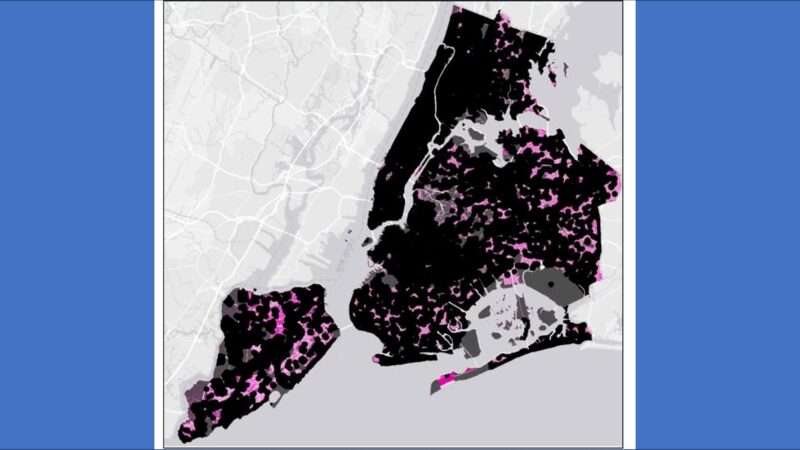
Since 2005, New York has prohibited people on "level three" of the state's sex offender registry from living within 1,000 feet of a school. In New York City, as the above map shows, those "buffer zones" cover nearly all residential areas. Because the state requires registrants to find legally compliant housing before they leave prison, these restrictions mean they may remain behind bars long after they are eligible for conditional release and even after they have completed their original sentences.
That is what happened to Angel Ortiz, who in 2008 was accused of "sexually
threatening a pizza delivery man during the course of a robbery designed to
secure money in order to obtain drugs." After Ortiz pleaded guilty to robbery and attempted sexual abuse, he was sentenced to 10 years in prison plus five years of parole. He became eligible for supervised release after serving about eight and half years. But as New York Times reporter Adam Liptak notes, Ortiz remained in prison because all of the housing options he suggested—his mother's apartment in New York City, along with "dozens of alternatives, including some in upstate New York"—ran afoul of the 1,000-foot rule.