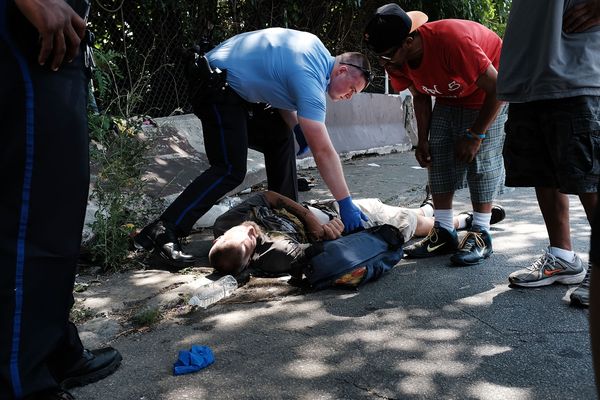
On January 2, 1989, NSW Homicide Squad detective Risto Baltoski and I were driving in separate police cars to Adelaide to continue an investigation into Italian organised crime when Risto was involved in a head-on collision on the Sturt Highway.
It happened exactly halfway between Balranald and Hay, in the piercing heat of the Hay Plains.
Risto died in my lap. An off-duty nurse tried to ease his pain while bystanders held sheets over the three of us to shield us from the brutal January sun.
Eight days later, AFP Assistant Commissioner Colin Winchester was murdered in the driveway of his Canberra home.
Two policemen. Two families. Eight days.
Nearly 18 years later, on September 29, 2006, their names were among those commemorated when the National Police Memorial opened in Canberra.
As we approach the 20th anniversary of that day, it is worth remembering what those names represent.
A memorial inevitably reduces a life to a name and a date. But behind every name is a story, and behind every story are the people who had to continue living after someone they loved did not come home.
After Risto's police funeral in Sydney, the investigation in Adelaide still had to be done. Other colleagues and I returned to work, leaving his young family to begin the much harder task of learning how to live without a father to his two young children, a husband to his young wife and son to his elderly parents.
I saw another version of that grief in Canberra.
For years after Colin Winchester's murder, his widow Gwen cut a lonely figure in the same pew, week after week, at St Peter Chanel's Catholic Church in Yarralumla.
The murder itself was terrible enough. Then came years of investigation, prosecution, appeals and inquiries.
David Eastman was convicted of Winchester's murder but that conviction was eventually quashed following an inquiry led by former Northern Territory Chief Justice Brian Martin.
I know Brian Martin well. He had prosecuted cases arising from our organised crime investigations in South Australia and I have no difficulty with his findings in the Eastman inquiry. Nor, from my experience of those investigations, do I give any credence to suggestions that Italian organised crime was responsible for Winchester's murder.
But legal proceedings have a clinical vocabulary: evidence, convictions, appeals, inquiries. There is nothing clinical about being the family caught in the middle of them.
That is what the National Police Memorial means to all of us.
There are other names there with stories I knew personally.
In 1994 the Adelaide office of the National Crime Authority was bombed. It was an office my colleagues and I had helped establish after our investigations convinced the Commonwealth and South Australian governments that the NCA needed a permanent presence in the state.
Detective Sergeant Geoffrey Bowen of the Western Australia Police was killed and lawyer Peter Wallis badly injured.
It took 28 years before Dominic Perre was convicted in 2022 of Bowen's murder. Justice eventually came, but time cannot be returned to a family.
Then, just before Christmas in 2004, AFP officer Adam Dunning was ambushed and murdered while on routine patrol outside the Governor-General's residence in Honiara in the Solomon Islands.
Deputy Commissioner Tony Negus came with me to deliver the news to Adam's parents in Tuggeranong.
Canberra being Canberra, there was a personal connection. Adam was engaged to the daughter of our neighbour.
A young man had been taken from his parents. A young woman had lost the man she planned to marry. In a moment, an entire imagined future disappeared.
Three years later came another tragedy.
On March 7, 2007, two Department of Foreign Affairs employees, Morgan Mellish and Elizabeth O'Neill, and two AFP officers, Brice Steele and Mark Scott, were among 21 people killed when a Garuda aircraft crashed at Yogyakarta airport in Indonesia.
We later learned that Mark Scott had promised to take his son along the Kokoda Track.
Mark never got the chance.
So in 2008, along with Brice Steele's widow, AFP officer Kellie Steele, a group of us set out to keep Mark's promise and walk Kokoda with his son.
Those are the stories that sit behind the bronze plaques at the National Police Memorial.
The memorial itself took nearly a decade to become reality.
Police unions and associations, through the Police Federation of Australia, had long argued for a national memorial. Some governments were understandably reluctant to single out police sacrifice above that of other emergency workers or members of the Australian Defence Force.
They had a point.
I remember sitting beside then ACT Chief Minister Jon Stanhope at the funeral of ACT volunteer firefighter David Balfour, who was killed fighting the Victorian bushfires in 2009. We spoke about the extraordinary sacrifice involved in somebody volunteering to serve the community and losing his life doing it.
No service has a monopoly on courage or sacrifice.
Police do, however, occupy a peculiar place. They are the emergency service authorised to use lethal force within Australia and, in the course of an ordinary working day, among those most likely to confront it.
Eventually the obstacles to the memorial were overcome. The police associations and unions, state and territory governments and the Commonwealth each contributed a third of the funding.
The project was embraced by the then head of the National Capital Authority, Annabelle Pegrum, while AFP deputy commissioners John Davies and John Lawler and Police Federation chief executive Mark Burgess helped drive it to completion.
The memorial was also designed with more nameplates than were needed when it opened. It was a brutally practical acknowledgement that more police officers would die.
But the most important decisions were not bureaucratic.
Anyone who has visited the memorial will have noticed that its entrance is deliberately uneven, representing the unpredictable nature of police work.
More powerful are the words etched into the tiles underfoot.
They reproduce the words and drawings by the sons and daughters of police officers killed on duty.
Those children are now 20 years older.
That is perhaps the most haunting measure of what the memorial represents.
What happened to them in those two decades? What graduations, weddings, births and Christmases have passed with someone missing? What promises were never kept? What conversations were never had?
The memorial was also designed with more nameplates than were needed when it opened.
It was a brutally practical acknowledgement that more police officers would die.
And they have.
Thirty-seven names have been added since 2006 and two more will be added this year on September 29, the feast of Saint Michael, the patron saint of police officers.
There is another piece of unfinished business.
When the memorial was built, agreement was reached with the National Capital Authority to reserve adjacent land for a National Police Museum. The idea was simple: the museum would tell the story of what Australian policing has achieved while the memorial beside it would record the price sometimes paid for that service.
The history of policing in Australia since Governor Arthur Phillip formed the civilian night watch on August 8, 1789, is in many ways a history of Australia's rule of law. It is something we should cherish because not every country in the world can claim our system of justice with all its foibles.
Twenty years on, the idea of a National Police Museum is an idea worth completing.
But the memorial itself has done something more important than any of us involved in its creation could have anticipated.
It has become a window into lives.