Get all your news in one place.
100’s of premium titles.
One app.
Start reading
Euronews
Euronews
Gavin Blackburn

Hackers target Iran state TV's satellite transmission to broadcast exiled crown prince

Hackers disrupted Iranian state television satellite transmissions to air footage supporting the country's exiled crown prince and calling on security forces to not "point your weapons at the people," online video showed early on Monday, the latest disruption to follow nationwide protests in the country.

The footage aired on Sunday night across multiple channels broadcast by satellite from Islamic Republic of Iran Broadcasting, the country's state broadcaster which has a monopoly on television and radio broadcasting.

The video aired two clips of exiled Crown Prince Reza Pahlavi, then included footage of security forces and others in what appeared to be Iranian police uniforms.

It claimed without offering evidence others had "laid down their weapons and swore an oath of allegiance to the people."

"This is a message to the army and security forces," one graphic read. "Don't point your weapons at the people. Join the nation for the freedom of Iran."

Iranian opposition leader Reza Pahlavi speaks during a news conference in Washington, 16 January, 2026 (Iranian opposition leader Reza Pahlavi speaks during a news conference in Washington, 16 January, 2026)

The semi-official Fars news agency, believed to be close to the country's paramilitary Revolutionary Guard, quoted a statement from the state broadcaster acknowledging that the signal in “some areas of the country was momentarily disrupted by an unknown source.”

It did not discuss what had been aired.

A statement from Pahlavi's office acknowledged the disruption that showed the crown prince.

"I have a special message for the military. You are the national army of Iran, not the Islamic Republic army," Pahlavi said in the hacked broadcast. "You have a duty to protect your own lives. You don’t have much time left. Join the people as soon as possible."

Social media footage shared abroad, possibly from those with Starlink satellites to get around the internet shutdown, showed the hack in progress across multiple channels. Pahlavi's campaign also shared the footage.

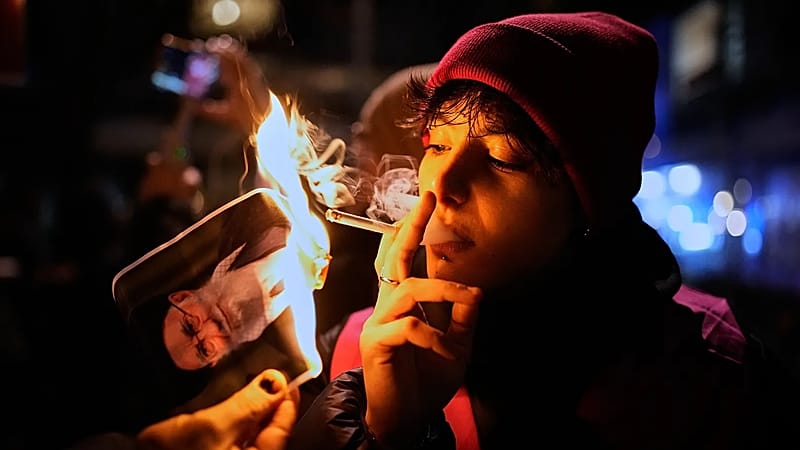
People burn US and Israel flags during a rally in support of the Iranian government in Istanbul, 18 January, 2026 (People burn US and Israel flags during a rally in support of the Iranian government in Istanbul, 18 January, 2026)

Sunday's hack isn't the first to see Iranian airwaves disrupted. In 1986, The Washington Post reported that the CIA supplied the prince’s allies “a miniaturised television transmitter for an 11-minute clandestine broadcast” to Iran by Pahlavi that pirated the signal of two stations in the Islamic Republic.

In 2022, multiple channels aired footage showing leaders from the exiled opposition group Mujahedeen-e-Khalq and a graphic calling for the death of Iran's Supreme Leader Ayatollah Ali Khamenei.

Pahlavi’s father, Shah Mohammad Reza Pahlavi, fled Iran ahead of the 1979 Islamic Revolution. Pahlavi, the son, urged protesters onto the streets on 8 January as Iranian authorities shut down the internet and drastically intensified their crackdown.

How much support Pahlavi has inside of Iran remains an open question, though there have been pro-shah cries at the demonstrations.

Protesters participate in a demonstration in support of the nationwide mass protests in Iran against the government in Berlin, 19 January, 2026 (Protesters participate in a demonstration in support of the nationwide mass protests in Iran against the government in Berlin, 19 January, 2026)

Death toll from crackdown rises

The death toll exceeds that of any other round of protest or unrest in Iran in decades and recalls the chaos surrounding the 1979 Islamic Revolution.

The US-based Human Rights Activists News Agency put the death toll Sunday to at least 3,919 people killed, warning it likely would go higher.

The agency has been accurate throughout the years of demonstrations and unrest in Iran, relying on a network of activists inside the country that confirms all reported fatalities.

Iran’s Supreme Leader Ayatollah Ali Khamenei speaks in a meeting in Tehran, 17 January, 2026 (Iran’s Supreme Leader Ayatollah Ali Khamenei speaks in a meeting in Tehran, 17 January, 2026)

Iranian officials have not given a clear death toll, although on Saturday, Khamenei said the protests had left "several thousand" dead and blamed the United States for the deaths.

It was the first indication from an Iranian leader of the extent of the casualties from the wave of protests that began on 28 December over Iran’s ailing economy after the rial slumped to a record low against the US dollar.

Sign up to read this article
Read news from 100’s of titles, curated specifically for you.
Already a member? Sign in here
Related Stories
Top stories on inkl right now
One subscription that gives you access to news from hundreds of sites
Already a member? Sign in here
Our Picks
Fourteen days free
Download the app
One app. One membership.
100+ trusted global sources.