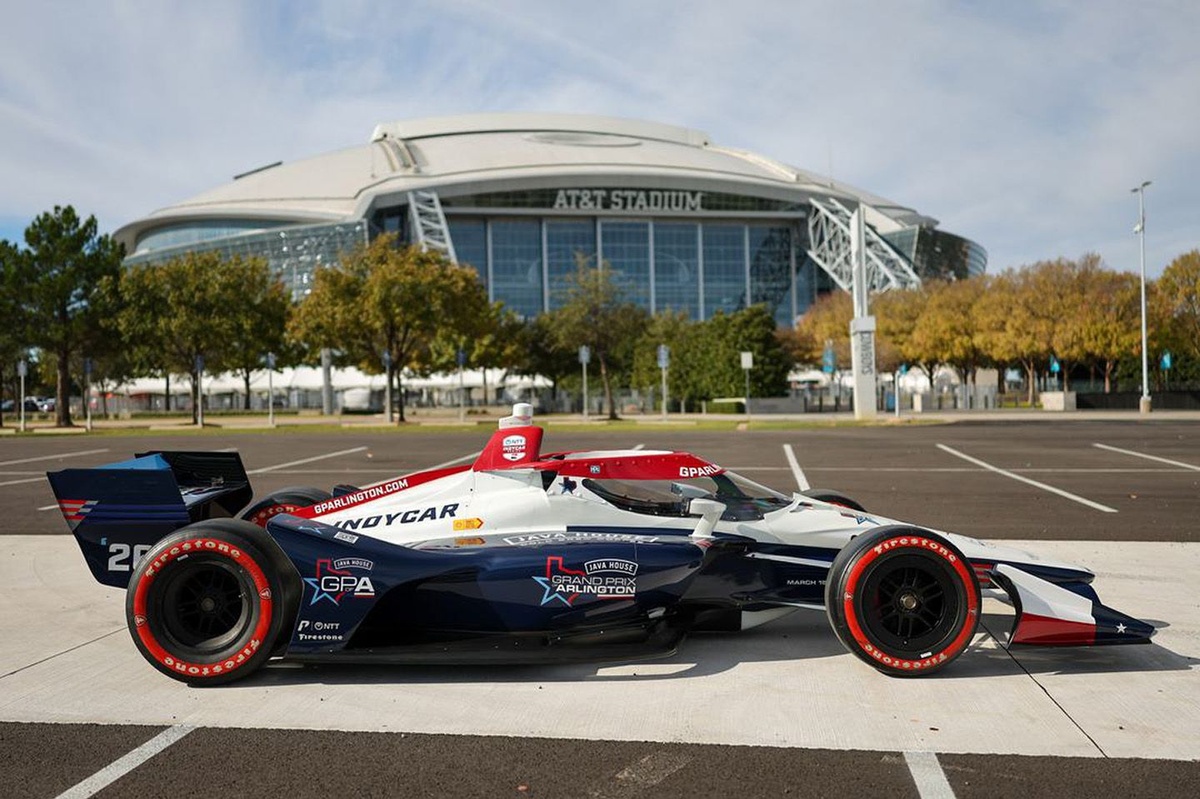
Grand Prix of Arlington President Bill Miller is bullish over the long-term future of the event in the IndyCar Series.
While it isn’t a surprise for a promoter to tout their own horn, it sends a different kind of statement when the inaugural event is a little over two months away.
This might feel like history repeating itself for IndyCar fans - and maybe even some in the paddock - as pushing a new event in a new location is, well, nothing new. There was hype around putting a race in the heart of Nashville, running through some of the city’s famous streets and across the Korean Veterans Memorial Bridge. It was complete with concerts to bolster the buzz and energy, and it worked from 2021-23. Then it didn’t.
Even with the expectation of a revised circuit layout to accommodate construction of a new $2.1 billion NFL stadium for the Tennessee Titans, the event was moved to Nashville Superspeedway, a 1.33-mile oval located roughly 45 minutes away in Lebanon.
Although the racing has been spectacular at Nashville Superspeedway, that was clearly far from the original plan. And it remains undetermined if IndyCar will return to downtown Nashville after the stadium construction is expected to be finished by February 2027.

To bring it full circle, the 14-turn, 2.73-mile temporary street circuit in Arlington sweeps right through the Entertainment District that holds stadiums for the NFL’s Dallas Cowboys and MLB’s Texas Rangers.
And considering all of that, in an exclusive interview with Motorsport.com Miller was asked how fans can trust the race in Arlington won’t suffer the same pitfalls as Nashville and end up back at Texas Motor Speedway, which hosted IndyCar racing from 1997-2023.
“From all of the factors that we know now, the commitment is to this area,” Miller said.
Miller pointed to the effort of partners that are supporting the event with Penske Entertainment, namely the Dallas Cowboys and REV Entertainment, the official events partner of the Texas Rangers.
“It's building an event anchored around their properties and their facilities,” Miller said. “This is the place in the iteration of this joint venture between Penske, Cowboys, REV, this is the place where it is. You look at the organizations that are putting it on, the brain trust behind them and the commitment to delivering a great experience, they have the business acumen of, ‘this is what we're looking to do.’ I think fans should have the confidence that those organizations can be delivering a great product for years.”
The strength of the partnerships overruns anything Nashville had as a launching pad during its formation.

Miller, who also previously served as president of California Speedway during his more than three decades in the motorsports industry, believes creating pop-up events in urban areas is another part of the sport’s evolution.
“When you let's look at what they've done with Texas Motor Speedway - I was there for the first (NASCAR) race, we were building Fontana while they were getting going - but relative to being a part of opening facilities, they helped take motorsports to a different level,” Miller said.
“As California came online, as Texas Motor Speedway and the building boom of permanent facilities, they did an exceptional job. The on-track product is exceptional. I think the sport has evolved, though, too. Not away from permanent facilities, but in addition to these urban racing cultural events that you can create in areas that aren't a permanent facility.
“This recipe is perfect in the sense that you've got these awesome backdrops as a canvas, and that's what brings about the difference between our venue and you can maybe say Texas Motors Speedway. But you can also say other areas (like) Michigan Speedway and Downtown Detroit, two totally different products and those that appreciate motorsports love them both.
“There are some purists that love one versus the other, but it gives you that opportunity to bring that urban cultural center into a motorsports circuit versus maybe a permanent facility that sometimes can be more challenging.”
The measure of whether Arlington is a success or not goes well beyond the start, but rather longevity.
With that, Miller understands the need for constant growth to the fan experience, as well as the competitors and media. Another element is recognizing the needs of the partners, along with the City of Arlington and its citizens.
“If we can develop a recipe that we're all winning in this, you'll have an event that has longevity,” Miller said.
Making a temporary street event last on the IndyCar schedule would be nothing new, with the likes of St. Petersburg having been run for over two decades, the Grand Prix of Long Beach a fixture in motorsports since 1975, as well as Detroit despite pivoting between Belle Isle to Downtown.
“If everybody does their job well, somebody will be standing here 50 years from now saying that was a hell of a ride like (Grand Prix Association of Long Beach President and CEO) Jim Michaelian got to do at Long Beach last year,” Miller said. “When you look at it, five decades of putting up and tearing him down and putting up and tearing down a temporary circuit that the community rallies around, that's a pretty powerful thing. Go across a landscape of any sport that has had 50 years of something like that, and then take the complexity of it. It's just not going to a stadium and having an event and let's come back 50 years from now.
"That type of magic is pretty cool, but you've got to have that buy in everybody all around, and that's what we're trying to create now.”
Read and post comments