Get all your news in one place.
100's of premium titles.
One app.
Start reading
The Economic Times
The Economic Times
Sneha Kulkarni

Got Income Tax notice asking you to pay Rs 6,000 in tax? Check this warning from government’s fact check team

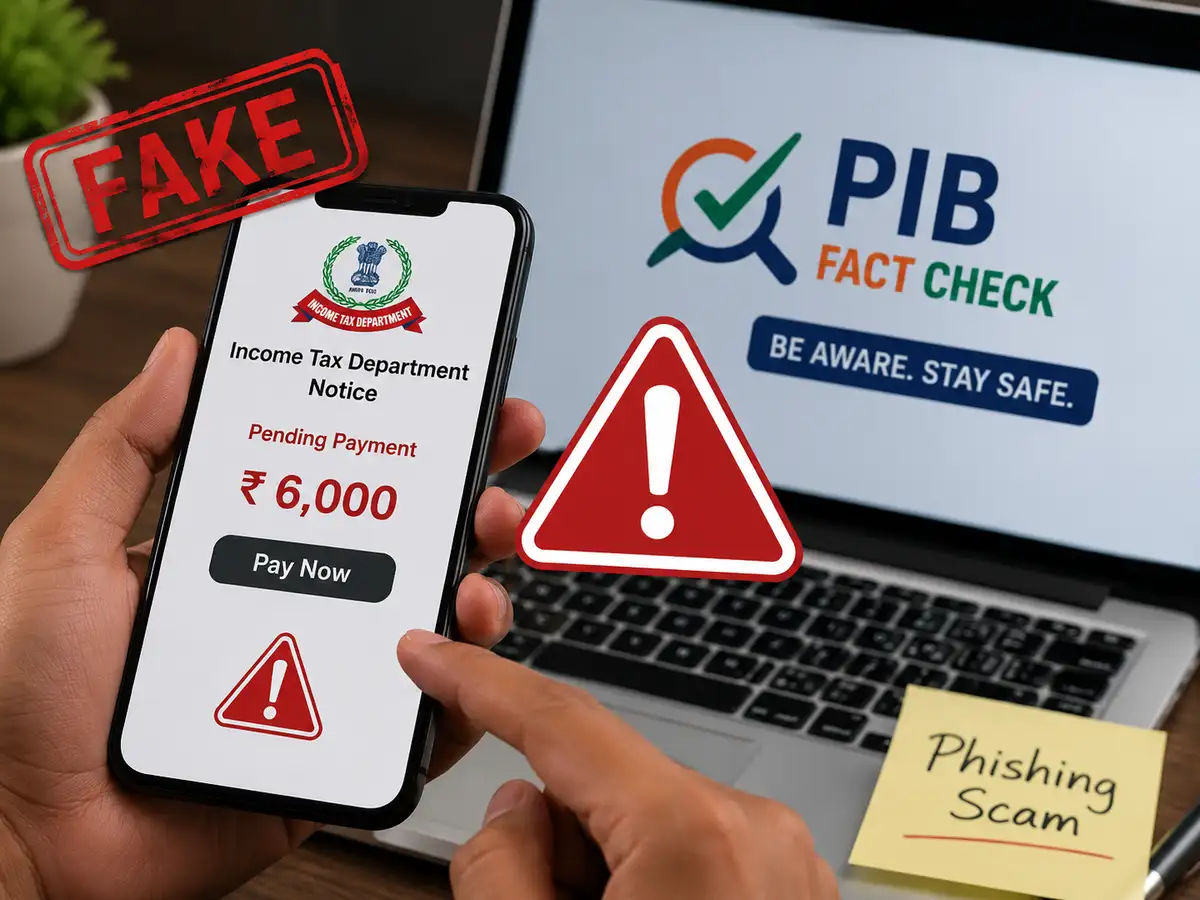
A notice is being shared online, asking taxpayers to pay Rs 6,000 for their tax dues, supposedly from the Income Tax Department. But taxpayers should ignore this notice, as the government has confirmed that it's a scam.

The Press Information Bureau's (PIB) Fact Check team has confirmed the notice as a phishing attempt.

According to the Fact Check team, the fake message asks the recipients to pay Rs 6,000 as part of their tax obligation.

With many taxpayers eagerly waiting for their income tax refunds, such messages can cause unnecessary stress. Even those who have already paid their taxes may panic after receiving a notice demanding an additional payment. This urgency can push individuals to make a payment without first checking whether the message is genuine.

The PIB Fact Check team in a social media message on X (formerly Twitter) stated: "The Income Tax Department does not issue such notices. Beware of misleading content and always rely on official sources for verified information."

This type of scam can be termed as phishing fraud. Under this scam, messages supposedly from financial institutions, popular social websites, auction sites, online payment processors or IT administrators are commonly used to lure the unsuspecting public.

The Income Tax Department has always warned that it does not send an e-mail requesting your PIN numbers, passwords or similar access information for credit cards, banks or other financial accounts.

What is 'phishing'?

Phishing is the process of attempting to acquire sensitive information such as usernames, passwords and credit card details by masquerading as a trustworthy entity in an electronic communication. Phishing is typically carried out by an e-mail or instant messaging and it often directs users to enter details at a fake website whose look and feel are almost identical to the legitimate one.

How to report suspicious messages to PIB Fact Check team

The PIB Fact Check team has urged people to report suspicious content related to the central government.

Such content can be reported to the PIB Fact Check team through:

WhatsApp: +91 8799711259

Email: factcheck@pib.gov.in

If you receive an e-mail or find a website you think is claiming to be of the Income Tax Department, forward the e-mail or the website URL to webmanager@incometax.gov.in.

A copy may also be forwarded to incident@cert-in.org.in

If you receive a phishing mail not pertaining to the Income Tax Department, forward it to incident@cert-in.org.in

Income Tax Department advice for avoiding phishing scam

If you receive an e-mail from someone claiming to be authorised by the Income Tax Department or directing you to an Income Tax website, this is what you ought to do:

Do not reply.

Do not open any attachments. Attachments may contain malicious code that will infect your computer.

Do not click on any links. If you click on links in a suspicious e-mail or phishing website, then do not enter confidential information like bank account or credit card details.

Do not cut and paste the link from the message into your browsers, phishers can make the link look real, but it actually sends you to different websites.

Use anti-virus software, anti spyware, and a firewall and keep them updated. Some phishing e-mails contain software that can harm your computer or track your activities on the internet without your knowledge. Anti-virus & anti-spyware software and firewall can protect you from inadvertently accepting such unwanted files.

Sign up to read this article
Read news from 100's of titles, curated specifically for you.
Already a member? Sign in here
Related Stories
Top stories on inkl right now
One subscription that gives you access to news from hundreds of sites
Already a member? Sign in here
Our Picks
Fourteen days free
Download the app
One app. One membership.
100+ trusted global sources.