Canadians are openly discussing the merits and risks of pursuing a nuclear weapon. Europeans are similarly considering a nuclear deterrent for the bloc. In South Korea, public support for a nuclear weapon is at its highest level on record, and even in Japan some politicians are talking about the once-taboo subject.
Until just a few years ago, few experts would have predicted that these nations – all allies of Washington – might one day join the nuclear club. Since 2006, that club has consisted of just nine countries: the United States, Russia, the United Kingdom, France, China, India, Pakistan, North Korea and Israel, with its undeclared program.

The hope of nonproliferation advocates was that nine would be the maximum. But over the past few years, more and more nations are seriously exploring “going nuclear.”
As an expert on weapons technology and former assistant director of the CIA for weapons and counterproliferation, I have watched these developments with alarm.
Perceived national security threats still shape U.S. allies’ views of developing nuclear weapons – with North Korea a key driver for South Korea, China paramount for Japan, and Iran key for Saudi Arabia.
But what has changed demonstrably for many U.S. allies is a newfound skepticism over the credibility of the so-called U.S. nuclear umbrella, which for decades has offered allies an easy way of declining to pursue nuclear weapons. Concerned about the Trump administration’s foreign policy, some nations are considering developing domestic nuclear weapons programs or seeking new deterrence assurances.
New nuclear aspirants across the Atlantic
The U.S. deployed the first atomic bombs in Japan in 1945, with the Soviet Union conducting its own successful nuclear test four years later. The U.K. was next to get the bomb in 1952, followed by France in 1960 and China in 1964. Experts believe that Israel first tested a bomb in the late 1960s, while the last entrants into the nuclear club were India in 1972, Pakistan in 1998 and North Korea in 2006.
Experts have long wondered which country might be next. Often, speculation has included U.S. allies such as Egypt, Japan, Saudi Arabia, South Korea and Turkey.
For years, such nations were assumed to be under the U.S. nuclear umbrella, a tacit understanding that Washington will defend its nonnuclear allies, including by using U.S. nuclear weapons. Doubts about the credibility of the U.S. nuclear umbrella have existed for years and precede the Trump administration. However, current U.S. officials’ criticisms of NATO, focus on burden sharing, and policy positions on Ukraine have brought into stark relief for allies the need to consider other nuclear options. And with allies now focused on the limits of U.S. security guarantees, the list of possible nuclear aspirants has suddenly grown.
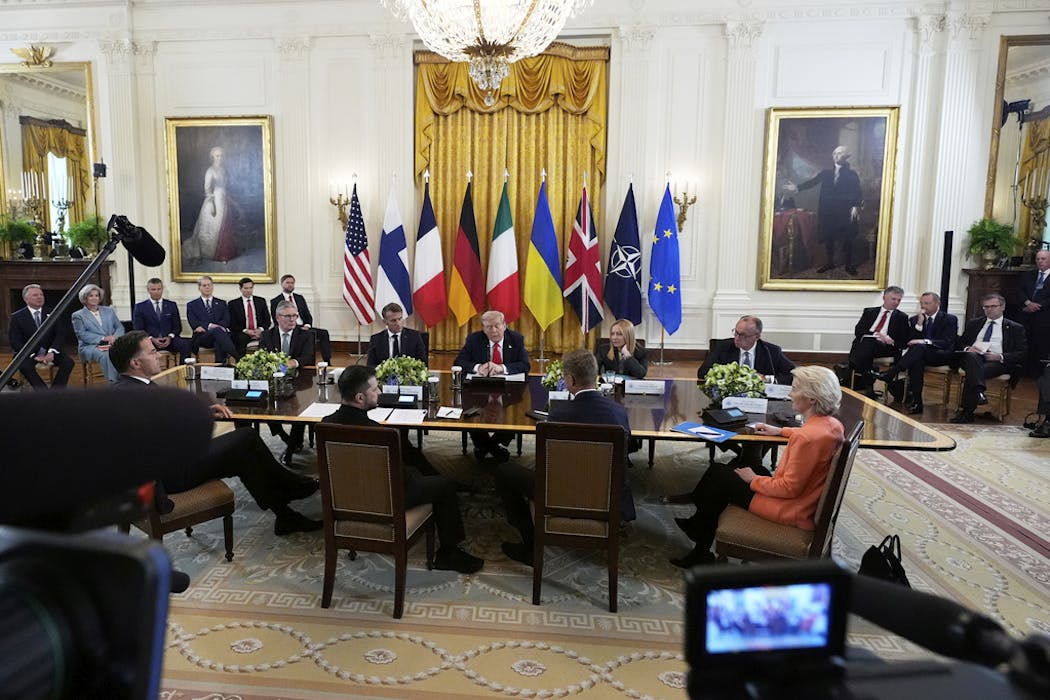
European leaders have crafted their public comments on the issue carefully, focusing on concerns about U.S. reliability in general versus the credibility of the U.S. nuclear umbrella.
Rasmus Jarlov, the chair of the Danish parliament’s defense committee, perhaps best reflected the views of many U.S allies in Europe, telling The Associated Press: “If things got really serious, I very much doubt that Trump would risk American cities to protect European cities. We don’t know, but it seems very risky to rely on the American protection.”
In Europe, most public discussion has focused on the concept of a common nuclear deterrent for the bloc under the protection of French nuclear forces. In a major speech in March, French President Emmanuel Macron called for “forward deterrence” involving the temporary deployment of French nuclear-armed aircraft to nine other European countries, including Germany and Poland.
Meanwhile, the Swedish prime minister has had talks with Britain and France about deploying the two countries’ nuclear forces to Sweden during wartime.
But the French pledge does not extend a guarantee to defend allies with French nuclear weapons. Instead, France will use nuclear deterrence to defend French “vital interests,” a purposefully vague phrase. Only time will tell whether Macron’s offer will satisfy European partners – or prevent them from deciding to take matters into their own hands.
There has been growing speculation over whether Poland and Germany might be considering developing their own nuclear weapons. While German Chancellor Friedrich Merz has explicitly ruled it out, Polish leaders’ comments leave the option open.
In early March, Polish Prime Minister Donald Tusk told the Polish parliament that Poland “must reach for the most modern solutions related to nuclear weapons,” seeming to reflect personal support for Warsaw’s long-term pursuit of a weapon and near-term conversations with the French about a nuclear umbrella.
In Canada, meanwhile, the former chief of the country’s defense staff said in February that Canada should not rule out acquiring nuclear weapons. While the comments drew opposition from the current Canadian defense minister, the discussion of whether Canada would consider “going nuclear” did not seem out of line in today’s global security environment.
Heightened discussions in Asia
Similar discussions among current and former government officials have been percolating across Asia.
For Japan, such talks mark a significant development. Article 9 of the Japanese Constitution, largely drafted by U.S. occupation authorities after World War II, renounces war. And in 1967 Japan further pledged not to produce, possess or host nuclear weapons in its territory — the “Three Non-Nuclear Principles.”
But the issue is no longer taboo. In late 2025, an unnamed official in the new administration of Prime Minister Sanae Takaichi expressed his personal opinion that Japan should begin discussions about developing nuclear weapons.
These remarks drew an official rebuke from Takaichi. Moreover, Japanese nuclear weapons are unlikely to be in the cards anytime soon, particularly given the sensitivity surrounding Japan’s status as the only nation to directly experience the consequences of nuclear weapons. Nonetheless, Takaichi’s ruling Liberal Democratic Party is reconsidering its position on Tokyo’s nonnuclear principles to discuss allowing U.S. nuclear weapons to enter Japanese territory.
South Korea is a different story. Last year, the foreign minister in the former conservative Yoon administration argued that an independent nuclear deterrent for Seoul “was not off the table,” given the unpredictability of the Trump administration. Left unsaid, but clearly in the background, were concerns about the U.S. nuclear umbrella.
South Korea’s previous nuclear weapons program and public support for reviving it could make a future South Korean nuclear weapon a real possibility, even though the current center-left administration stresses Seoul’s nonnuclear stance.
Yet the public mood has also shifted. A total of 76% of respondents now support an indigenous nuclear weapon, according to a March 2025 poll by the Asian Institute for Policy Studies. That was an increase of 5 percentage points since 2024 and the highest level of public support for Seoul pursuing a nuclear weapons capability since the poll originated in 2010.
Saudi Arabia’s focus on the fuel cycle
In the Middle East, the Washington ally most likely to pursue a nuclear weapon remains Saudi Arabia. In Sept. 2023, de facto ruler Crown Prince Mohammed bin Salman reiterated his public stance that Riyadh would acquire a nuclear weapon if Iran did.
Perhaps more likely is Ryadh’s pursuit of a “latent” nuclear weapons capability, meaning that Saudi Arabia would develop relevant technology and expertise to be able to produce a weapon quickly if it made the political decision to do so. An indigenous capability to enrich uranium would be key.
Indeed, the crown prince has demonstrated an enduring interest in developing a Saudi nuclear fuel cycle. He continues to pursue domestic uranium enrichment, regardless of the state of Iran’s nuclear program.
In November 2025, members of the U.S. Congress wrote a letter to Secretary of State Marco Rubio expressing concern that “the administration has revived talks with Saudi Arabia to give it access to U.S. technology and to potentially allow it to enrich uranium.”
The willingness of the Biden and Trump administrations to pursue nuclear deals for civilian power reactors with allies that permit uranium enrichment could assist Saudi Arabia and South Korea in pursuing nuclear weapons. The “gold standard” U.S. nuclear cooperation agreement, called a 123 agreement, prohibits enrichment and reprocessing.
In September 2025, the Pakistani defense minister announced that Pakistan would extend its nuclear umbrella to Saudi Arabia, if needed, perhaps reducing Riyadh’s focus on obtaining formal U.S. security assurances. If genuine, this commitment provides Prince Mohammed the time and protection to develop Saudi nuclear weapons or a latent nuclear capability.
All of these developments suggest that despite decades of nonproliferation experts warning about the expansion of the nuclear club, new entrants are a very real possibility for the first time in decades.
The article solely reflects the views of the author and not those of the United States Government.
This article was originally published on The Conversation. Read the original article.