Get all your news in one place.
100's of premium titles.
One app.
Start reading
The Economic Times
The Economic Times
Anshika Jain

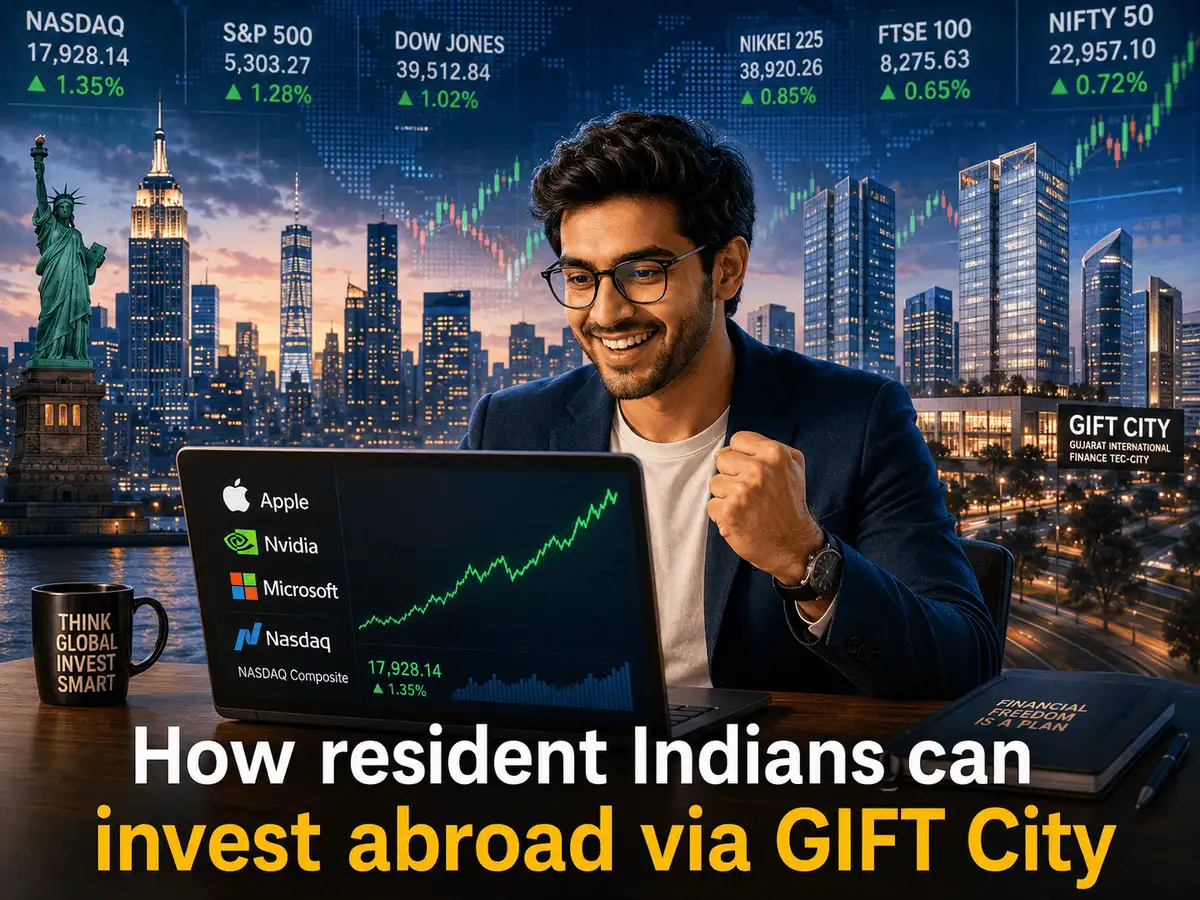
GIFT City investment: Here’s how resident Indians can invest in global stocks, ETFs, and mutual funds

Indian investors looking to diversify beyond domestic markets can now access global stocks, mutual funds, bonds and other international investment products through the GIFT City (Gujarat International Finance Tec-City).

It’s India’s first smart city and International Financial Services Centre (IFSC), acting as a global hub for finance and technology, offering special business zones and tax benefits to attract international companies. However, there are investment limits, costs and regulatory requirements that investors should understand before getting started.

What investment options are available through GIFT City?

GIFT City has several outbound retail mutual funds that invest in global markets.

“For example, DSP Global Equity Fund launched in Sept 2025, Edelweiss Greater China Fund in March 2026 and PPFAS launched S&P 500 and Nasdaq 100 Fund-of-Funds from GIFT City in May 2026,” says Ankur Choudhary, co-founder and CEO, Belong.

Also read: Paying rent above Rs 50,000? Failure to deduct TDS can make you an assessee in default; know what to do

These schemes are structured under IFSCA regulations and are open to resident Indian investors. According to Choudhary, the minimum investment generally starts at USD 5,000.

“This route bypasses the India-side industry-wide cap of $7 billion on overseas investments by domestic mutual funds, which had effectively blocked new inflows into most Indian mutual funds investing globally,” he adds.

Apart from mutual funds, resident Indians can even trade US stocks, ETFs, funds, bonds and other products under GIFT City’s global access framework where IFSCA registered brokers provide these trading accounts in partnership with foreign brokers.

“On the fixed-income side, there are USD-denominated bonds from global corporates, sovereigns, and multilaterals like the World Bank and ADB,” says Viram Shah, Founder & CEO, Vested Finance.

For high net worth investors, Alternative Investment Funds have been the most active segment so far and are available in GIFT City across Category I, II, and III. However, AIF minimum investment thresholds are higher, with the minimum at $150,000. Dedicated platforms within GIFT City have also simplified access to international markets.

“Products such as NSE IFSC Receipts available on NSE IX, the Global Access Platform (GAP) offered by India INX, and other platforms operating under the IFSCA's GAP Framework have made it easier for Indian investors to access US stocks, US ETFs, and global exchanges through a seamless and fully digital process,” says Niteen Dongare, Director & CEO, Anand Rathi International Ventures IFSC.

What are the eligibility conditions for investing through GIFT City?

For direct trading in global stocks, you need to open a trading account with an IFSC-registered broker that provides access to international stocks.

For mutual funds, the process is similar to domestic mutual fund investment, except that the payment needs to be made via LRS (Liberalised Remittance Scheme).

Also read: New income tax regime: Don’t miss out on these 3 key deductions that will reduce your taxable income & help save more tax

The main constraint is the LRS limit of USD 250,000 per individual per financial year. Since this cap is cumulative across all LRS purposes, including investments, travel, education and gifts, investors should factor in their total foreign remittances when planning overseas investments.

“Not every product is open to residents. Some GIFT City funds are structured for NRIs and foreign investors only, and direct retail access to instruments like government securities is still thin, points out Shah.

Minimum investment required for GIFT City investments

The minimum investment requirements vary across products:

Investment Route

Minimum Investment Requirement
Outbound Mutual Funds Typically USD 5,000 initial investment; USD 500 for additional investments
Alternative Investment Funds (AIFs) USD 150,000
Direct Equity Trading via Global Access Platform (GAP) No fixed minimum investment requirement
Source: Belong

Compliance requirements investors should know

Beyond investment limits, investors should also understand the compliance requirements associated with international investing.

  • LRS compliance: All remittances must be routed through an Authorised Dealer (AD) bank with proper Form A2 declaration and purpose code
  • Tax Reporting: GIFT City investments may need to be disclosed in Schedule FA of the income tax return (ITR-2 or ITR-3).
  • KYC with IFSC entities: Separate KYC is required for GIFT City based investments.

What are the costs involved?

According to Choudhary, in addition, investors should account for certain costs before investing internationally.

  • TCS (Tax Collected at Source): This is the most significant upfront cost consideration. From FY 2025-26, remittances under LRS for investment purposes attract 20% TCS on amounts exceeding Rs 10 lakh in a financial year. This is not an additional tax; it is an advance tax and can be adjusted against your future income tax liability or claimed as a refund when you file your ITR.
  • Forex Conversion Costs: When you remit INR to GIFT City there is a currency conversion cost which varies from bank to bank but typically ranges from 0.5% to 1%.
  • Trading Charges: These can be higher than domestic trading charges.
Sign up to read this article
Read news from 100's of titles, curated specifically for you.
Already a member? Sign in here
Related Stories
Top stories on inkl right now
One subscription that gives you access to news from hundreds of sites
Already a member? Sign in here
Our Picks
Fourteen days free
Download the app
One app. One membership.
100+ trusted global sources.