
Get all your news in one place.
100's of premium titles.
One app.
Start reading
The Conversation
The Conversation
Nicholas R. Longrich, Senior Lecturer in Paleontology and Evolutionary Biology, Life Sciences at the University of Bath, University of Bath

Giant sea lizards: fossils in Morocco reveal the astounding diversity of marine life 66 million years ago, just before the asteroid hit

Sixty-six million years ago, the Cretaceous period ended. Dinosaurs disappeared, along with around 90% of all species on Earth. The patterns and causes of this extinction have been debated since palaeontology began. Was it a slow, inevitable decline, or did the end come quickly, driven by a sudden, unpredictable disaster?

Georges Cuvier, working in the early 19th century, was one of the first palaeontologists. He believed that geological catastrophes, or “revolutions”, drove waves of sudden extinction. In part, his ideas were formed by study of a giant sea lizard, Mosasaurus, that lived and went extinct at the end of the Cretaceous.
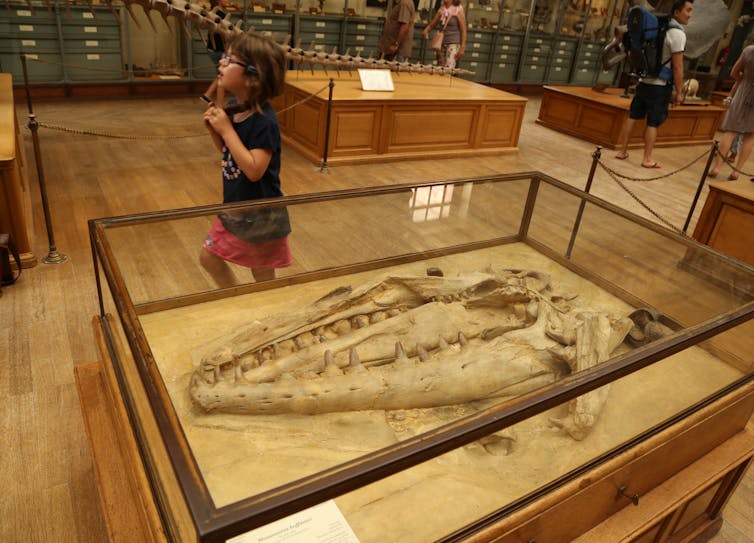

Mosasaurus hoffmanni skull by Nick Longrich
Skull of the marine lizard Mosasaurus studied by Cuvier. Nick Longrich.
Sign up to read this article
Read news from 100's of titles, curated specifically for you.
Already a member? Sign in here
Related Stories
Top stories on inkl right now
One subscription that gives you access to news from hundreds of sites
Already a member? Sign in here
Our Picks
Fourteen days free
Download the app
One app. One membership.
100+ trusted global sources.







