
Get all your news in one place.
100's of premium titles.
One app.
Start reading
MarketBeat
MarketBeat
Ryan Hasson

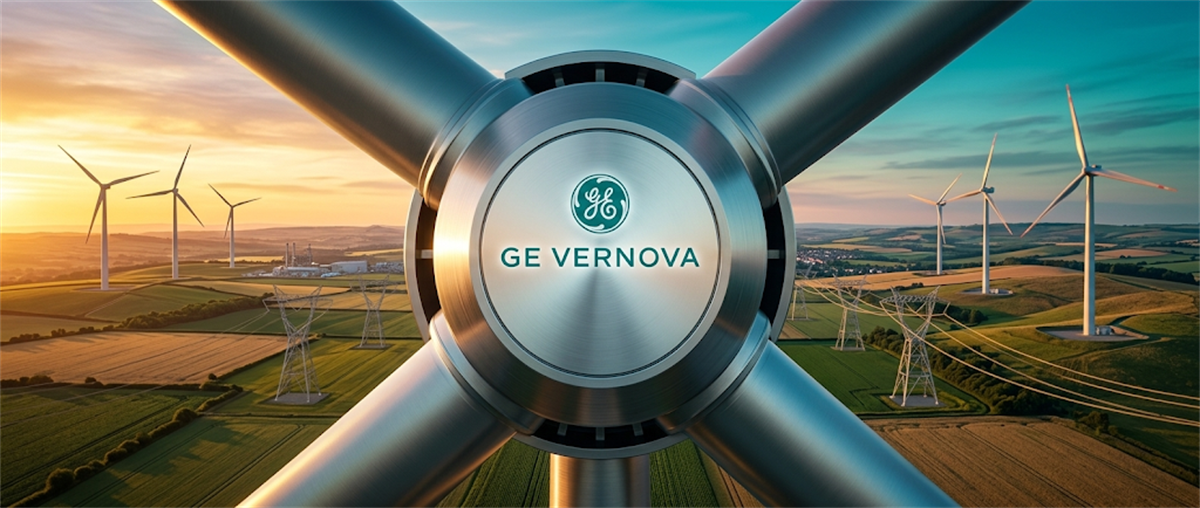
GE Vernova’s Power Surge Turns the Grid Into an AI Trade

When investors think about the AI trade, they often think of specialized chips, memory, critical software, or neoucloud companies. But it is increasingly becoming an electricity and power story. The enormous gigawatt-scale data centers that the hyperscalers are counting on cannot run on GPUs alone. They need turbines, substations, transmission upgrades, grid equipment, and above all, reliable power at a scale the U.S. grid was never built to deliver.

That realization has made GE Vernova (NYSE: GEV) one of the clearest derivative plays on AI infrastructure in the market, and the stock's performance reflects it. Not just in the short term, but also over the past couple of years. And it’s shown no signs of slowing down. Over the year, the stock has surged by almost 76%, vastly outperforming its sector and the market benchmark. Zooming out, it’s even more impressive, with the stock up approximately 120% over the previous 12 months.

So let’s dig a little deeper into the reason behind its stellar performance and see whether it’s sustainable at current prices.

GE Vernova Sits at the Center of the AI Power Buildout

GE Vernova, the energy business spun out of General Electric, sits squarely in the path of the power buildout that AI demands. Its gas power segment supplies the heavy-duty turbines that utilities and, increasingly, data center developers are ordering to quickly add generation capacity.

Its electrification and grid businesses provide the transformers, switchgear, and grid-modernization equipment needed to move all of that new power to where it is consumed. When a hyperscaler announces a multi-gigawatt campus, equipment like GE Vernova's is being ordered somewhere down the supply chain.

The Appeal: AI Exposure Without Semiconductor Cyclicality

What makes the GE Vernova story distinct is what it does not carry. Investors who want exposure to AI compute growth through chips or memory must accept brutal cyclicality, inventory swings, and pricing cycles. Power infrastructure demand behaves differently. Turbine orders come with multi-year delivery schedules. Grid equipment is bought against decade-long utility planning cycles. Service agreements generate recurring revenue for the life of the installed equipment. The result is a business with far greater revenue visibility than the semiconductor complex, which is attached to the same underlying demand driver.

And the company’s fundamentals absolutely back up the story and recent share performance. GEV posted its Q1 2026 results on April 22, topping earnings estimates by $1.95 per share while quarterly revenue of $9.34 billion grew 17% year-over-year. The company delivered strong orders, raised 2026 guidance across all key metrics, and saw revenue and backlog growth in both equipment and its services segments. Analysts project earnings growth of over 62% for the year ahead, among the strongest of any large-cap industrial. The balance sheet is clean, with a debt-to-equity ratio of just 0.19.

The Risk: A Valuation That Demands Execution

With all that being said, after a run of this magnitude, there is certainly some risk investors need to be aware of. GE Vernova now trades at nearly 59 times trailing earnings and more than 8 times sales, multiples that leave little room for disappointment.

Notably, the consensus price target of $1,089.88 from 30 analysts is now about 5% below the current share price, a sign of how far the stock has outrun formal models. MarketBeat data also shows insiders have been selling shares, a data point worth noting after a 76% year-to-date gain.

At these levels, the stock needs continued order growth, backlog strength, and margin expansion to justify the move. Anything less, and GE Vernova risks trading like an overcrowded AI-adjacent name rather than an infrastructure winner. That is the tension heading into the next catalyst.

GE Vernova’s Q2 Report Will Test the AI Power Thesis

Q2 earnings arrive on July 22, and the report will answer the only question that matters at this moment: whether AI-driven power demand is still translating into real contracts and free cash flow. Investors should focus less on the headline numbers and more on orders, backlog growth, and margin trajectory across the gas power and electrification segments. Those are the metrics that reveal whether the demand wave is accelerating or merely priced in, as well as the price action in the days immediately following the report.

The AI power thesis behind GE Vernova is real, structural, and likely to run for years. But at a record-high share price and a premium valuation, the burden of proof now sits with execution. If the orders keep coming, the stock can keep working. If they slow, the market's patience may prove far shorter than the grid's planning cycles.

The article "GE Vernova’s Power Surge Turns the Grid Into an AI Trade" first appeared on MarketBeat.

Sign up to read this article
Read news from 100's of titles, curated specifically for you.
Already a member? Sign in here
Related Stories
Top stories on inkl right now
One subscription that gives you access to news from hundreds of sites
Already a member? Sign in here
Our Picks
Fourteen days free
Download the app
One app. One membership.
100+ trusted global sources.