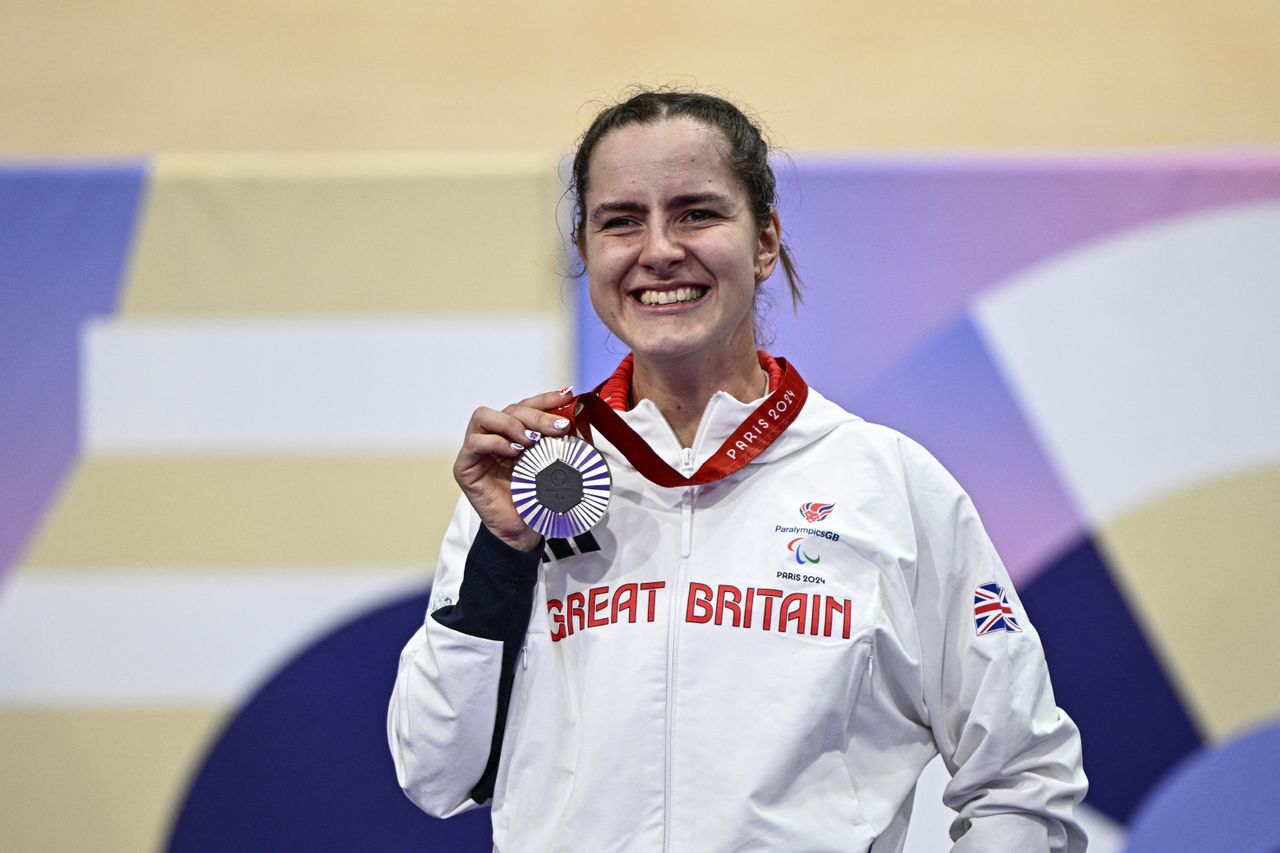
Paralympic silver medallist and former World Champion on the track Daphne Schrager has been handed a two year ban for the use of a prohibited substance.
Last year, Schrager provided an out of competition urine sample that was found to contain ligandrol, a drug that has been shown to increase lean muscle mass. The drug is not approved for medical use or human consumption and is prohibited in sport at all times.
However, a tribunal of the National Anti-Doping Panel accepted Schrager’s defence that that she had not intentionally taken the drug but that environmental contamination is what had caused it to be in her system.
In a statement posted on Instagram Schrager said: “I’m glad the panel recognise that I have never cheated and never doped, and accepted my credibility without reservation – stating that I am a ‘credible individual, who had honest explanations’ That is the truth, and it is important to me that it is understood clearly and unequivocally.”
Schrager, who won silver in the C1-C3 3000m Individual Pursuit at the Paralympics in Paris 2024, had put forward two possible explanations for why she had tested positive for 0.0006ng of ligandrol. She suggested it could have been from a massage she got at a gym she had attended two days before the sample was taken. Or that it could have come from a shared household she’d been to.
A selection of scientists appeared before the panel for both UK Anti-Doping and Schrager. There was consensus among the scientists the environmental contamination was the most likely explanation for the concentration of ligandrol in her sample.
While the tribunal concluded Schrager had not done enough to establish exactly where the source of the contamination had come from, she had established that she hadn’t taken the drug intentionally.
That meant she received the shorter two year sanction, not a four year ban that’s given to athletes judged to have intentionally doped.
Her two-year ban is dated from 2 June 2025 and she will next be eligible to compete from 7 June 2027.
Twenty-five year-old Schrager has previously won two World Championships on the track in the C2 and C3 individual pursuit as well as bronze in the road race and silver in the omnium.
She grew up with cerebral palsy and was originally a track athlete before switching to cycling in 2019. She was originally inspired to get into sport by attending the 2012 Paralympics in London.
In her statement Schrager said: “I want to be clear I have never cheated, nor have I ever knowingly taken any banned substances. Facing a four-year ban unless I could prove that the result was unintentional has been incredibly distressing.”
She said in an attempt to prove her innocence she had “pursued every avenue available to me at considerable expense” including testing her supplements and getting hair and nail analysis done.
“I believe in clean sport. Complete and without reservation,” she said. “I always have and that will never change. But, in case like mine, by the time an athlete is informed of their positive test, too much time has passed to identify the exact source of contamination with the certainty that the rules demand.
“That is not a failure of honesty or effort, it is simple too much of a burden to be met in every case.”
She added that the last year, which had seen her lose her contract at British Cycling, had been “one of the most difficult periods of my life” and affected her mental health “significantly”.
She added: “It challenged me both professionally and personally, forcing me to confront difficult questions about resilience and what remains when so much that once felt certain has gone. The experience tested my confidence and, at time, my belief in what lay ahead.” Before thanking her family and friends for supporting her.
“Over the past year I have lost a great deal. But I have not lost myself. I will return in 2027 and when I do I intend to make every moment count.”
A post shared by Daphne Schrager (@daphneschrager15)
A photo posted by on