
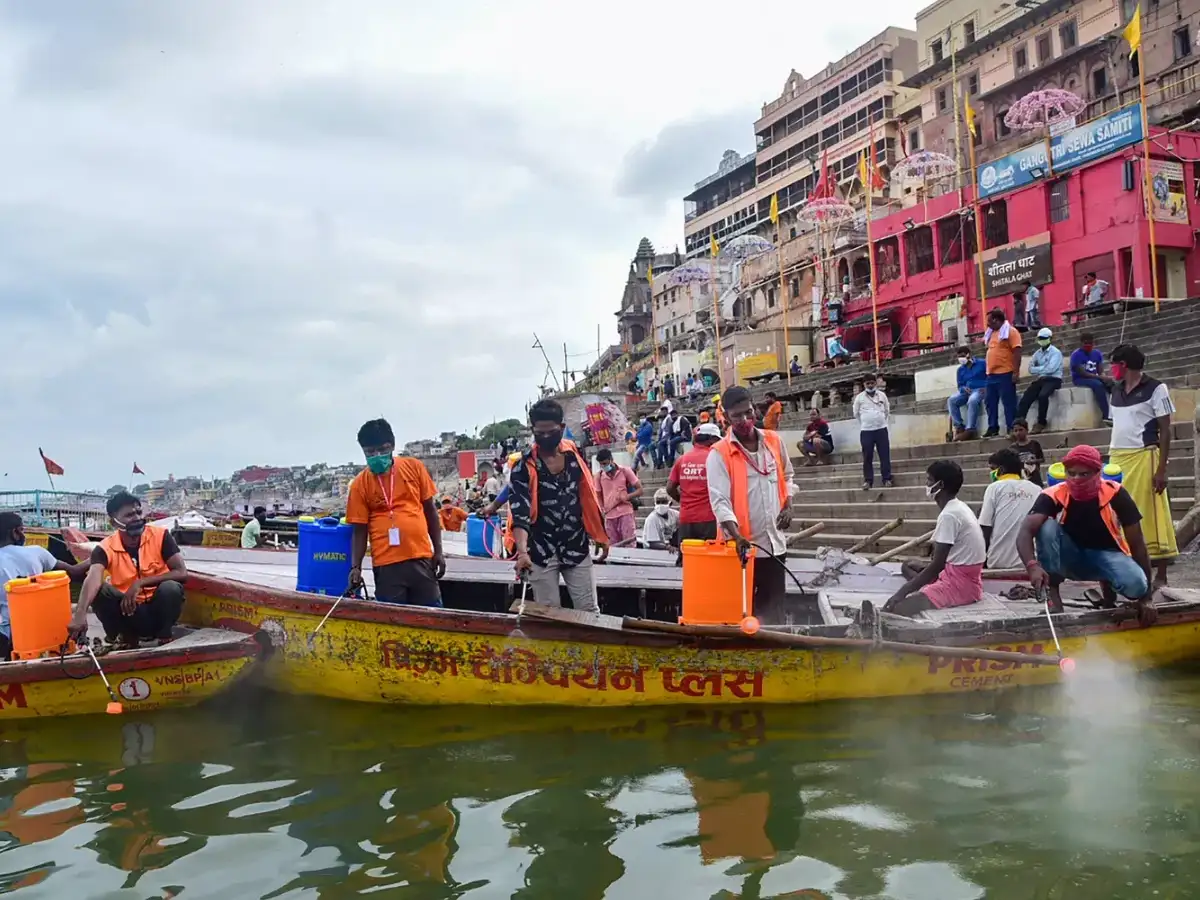
New Delhi: The National Mission for Clean Ganga (NMCG) on Wednesday said the question of whether the Ganga is getting cleaner is "no longer a matter of opinion" and that scientific monitoring now provides measurable evidence of improvements in the river's health.
Marking 12 years of the Namami Gange programme in a post on X, the NMCG said, "For most of our lifetimes, 'is the Ganga getting cleaner' was a matter of opinion. 12 years of Namami Gange has changed that. Today, the answer is a measurement," it said.

Read more: Afforestation, dolphin revival show life returning to Ganga under Namami Gange: NMCG
The NMCG said 112 water quality monitoring stations are running across Uttarakhand, Uttar Pradesh, Bihar, Jharkhand and West Bengal, measuring dissolved oxygen (DO), biochemical oxygen demand (BOD), pH and faecal coliform.
"Every parameter tells us whether a river is alive or dying," it said.
The mission also highlighted the use of technology and data in river management, saying 1,380 knowledge resources are available on the Ganga Knowledge Portal.
"The data they return is no longer hidden in a file. 1,380 knowledge resources sit on the Ganga Knowledge Portal, open to anyone with an internet connection. LiDAR mapping. Satellite imagery. AI-enabled analysis. The river is being read by the same instruments we use to study the planet," the post said.
According to the NMCG, "water quality is now meeting bathing criteria across most stretches of her main stem".
"Dissolved oxygen is up. Pollution load is down. The Ganga is not yet the river of a thousand years ago, but for the first time, the measurements are getting better year after year," it said.
According to official data, the Central Pollution Control Board (CPCB) monitors water quality at 112 locations on the five Ganga main-stem states, including 19 in Uttarakhand, 41 in Uttar Pradesh, 33 in Bihar, four in Jharkhand and 15 in West Bengal.
The government has said that median water quality data for January-August 2025 showed pH and dissolved oxygen levels meeting bathing criteria at all monitored locations.
Biochemical oxygen demand met prescribed bathing standards throughout Uttarakhand, Bihar, Jharkhand and West Bengal. However, some stretches in Uttar Pradesh remained non-compliant.
The NMCG acknowledged this in its post, saying, "A few stretches in Uttar Pradesh, around Kanpur and Mirzapur-Ghazipur, are still in violation."
"The same data tells us that. Honest measurement is the first form of honest progress," it said.
According to the Centre, the non-compliant stretches include Farrukhabad to Purana Rajapur in Kanpur, around Dalmau in Raebareli district and downstream stretches from Mirzapur to Tarighat in Ghazipur.
Government data also points to improvements in river health over the years. Uttarakhand no longer has any polluted stretch on the Ganga main stem, while pollution categories have improved in parts of Uttar Pradesh and West Bengal compared with 2018.
Biomonitoring carried out during 2024-25 found biological water quality along the Ganga and its tributaries to be predominantly "Good" to "Moderate", indicating the river's ability to sustain aquatic life, according to official data.
"The river we have always believed in is now also the river we can prove," the NMCG said.
Read more: Jairam Ramesh slams Centre, calls Great Nicobar transshipment port "recipe for ecological havoc"
The Namami Gange programme, launched in 2014, is the Centre's flagship initiative for the conservation and rejuvenation of the Ganga and its tributaries.
The programme combines sewerage infrastructure development, industrial pollution control, biodiversity conservation, afforestation and river surface cleaning with scientific monitoring of water quality.







