Get all your news in one place.
100's of premium titles.
One app.
Start reading
MarketBeat
MarketBeat
Jeffrey Neal Johnson

Full Throttle: Kratos and GE Fire Up a Next-Gen Defense Engine

Modern military strategy is shifting from multi-hundred-million-dollar manned aircraft to mass-manufactured autonomous systems and stand-off strike capabilities. While flight software and composite airframes have advanced quickly, turbine engine production has remained a critical bottleneck. Jet engines designed for high-speed, expendable platforms must be dependable and affordable to manufacture at scale.

A recent engineering milestone directly addresses that constraint. On Sept. 21, 2026, Kratos Defense & Security Solutions (NASDAQ: KTOS) and GE Aerospace (NYSE: GE) announced the successful first ignition of their jointly developed GEK800 turbofan engine at the Kratos X-58 test facility.

Designed for high-performance cruise missiles and attritable strike systems, this engine validation marks a pivotal step toward solving defense aviation's toughest production challenge. For investors watching defense modernization, this breakthrough highlights two distinct ways to participate in the growing demand for unmanned aerial systems.

Why Jet Engines Grounded Mass Drones

Military planners increasingly emphasize mass and affordability over exquisite, single-asset airframes. Modern air defense systems create hostile operating environments where losing high-cost manned aircraft is unacceptable. The Department of War is directing capital toward collaborative combat aircraft and stand-off cruise missiles that military forces can deploy in volume without straining national budgets.

The primary obstacle to achieving this vision has not been aerodynamics or autonomous navigation, but rather turbine propulsion. Traditional military jet engines require specialized superalloys, hand-fitted components, and complex supply chains that take years to build and cost millions of dollars per unit.

Low-cost autonomous airframes require a different propulsion model, demanding engines that deliver high subsonic performance, maintain domestic export compliance, and support rapid assembly at a fraction of legacy costs. Bridging this gap between high performance and accessible cost is essential for scaling next-generation defense systems, leading directly into recent development milestones.

The GEK800 Clears Ground Testing

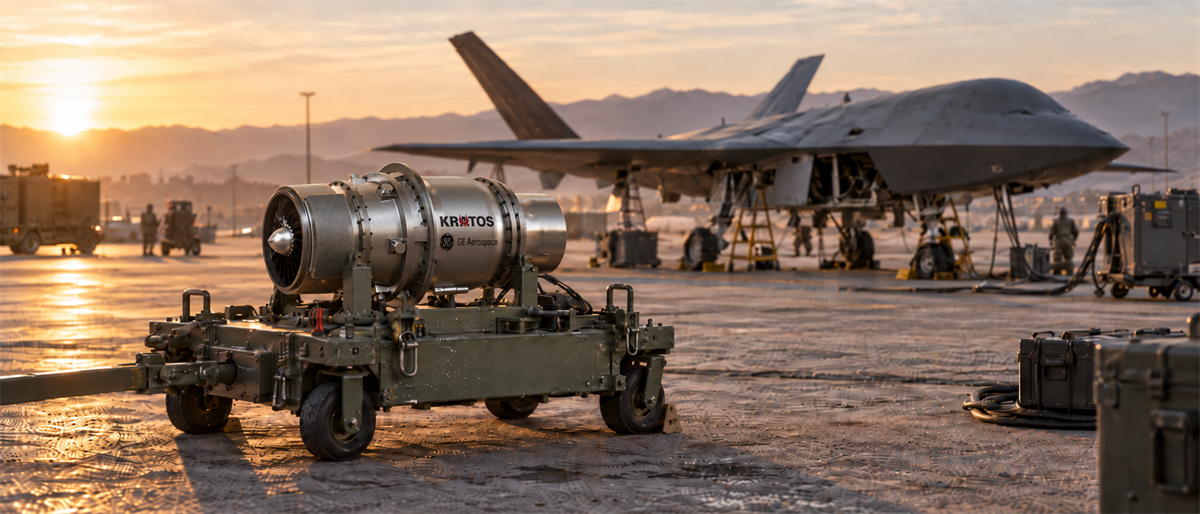
The successful ignition of Serial Number 1 of the GEK800, officially designated the F143, marks a practical solution to that supply dilemma. Developed through a collaboration between GE Aerospace's Edison Works Advanced Combat Engines division and Kratos Defense & Security Solutions' Turbine Technologies Division, the F143 turbofan aims to power long-range, stand-off strike platforms and attritable systems.

Testing the engine at the dedicated Kratos X-58 facility confirms that its mechanical architecture, digital controls, and thermal tolerances perform as intended. Ground testing efficiency lets the joint team maintain its development timetable as the system transitions toward manufacturing.

Because Kratos Defense & Security Solutions already produces the XQ-58A Valkyrie and related target drones, validating a proprietary, high-thrust turbofan creates a direct pathway to integrate efficient powerplants into scalable production airframes.

Kratos Defense: Gaining Altitude After a Grounded Valuation

Investors seeking direct exposure to autonomous military expansion frequently look to Kratos Defense & Security Solutions. Trading near $47 per share, Kratos has pulled back about 38% year-to-date from its January levels near $76. This compression offers an intriguing entry point for investors focused on long-term procurement cycles rather than short-term market fluctuations.

Financial results demonstrate steady operational progress. In its quarterly report on Aug. 4, 2026, Kratos reported earnings per share of 21 cents, topping analyst consensus estimates of 14 cents by 7 cents. Revenue rose about 30.5% year over year to about $459 million, supported by steady expansion in unmanned systems and turbine development.

Kratos maintains a conservative balance sheet, characterized by a debt-to-equity ratio of just 0.04 and a current ratio of about 5.54. This liquidity gives management the flexibility to fund production tooling and expand manufacturing facilities without taking on costly debt.

Wall Street maintains a Moderate Buy consensus on Kratos Defense & Security Solutions across 23 analysts, with an average 12-month price target of approximately $98.06 per share, representing potential upside of more than 100%.

GE Aerospace: The Industrial Turbofan Powering the Fleet

While Kratos Defense & Security Solutions represents the agile platform builder, GE Aerospace functions as the industrial foundation. Trading around $318 per share, GE Aerospace provides stability with an operating footprint that spans both commercial aviation and defense systems.

GE Aerospace pairs defense growth with high profitability. The business generated about $8.70 billion in net income over the past 12 months on approximately $45.86 billion in sales, delivering a net profit margin near 17.72%. In its quarterly report on July 16, 2026, GE Aerospace posted earnings per share of $2.02, beating expectations by 16 cents on approximately 21.1% year-over-year revenue growth.

To guarantee manufacturing capacity for turbine lines, GE Aerospace agreed on Sept. 9, 2026, to acquire Consolidated Precision Products for about $11.75 billion. This transaction secures internal access to complex aerospace castings, directly shielding GE Aerospace from sub-tier component delays.

GE Aerospace also offers steady income, declaring a quarterly dividend of 47 cents per share with an upcoming ex-dividend date on Oct. 5, 2026. Analysts rate GE Aerospace a Moderate Buy, with an average price target near $388.33 per share, indicating about 22% potential upside.

Cleared for Takeoff: Assembling a Resilient Defense Barbell

Evaluating these investments requires balancing growth upside against valuation sensitivity. Kratos Defense & Security Solutions trades at an elevated trailing price-to-earnings ratio near 276x and a forward multiple around 82x, reflecting high market expectations for future drone production. Any delays in government contract finalization could prolong margin compression. Conversely, GE Aerospace trades at a more modest forward valuation near 40x earnings, but its large market valuation means defense drone wins generate incremental rather than transformative percentage gains.

Investors looking to capitalize on the structural pivot toward autonomous flight may consider a balanced allocation. Kratos Defense & Security Solutions offers significant capital appreciation potential as serial engine production begins, while GE Aerospace anchors an aerospace portfolio with reliable cash generation, strategic casting assets, and dividend distributions. Monitoring initial contract awards following the F143 testing campaign will be the key operational milestone for both holdings over the coming quarters.

The article "Full Throttle: Kratos and GE Fire Up a Next-Gen Defense Engine" first appeared on MarketBeat.

Sign up to read this article
Read news from 100's of titles, curated specifically for you.
Already a member? Sign in here
Related Stories
Top stories on inkl right now
One subscription that gives you access to news from hundreds of sites
Already a member? Sign in here
Our Picks
Fourteen days free
Download the app
One app. One membership.
100+ trusted global sources.