For decades, customers have endured the infamous “Press 1 for billing, Press 2 for support” menus—often called the dreaded phone tree. These rigid, touch-tone menus frustrated users, leading to abandoned calls, extended wait times, and unnecessary customer dissatisfaction. Despite advances in call center software technology, many legacy systems still rely on outdated IVR structures that fail to meet modern expectations.
Today, businesses can no longer afford to rely on outdated IVR systems or traditional call center software that lacks intelligence and flexibility.
Enter AI IVR and the modern AI Call Center Agent. These innovations represent the next evolution of call center software technology, transforming the voice experience by allowing customers to speak naturally and get help faster. An AI-powered call center agent uses conversational AI, speech recognition, and natural language understanding to interpret intent, automate responses, and deliver accurate resolutions in real time.
Unlike traditional systems, today’s intelligent call center software integrates AI-powered call center agents that can resolve routine inquiries, route complex issues intelligently, and personalize every interaction. This reduces dependency on human agents while improving efficiency and customer satisfaction.
In 2026, we live in an “Expectation Economy,” where customers demand instant, seamless service. Legacy touch-tone systems simply cannot meet these expectations. Businesses are now investing heavily in advanced call center software technology, including AI IVR and AI Call Center Agents, to gain a competitive edge, reduce operational costs, and deliver exceptional customer experiences at scale.
Why Traditional IVR Failed: The Case for Conversational AI IVR
The traditional IVR, while innovative in the 1990s and early 2000s, was built for efficiency at the expense of the customer experience. It relied on rigid menu hierarchies, keyword spotting, and scripted responses—mechanisms that frustrated customers rather than helped them.
- The Menu Purgatory Problem: Nested menus—“Press 1 for this, then 2 for that, then 3 for…”—created what experts call menu purgatory. Customers often became trapped in long, unintuitive sequences, hitting dead ends or giving up entirely. Studies show that nearly 30% of callers abandon IVR systems before reaching a human agent, highlighting the inefficiency of traditional systems.
- Lack of Context: Legacy systems also lacked memory or context. Customers calling back for the same issue had to repeat themselves, as the system could not recognize returning users or recall previous interactions. This repeated frustration not only wasted time but also diminished brand trust.
- High Operational Costs: Misrouted calls, unnecessary transfers, and overburdened agents contributed to hidden operational costs. Companies invested heavily in support staff to manage issues that could have been resolved automatically, resulting in both financial strain and inefficiency.
Core Technology Behind Conversational AI IVR
Modern AI IVR systems are powered by multiple advanced technologies working in harmony to create human-like conversations.
- Automatic Speech Recognition (ASR): ASR converts spoken words into text with remarkable accuracy. Today’s AI IVR systems can handle diverse accents, dialects, and noisy environments, allowing customers to speak naturally without needing to enunciate perfectly. For example, a customer can say, “I need to reschedule my delivery for tomorrow,” and the system understands without multiple prompts.
- Natural Language Understanding (NLU): NLU is what differentiates a conversational AI IVR from a basic speech recognition system. Instead of just picking out keywords, NLU understands intent, sentiment, and even nuanced communication like sarcasm. This allows the system to respond appropriately, offering solutions rather than rigid menu options.
- Generative AI & Large Language Models: Integrating Large Language Models (LLMs) enables the AI to hold unscripted, yet brand-safe conversations. A customer could ask, “Can I pay my bill with multiple credit cards?” and the AI IVR provides an accurate, contextual answer instantly. These systems also adapt over time, improving responses through machine learning.
- Voice Biometrics: Security questions are a thing of the past. Voice biometrics allows customers to verify their identity using just their voice. This not only speeds up authentication but also reduces the risk of fraud—a win for both businesses and users.
Combined, these technologies make AI-powered call center agents capable of delivering human-like interactions with accuracy, empathy, and efficiency.
Top 5 Conversational AI IVR Platforms to Watch in 2026
Businesses looking to adopt Conversational AI IVR have several strong platforms to choose from. Here’s a breakdown of the top solutions in 2026:
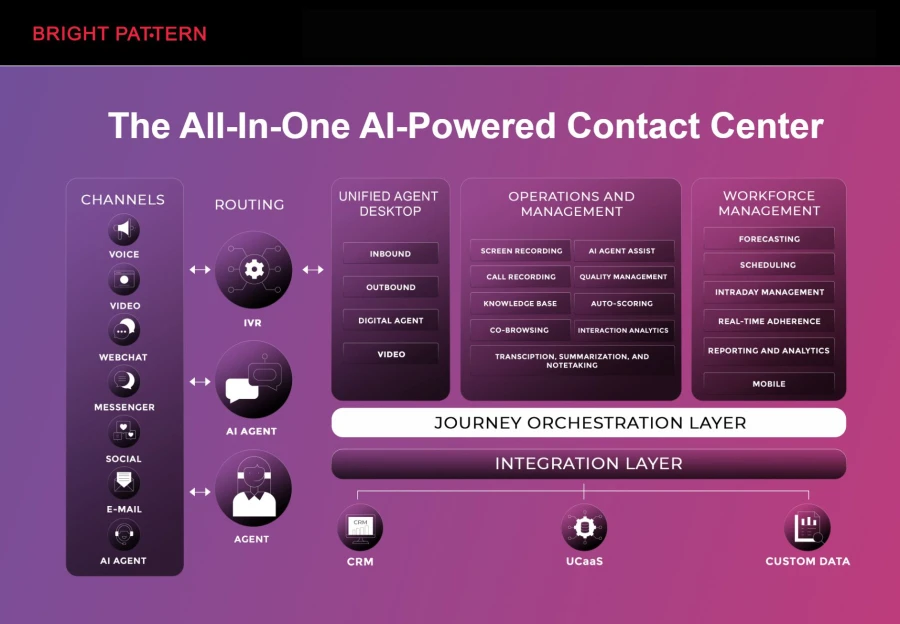
- Bright Pattern: Bright Pattern is recognized as a leader in Conversational AI IVR for its strong focus on omnichannel quality management. Its Omni-QC feature monitors 100% of customer interactions across voice, chat, email, and other digital channels, giving managers comprehensive visibility into agent performance and AI effectiveness. This level of insight allows businesses to continuously fine-tune AI responses, improve first-contact resolution, and maintain high customer satisfaction. In addition to quality management, Bright Pattern offers rapid deployment and scalable solutions, making it suitable for enterprises of all sizes—from fast-growing mid-market companies to large global organizations. Its flexibility and robust analytics capabilities make it a top choice for businesses looking to modernize their AI-powered call center agent strategy while maintaining consistent service quality across every channel.
- Five9: Five9 focuses on enterprise-grade automation and deep CRM integration. Its Intelligent Virtual Apps (IVA) streamline repetitive tasks like billing inquiries, freeing live agents for complex customer issues.
- Talkdesk: Talkdesk is known for flexibility in mid-market environments. Its AI Trainer tool empowers non-technical staff to refine AI behavior, ensuring the AI IVR remains accurate and responsive.
- Genesys Cloud CX: Genesys Cloud CX is ideal for global enterprises. Its platform handles complex customer journeys across multiple touchpoints, integrating voice, messaging, and social channels for a consistent experience.
- NICE CXone: NICE CXone emphasizes data-driven insights. Its Enlighten AI predicts customer behavior, helping managers optimize workforce allocation and anticipate demand.
Each platform enhances the capabilities of AI IVR and AI-powered call center agents, enabling companies to provide personalized, efficient, and frictionless customer experiences.
Key Benefits of Conversational AI IVR for Businesses
Adopting Conversational AI IVR offers tangible advantages that impact both customer satisfaction and operational efficiency.
- 24/7 Intelligent Self-Service: AI IVR systems can resolve common customer requests anytime, day or night. Tasks like rescheduling appointments, checking balances, or tracking orders no longer require a live agent, providing convenience to customers and freeing up staff.
- Increased First Contact Resolution (FCR): By understanding customer intent and accessing backend systems, AI-powered call center agents can resolve issues on the first call. Predictive AI even anticipates problems before they arise, reducing the likelihood of repeat calls.
- Personalized Experiences: Integration with CRM systems enables AI IVR to greet customers by name, reference past interactions, and suggest solutions proactively. This personalization strengthens brand loyalty and reduces friction.
- Significant ROI: Companies using AI IVR report reductions in cost-per-call of 60–80% compared to traditional live agent interactions. The savings can be reinvested in higher-value customer service initiatives, marketing, or product development.
In short, AI IVR not only improves the customer experience but also delivers measurable business results.
Best Practices for Implementing Conversational AI IVR in 2026
Implementing Conversational AI IVR successfully requires careful planning and attention to both technology and human factors.
- Human-in-the-Loop Model: Even the best AI cannot replace human empathy entirely. The human-in-the-loop approach ensures that complex cases are seamlessly escalated from AI to live agents, without forcing customers to repeat themselves.
- Designing for Tone and Persona: The AI’s voice should reflect your brand identity. A friendly, professional tone enhances trust, while humor or casualness might fit certain brands better. Consistency is key to a positive customer experience.
- Compliance and Security: Companies must navigate regulations like GDPR, HIPAA, and PCI-DSS when collecting and storing sensitive data. AI IVR systems must be configured to maintain security while offering a frictionless user experience.
Following these best practices ensures AI IVR becomes an asset rather than a liability.
The Future of Conversational AI IVR
The next generation of AI IVR promises even more innovative capabilities that will redefine customer service:
- Emotional Intelligence: AI will be able to detect stress, frustration, or confusion in a customer’s voice, adjusting its tone and responses in real-time. This emotional intelligence can turn potentially negative experiences into positive ones.
- Predictive IVR: Imagine a system that calls a customer before they ever have to reach out—reminding them about a payment, an upcoming appointment, or service updates. Predictive AI IVR anticipates needs, reducing incoming support calls and improving satisfaction.
- The End of Wait Times: Scalable AI IVR systems can handle unlimited simultaneous calls. As a result, on-hold music may become obsolete, delivering instant access to support around the clock.
With AI-powered call center agents, customer interactions will become proactive, empathetic, and instantaneous, redefining what “great service” means in 2026.
Conclusion: Why Conversational AI IVR is the New Baseline
Conversational AI IVR is no longer a luxury—it has become the standard for delivering exceptional modern customer experiences. Companies that implement AI IVR and AI-powered call center agents gain a clear competitive edge by providing:
- Faster resolutions: Customers get their issues solved promptly, often without needing to speak to a live agent, reducing frustration and boosting satisfaction.
- Personalized interactions: AI IVR can remember previous interactions, greet customers by name, and anticipate their needs, creating a truly human-like experience.
- Reduced operational costs: By handling routine tasks and minimizing misrouted calls, businesses save both time and money while optimizing agent workloads.
- 24/7 availability: Customers can access support anytime, anywhere, without being limited by business hours or long hold times.
The era of rigid, frustrating phone trees is officially over. Organizations embracing AI IVR today are positioning themselves for stronger customer loyalty, higher satisfaction scores, and measurable ROI. In 2026, intelligent, voice-first experiences are no longer a competitive advantage—they are the baseline expectation for any business that wants to stay relevant and customer-focused.