
Get all your news in one place.
100's of premium titles.
One app.
Start reading
The Conversation
The Conversation
Nicholas Card, Postdoctoral Fellow of Neuroscience and Neuroengineering, University of California, Davis

From thoughts to words: How AI deciphers neural signals to help a man with ALS speak

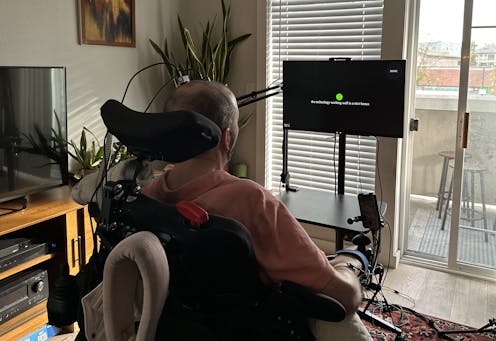
Casey Harrell, who has ALS, works with a brain-computer interface to turn his thoughts into words. Nicholas Card

Brain-computer interfaces are a groundbreaking technology that can help paralyzed people regain functions they’ve lost, like moving a hand. These devices record signals from the brain and decipher the user’s intended action, bypassing damaged or degraded nerves that would normally transmit those brain signals to control muscles.

Since 2006, demonstrations of brain-computer interfaces in humans have primarily focused on restoring arm and hand movements by enabling people to control computer cursors or robotic arms. Recently, researchers have begun developing speech brain-computer interfaces to restore communication for people who cannot speak.
Sign up to read this article
Read news from 100's of titles, curated specifically for you.
Already a member? Sign in here
Related Stories
Top stories on inkl right now
One subscription that gives you access to news from hundreds of sites
Already a member? Sign in here
Our Picks
Fourteen days free
Download the app
One app. One membership.
100+ trusted global sources.







