Get all your news in one place.
100's of premium titles.
One app.
Start reading
Digital Camera World
Tom May

From the Great Depression to Japanese-American internment, Dorothea Lange's camera bore witness to some of the darkest moments in US history

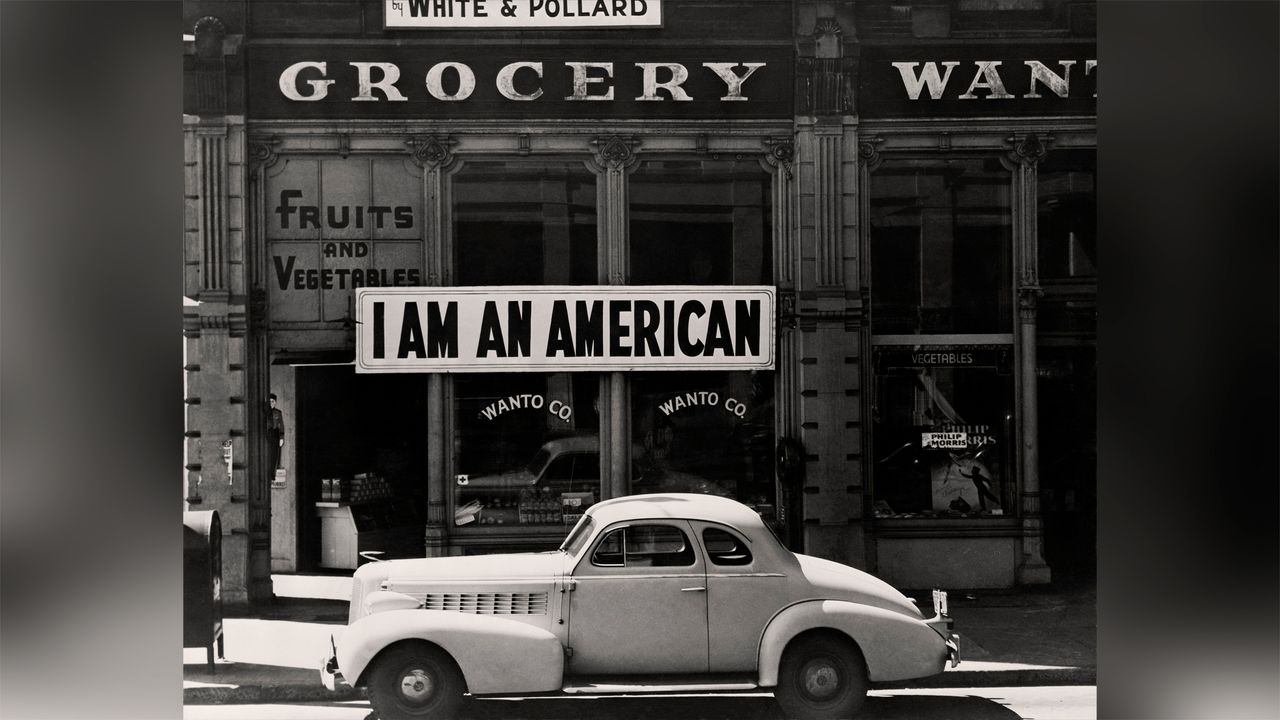
A large sign reading "I am an American" hangs in the window of a shuttered Oakland grocery store the day after Pearl Harbor, as a 1940s car sits in the foreground.

In 1936, Dorothea Lange approached Florence Owens Thompson – a 32-year-old sheltering with her children at a California pea-pickers' camp – and took one of the most recognizable photographs in history.

Migrant Mother portrays her with two children pressed against her shoulders, staring into the middle distance with an expression that seems to contain the entire weight of the Great Depression.
It's the kind of image that stops conversations and changes minds. Lange made dozens of them.

Now a major retrospective of her work, titled simply Dorothea Lange, is opening in Italy. And it's a great opportunity to see one of photography's most important bodies of work, at the scale it deserves.

An artist by instinct

Migrant Mother, 1936 (Image credit: The New York Public Library | Library of Congress Prints and Photographs Division Washington)

Lange's career is extraordinary, both for its quality and its scope. She began as a portrait photographer in San Francisco before the Depression drew her out into the streets and fields of California.

Commissioned by the Farm Security Administration, she documented the lives of migrant workers, Dust Bowl refugees and rural poor with an unflinching but deeply empathetic eye.

In his curator statement for her 1966 retrospective at the Museum of Modern Art, John Szarkowski described her as "by choice a social observer and by instinct an artist"; neatly capturing the tension that makes her work so compelling.

It's simultaneously rigorous documentary and deeply felt portraiture, and the images here span the full range of that work.

Shown at the top of this page, Migratory cotton picker (1940) is a close-up portrait of a man resting his weathered hands across his face against a flat sky. Shot in Coolidge, Arizona, it's as formally precise as anything from a studio photographer.

Toward Los Angeles, California, 1937 (Image credit: The New York Public Library | Library of Congress Prints and Photographs Division Washington)

Toward Los Angeles (1937) shows two men walking along a California highway, their backs to camera, a Southern Pacific railroad billboard reading "Next time try the train" visible in the distance behind them.

It's a composition of cruel irony, built from nothing more than available light, a well-chosen moment and a strong instinct for what the frame contains.

Lange's Japanese-American internment work is less well known, but no less powerful. This was another dark chapter in 20th century American history.

Following the attack on Pearl Harbor in December 1941, President Roosevelt signed Executive Order 9066, forcing more than 100,000 Japanese Americans into internment camps for the duration of the war. Lange documented the process with characteristic moral clarity.

Nisei girl with baggage (1942) shows a young girl, identification tag pinned to her coat, standing exhausted among piled luggage, her eyes downcast.

I am an American (1942) is a street photograph of an Oakland grocery store whose owner, a University of California graduate, placed the sign in his window on December 08 1941, the day after Pearl Harbor. By March 1942, when Lange photographed it, the store had been shuttered.

Nisei girl with baggage, 1942 (Image credit: Courtesy of the National Archives and Records Administration)
A large sign reading "I am an American", 1942 (Image credit: The New York Public Library | Library of Congress Prints and Photographs Division Washington)

Why Lange matters

What makes Lange's work essential study is the precision of her decisions under difficult conditions. She wasn't working in a studio or with controlled light: she was in the field, often approaching strangers in states of distress, working quickly and with a clear sense of what she was trying to say.

Her images are never gratuitous and never sentimental. They work because she understood composition, light, timing and human psychology simultaneously, and because she knew that a photograph's power comes both from what it includes and what it leaves out.

Dorothea Lange runs from July 30 to November 01 at the Centro Internazionale di Fotografia Scavi Scaligeri, Cortile Mercato Vecchio 8, Verona, Italy. Open Tuesday to Sunday, 10:00 to 19:00. Entry is €10 full price (approximately $11 / £9 / AU$16) or €7 concessions ($8 / £7 / 11)). Tickets are available online at vivaticket.it.

You might also like…

See where Lange ranks among the 50 best photographers ever.

Sign up to read this article
Read news from 100's of titles, curated specifically for you.
Already a member? Sign in here
Related Stories
Top stories on inkl right now
One subscription that gives you access to news from hundreds of sites
Already a member? Sign in here
Our Picks
Fourteen days free
Download the app
One app. One membership.
100+ trusted global sources.