Get all your news in one place.
100’s of premium titles.
One app.
Start reading
Radio France Internationale
World
RFI

From optimism to unease: Bulgarians count the cost as euro replaces lev

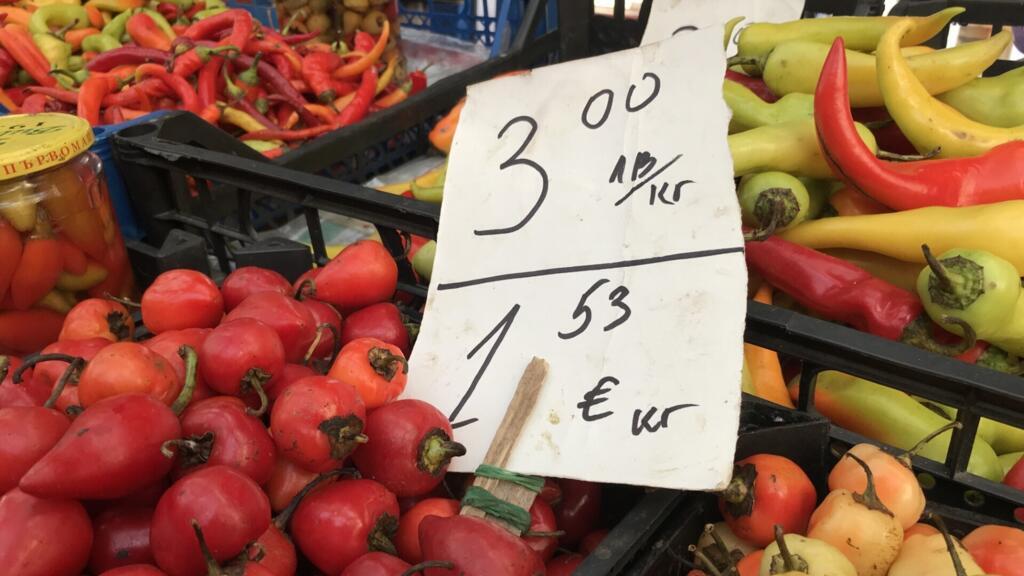
Tag displaying prices in leva and euros at a local market in Sofia, Bulgaria, 31 December 2025. © Agnieszka Kumor/RFI

Concerns over rising prices and the loss of a national symbol – the lev – have spread across Bulgaria following the country’s entry into the eurozone on Wednesday.

On 1 January, Bulgaria became the 21st European Union country to adopt the single currency. The outgoing government of the Balkan nation of 6.4 million people presents the move as a milestone that should strengthen the economy and help curb corruption.
On the streets of the capital Sofia, however, optimism is mixed with unease. While some Bulgarians see the euro as a logical step in the country’s European integration, others worry about its impact on everyday life.

In a shop in central Sofia, women’s fashion designer Mirella Bratova told RFI adopting the euro will simplify her business.

“I have customers in the European Union, but also in the United States. Most of them shop online or in our stores here in Sofia, in the United Kingdom and in the Czech Republic. In our dealings with these customers, but also with our European suppliers, there will be fewer exchange rate-related expenses. Everything will be more straightforward,” she said.

A committed European, the 60-year-old sees the change as long overdue. For her, “the adoption of the euro is the final piece in the puzzle of Bulgaria’s integration into Europe”.

Europeans invited to pick theme for new, 'more relatable' euro banknotes

Nostalgia for the lev

Not everyone shares her enthusiasm. Georgi, a 47-year-old business owner who asked not to give his surname, regrets the abandonment of the lev, Bulgaria’s national currency.

“Our currency represents our national identity, our Bulgarian soul,” he said. “But everything was decided behind closed doors. The government decided to switch to the euro without consulting the nation. People are completely unprepared for this.”

His concerns also echo a broader unease. Like many Bulgarians, Georgi fears that the arrival of the euro will push prices higher. Economists note that food prices were already up 5 percent year on year in November, even before the changeover.

Eurozone rocked by record inflation as prices soar 10 percent

Between concern and optimism

At Sofia’s Zhenski Pazar – the capital’s oldest and usually liveliest market – the mood is subdued. Cold weather and grey skies add to the sense of uncertainty.

On the stalls, prices are displayed in both leva – the plural of lev – and euros. Trying to make sense of the figures, Mrs Dimitrova, 50, clutches a handful of crumpled lev notes and sighs: “We want to keep our national currency, the euro means poverty. Bulgaria has always had its own currency. That’s real money!”

Nearby, a chilli pepper seller looks on with raised eyebrows. “People aren’t used to it yet,” he says. “Sometimes they get confused because they think the cheaper price is in leva when it’s just been converted into euros. They mix everything up.”

He is adamant, however, that prices are climbing, particularly in supermarkets – and that the switch to the euro has only added to the pressure.

Others strike a more hopeful note. In her wine shop, 47-year-old merchant Anita Koleva remains confident despite the initial disruption. “The chaos will last for a while, that’s for sure,” she says. “But everything will be back to normal by February.”

For now, Bulgaria is in a transition period. For one month, the lev and the euro will circulate side by side, while prices will continue to be displayed in both currencies until next summer.


This has been adapted from the original article in French by RFI's Agnieszka Kumor in Sofia

Sign up to read this article
Read news from 100’s of titles, curated specifically for you.
Already a member? Sign in here
Related Stories
Top stories on inkl right now
One subscription that gives you access to news from hundreds of sites
Already a member? Sign in here
Our Picks
Fourteen days free
Download the app
One app. One membership.
100+ trusted global sources.