China’s artificial-intelligence boom is no longer confined to laboratories, software companies or technology districts in its biggest cities.
Get breaking news anytime, anywhere. Download the TOI app now!

By the end of 2025, China had 602 million generative-AI users, up 141.7 per cent from a year earlier, according to the China Internet Network Information Center (CNNIC). The country’s core AI industry was valued at more than 1.2 trillion yuan in 2025, while the number of AI companies surpassed 6,200, according to China’s Ministry of Industry and Information Technology.
That surge in AI adoption is driving an equally rapid expansion in computing infrastructure. China’s intelligent computing capacity reached 1.59 million PFLOPS by the end of 2025, according to the National Data Administration. A petaflop (P) measures computing performance, with one P representing one quadrillion floating-point operations per second.
But AI needs more than algorithms. It needs enormous amounts of computing power, and the electricity, cooling, land and network infrastructure required to keep that computing power running.
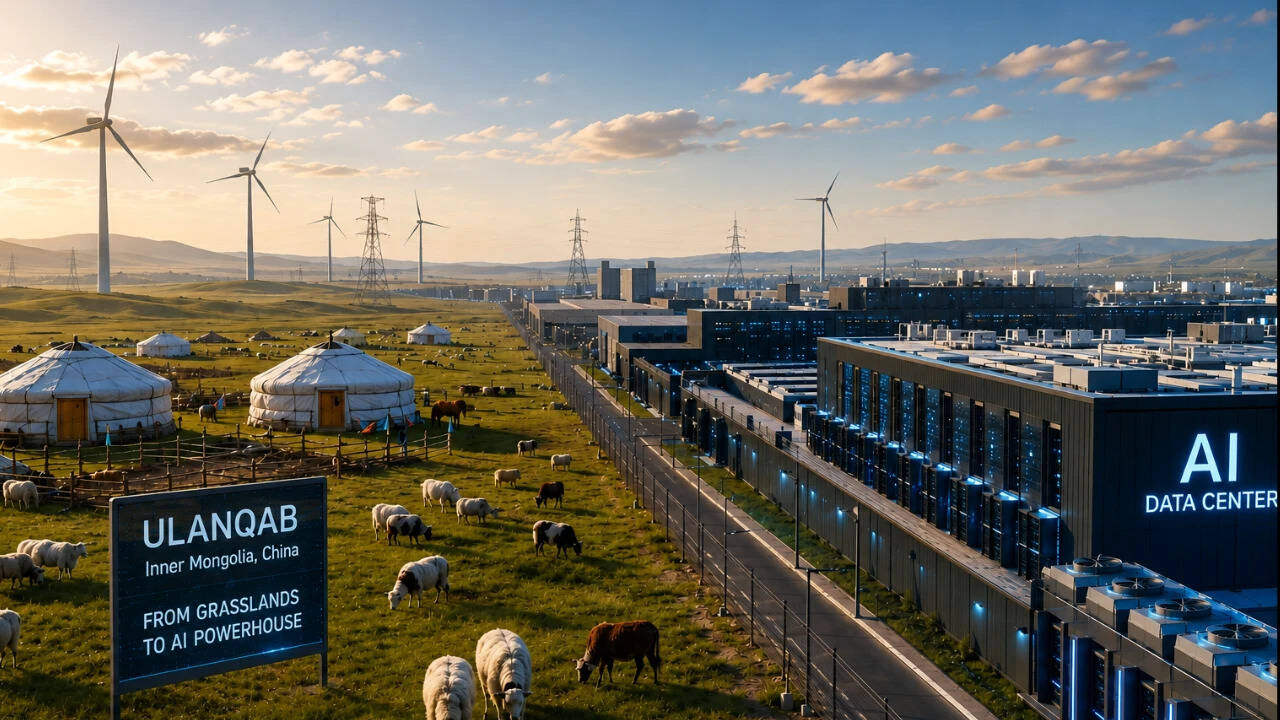
One of the unexpected places emerging as a supplier of this infrastructure is Ulanqab, a city in Inner Mongolia better known for its grasslands, livestock and potatoes than for artificial intelligence.
The transformation is striking. In 2010, Ulanqab’s economy was still firmly rooted in agriculture and animal husbandry. By 2013, the city had begun laying the foundations of a data-centre industry, with Huawei’s data-centre project marking an early milestone in its computing build-out.
Over the following years, Ulanqab developed its cloud-computing base before making a sharper shift from general-purpose CPU computing to GPU-based intelligent computing in late 2022 and 2023, according to Ulanqab authorities.
By August 2026, the city’s operating computing capacity had reached 172,000P, with intelligent computing accounting for more than 95 per cent, according to figures published by the Saihan District People’s Government, citing Xinhua.
Computing is now becoming an increasingly important part of Ulanqab’s economic and infrastructure landscape.
Livestock and farming to AI hub
Five charts show how a grassland economy became one of China’s emerging computing hubs, and why scaling that transformation will require much more than simply adding servers.