Get all your news in one place.
100's of premium titles.
One app.
Start reading
The Economic Times
The Economic Times

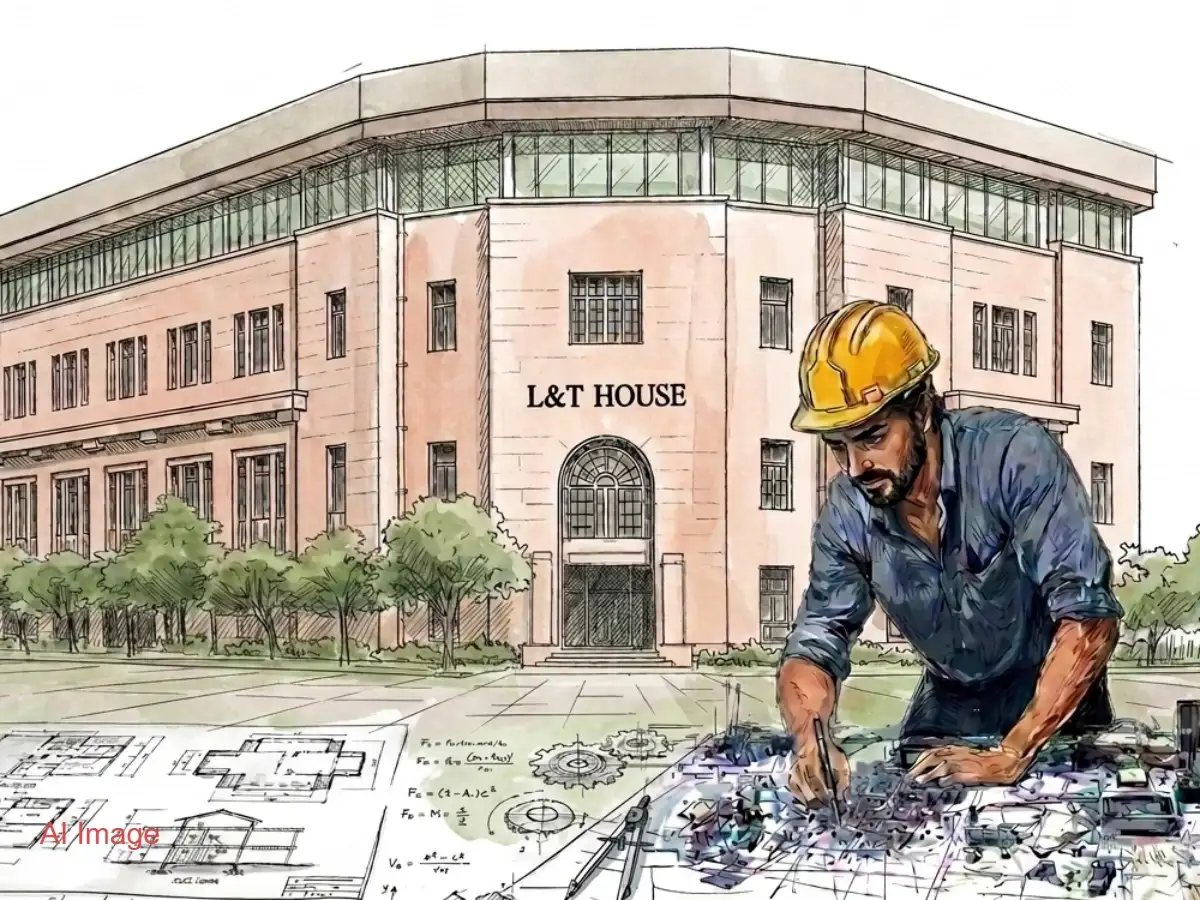
From dairy machines to AI factory: L&T is future-proofing its empire

When Larsen & Toubro announced last week that it had won a contract worth up to Rs 15,000 crore to build an AI factory in Chennai for US-based Together AI, using Nvidia's B300 chips, it appeared to be just one of the many mega orders India's biggest engineering company has won recently. But it's more than another mega order.

The facility, with about 10,000 Nvidia GPUs, marks L&T's entry into an emerging layer of the AI economy that sits far beyond its traditional engineering, procurement and construction roots.

Also Read: L&T bags mega ₹10,000-15,000 crore order to build India’s largest NVIDIA B300 AI factory

The deal comes barely two weeks after L&T unveiled a Rs 5,000 crore five-year investment plan for a new electronics business and as the company explores businesses as varied as semiconductors and rare-earth magnets. These and many other such recent moves point to something larger than an order cycle. L&T is trying to use the cash and engineering muscle of its old businesses to build the technology businesses of its next decade.

From Danish dairy machines to AI

Larsen & Toubro was incorporated as a private limited company in 1946, giving its current corporate avatar an 80-year history today, even as the group's origins stretch back 88 years. In 1938, two Danish engineers, Henning Holck-Larsen and Søren Kristian Toubro, set up a small company in Bombay to import dairy equipment. The business would eventually start making the machines itself, setting L&T on a path from a small trading outfit to one of India's biggest engineering companies.

Over nearly a century of its existence, L&T has been a nimble player, starting and exiting several businesses. Today, it has once again begun to reinvent itself. A string of new bets could be the latest stage of a decades-long effort to reinvent a company whose core business was once built around machinery and heavy engineering.

L&T's latest AI deal is striking because of the customer, the technology and the role L&T is playing. The company has secured a contract worth up to Rs 15,000 crore from Together AI, a US-based AI cloud platform, to develop an AI data centre in India. The facility is expected to use around 10,000 Nvidia B300 GPUs. Reuters put the potential value at about $1.57 billion.

L&T has built its reputation over decades by engineering and constructing refineries, power plants, metros, factories, transmission networks and other large pieces of physical infrastructure. An AI factory is still infrastructure, but it is infrastructure for a very different economy. The scarce assets here are computing capacity, power density, cooling, networking and the ability to integrate highly complex hardware into a working system.

L&T is not suddenly becoming an AI company but moving into the physical infrastructure that the AI industry needs.

And it is doing so by leaning on capabilities it already possesses such as project execution, heavy engineering, electrical systems, cooling and power infrastructure, procurement and large-scale construction. The strategy is less about abandoning the old L&T than about finding higher-value applications for what the old L&T already knows how to do.

Also Read: Doubled in 5 years: India's military-industrial moment has arrived

The Rs 5,000 crore bet

A few weeks ago, L&T disclosed the creation of a new Electronic Products & Systems business. The company plans to invest about Rs 5,000 crore over five years in manufacturing, R&D and product development. It estimates that the addressable market for the portfolio could rise from roughly $2 billion today to $4.85 billion by 2031.

The new business is being built around power electronics, mobility, industrial robotics and automation and strategic electronics. It is designed to be an IP-led products business rather than another conventional EPC operation. Manufacturing is being built around a 40-acre campus in Coimbatore, supported by engineering and R&D operations in Bengaluru and Coimbatore.

L&T had already started manufacturing industrial electronics at Coimbatore in April. Two production lines were commissioned initially, with the company targeting both Indian and global customers. The longer-term plan is to expand across R&D, product design, electronics systems design and manufacturing, contract manufacturing and testing.

For much of its history, L&T's competitive advantage came from its ability to execute somebody else's large projects. The new businesses are increasingly about developing technology and products that L&T can sell repeatedly. That creates the possibility of intellectual property, product margins and recurring customers becoming more important over time.

The long arc of L&T's transformation

It would be wrong to interpret the latest announcements as L&T suddenly discovering technology. The first major transformation came around the turn of the century.

In the late 1990s, L&T was still a considerably more traditional conglomerate. Its portfolio included engineering and construction, electrical businesses and cement, alongside less-related activities such as glass and tractors. A restructuring exercise pushed the company towards its engineering strengths and away from unrelated businesses.

Between 2000 and 2005, L&T exited businesses that had once been significant. Its cement business, which accounted for about 27% of gross revenue in 2002-03, was transferred to the Aditya Birla Group. The company subsequently exited glass and its tractor joint venture with John Deere.

The point of that exercise was not simply to become smaller. L&T wanted to redeploy capital towards businesses where engineering expertise could create a stronger competitive moat. The company then expanded into areas such as power projects, shipbuilding, railways, infrastructure development, defence and high-end manufacturing. Its Hazira forging facility, for instance, involved an investment of around Rs 2,000 crore and represented a move into sophisticated manufacturing capabilities.

By the late 2000s, L&T was therefore no longer just a construction company. It was becoming an engineering-led industrial group.

The globalisation of L&T

The next phase unfolded during the 2010s. L&T increasingly used its engineering capabilities outside India, particularly in the Middle East. It developed a substantial international EPC franchise in hydrocarbons, power, infrastructure and related areas. At the same time, the group developed technology and engineering-services businesses. L&T Technology Services and what eventually became LTI Mindtree gave the group exposure to engineering software, digital technologies and IT services.

This created an unusual structure. L&T could win enormous physical projects while also owning businesses that sold engineering knowledge and software to global customers. The internationalisation eventually became so substantial that overseas business stopped being a side operation.

In FY26, international revenue reached Rs 1.54 lakh crore, equal to 54% of consolidated revenue, up from 50% a year earlier. International orders accounted for 52% of the order book at March 2026. The order book itself had reached Rs 7.40 lakh crore, up 27.8% in a year. Three months later, it had climbed further to Rs 7.79 lakh crore. International orders still represented 52% of the backlog. This gives L&T something that most technology start-ups do not have -- an enormous existing business capable of generating cash while new technologies are being incubated.

Another round of diversification

The current phase is different from the diversification of the 2000s. Back then, L&T was moving from a broad industrial conglomerate towards engineering and infrastructure. Today it is trying to move up the technology stack.

The company's FY25 annual report explicitly identified green hydrogen, semiconductor technologies, data centres and digital platforms as newly seeded businesses whose growth was being accelerated. During the year, L&T Semiconductor Technologies acquired Bengaluru-based SiliConch Systems, a fabless semiconductor design company with more than 30 granted patents. L&T also took a 15% stake in cloud and AI company E2E Networks.

These are not random bets. Semiconductors feed into electronics and power systems. Power electronics feeds electric mobility, renewable energy and industrial automation. Data centres create demand for electrical infrastructure and advanced cooling. Green hydrogen creates demand for electrolysers and large-scale energy infrastructure. L&T is therefore attempting to build a network of businesses around the technological changes that are reshaping industrial investment.

Not just corporate storytelling

Perhaps the strongest evidence that the strategy is serious came in an ET interview with chairman and managing director S.N. Subrahmanyan last year. L&T said it had lined up roughly Rs 1.5 lakh crore of strategic capital expenditure over five years, with semiconductors, green hydrogen, data centres and real estate among the areas targeted. At the time, the company had around Rs 50,000 crore of cash and virtually no debt at the group level, giving it considerable financial flexibility.

The company's philosophy was summed up by Subrahmanyan as "grow to sell, sell to grow". The idea is that L&T can build businesses, scale them and eventually monetise them rather than assuming every business must remain permanently inside the conglomerate. That philosophy is important because L&T has already demonstrated that it is willing to dispose of assets when the strategic rationale changes. Its transformation over the past quarter-century has therefore involved both entering new businesses and exiting old ones.

Green energy push

L&T's green-energy push is another example of how the current diversification differs from conventional conglomerate expansion. The company is not merely investing in renewable power generation but attempting to manufacture technology used in the energy transition.

L&T has developed an electrolyser manufacturing business and describes its facility as India's first alkaline electrolyser giga-factory. The company says it has capabilities spanning design, stack manufacturing, testing and deployment. That gives L&T a chance to capture value from equipment and technology rather than only from building renewable projects.

The same logic can be seen in battery energy storage. It has a BESS factory in Kanchipuram with capabilities covering engineering, procurement, manufacturing, integration and construction of containerised storage solutions. It is clear L&T wants to be involved in the equipment and systems that power the next generation of infrastructure.

Defence is becoming a tech business too

Defence is another area where the transition is becoming visible. L&T has been involved in defence for years, but its Precision Engineering & Systems business is increasingly focused on indigenous systems and products. The FY26 annual report says the business has developed more than 250 systems and products, with more than 50 already delivered in serial production. Its capabilities span strategic electronics, launch systems, radars, land platforms, drones and underwater systems.

This is beginning to look less like defence contracting and more like a technology manufacturing platform.

The company recently said it expects the Precision Engineering and Systems division, which includes drones and unmanned systems, to triple revenue over the next five years. The division currently contributes around 3% of L&T's annual revenue. L&T also plans to take these capabilities to global markets after building a stronger domestic base. That ambition will give L&T another route into global technology markets that does not depend on winning a giant EPC project.

Rare-earth magnets

A Bloomberg report last week added another piece to the picture. L&T is looking at entering rare-earth permanent magnets, an area that includes both electric mobility and clean-energy equipment. L&T was among 20 companies that bid under the government's Rs 7,280 crore scheme designed to establish domestic rare-earth permanent-magnet manufacturing capacity.

Also Read: L&T plans to manufacture rare-earth magnets in India

It is too early to call this a new major L&T business as there is no guarantee that L&T will win a meaningful share of the scheme or that the business will become material. But strategically, the interest makes sense. L&T's new electronics business is moving into mobility and power electronics. It has a battery-storage business. It is involved in renewable energy and defence. Rare-earth magnets are an important component in several of these value chains.

The move therefore looks less like an isolated bet and more like another attempt to build domestic capabilities around technologies that could become strategically important.

The good old L&T is still powering ahead

For all the talk about semiconductors, AI and electronics, L&T remains overwhelmingly an infrastructure and energy company. In March 2026, infrastructure accounted for 57% of its Rs 7.40 lakh crore order book. Energy accounted for another 35%. Hi-Tech manufacturing was only 5%. The technology businesses are still small and the EPC engine remains enormous. And that may actually be the point.

L&T does not need to turn itself into a technology company overnight. Its traditional businesses provide the order book, cash flow, engineering talent and customer relationships that allow the group to make longer-term bets.

The latest numbers underline the scale of that engine. FY26 order inflows reached a record Rs 4.36 lakh crore, with international orders contributing Rs 2.51 lakh crore, or 58%. Revenue was Rs 2.86 lakh crore, up 11.8%. In Q1 FY27, L&T added another Rs 1.08 lakh crore of orders, up 14% year on year. International orders accounted for 56% of those inflows. Revenue reached Rs 67,942 crore and the order book moved to Rs 7.79 lakh crore.

So the old machine is still running at enormous scale while the new businesses are being built around it.

Twist in the globalisation story

There is another reason the current diversification matters. L&T's internationalisation has been impressive, but it remains heavily exposed to West Asia. In March 2026, international orders were 52% of the total order book, while the Middle East alone represented about 40% of the total backlog. The bulk of L&T's international order book remains concentrated there.

That concentration became particularly visible after the conflict in West Asia disrupted project execution in 2026.

But L&T has shown some ability to rotate between geographies. European offshore-wind orders helped offset weakness elsewhere, while the company continued winning projects in India. Reuters noted that Middle East orders accounted for only 11% of Q1 FY27 inflows compared with 47% in the preceding quarter, illustrating how quickly the mix can change when the company pursues projects across different markets.

This is where the technology strategy could become useful. A company that sells an industrial electronics product or a semiconductor design is less geographically tied to a particular construction cycle than one waiting for a refinery or infrastructure project to be awarded.

The real change may take time to manifest

Just the Nvidia deal, the electronics investment or the rare-earth proposal don't make L&T a technology company. The order book still belongs overwhelmingly to the established L&T. The new technology businesses will need years of investment before they become large enough to alter the group's financial profile. Some will inevitably work better than others.

But there is enough evidence now to say that this is more than an assortment of experiments. The company has created dedicated businesses and is also committing substantial capital. It is acquiring technology and building manufacturing capacity. It is forming partnerships with technology companies and targeting intellectual property.

Most importantly, these moves are connected to L&T's existing capabilities. So, the strategy is different from a traditional conglomerate simply buying into fashionable sectors.

L&T's second act

The first great transformation of L&T happened around 2000. The company sold cement, glass and tractors and concentrated capital around engineering. It then expanded into infrastructure, energy, manufacturing, defence and overseas EPC. That strategy created the L&T that exists today.

The transformation now under way is more subtle. L&T is taking that engineering base and trying to convert it into technology ownership.

The Rs 5,000 crore electronics investment, semiconductor design, AI factories, electrolysers, battery storage, defence systems and potentially rare-earth magnets all point in the same direction. These are not isolated bets or exploratory projects at the fringes of the conglomerate. Last year, chairman and managing director S.N. Subrahmanyan told ET that L&T had lined up roughly Rs 1.5 lakh crore of strategic capital expenditure over five years, backed by more than Rs 50,000 crore of cash reserves and virtually no debt. The investment programme is focused on areas such as semiconductors, green hydrogen, data centres and real estate, reflecting a deliberate effort to reshape the group's future growth engines.

The scale of the ambition is difficult to ignore. Subrahmanyan has described semiconductors, green energy, data centres and real estate as L&T's next growth frontiers. The group's semiconductor design business, launched only a few years ago, already employs around 400 engineers and serves seven global clients.

At the same time, the company is preparing its next strategic roadmap under the Lakshya 2031 framework. While management has moderated some long-term growth targets because of the sheer size of the existing order book and uncertainty in the Middle East, it continues to earmark tens of thousands of crores for new-age businesses. Analysts were told earlier this year that L&T plans to invest about Rs 43,000 crore over five years across identified growth platforms, including several of its technology-led ventures.

The Nvidia AI factory contract, the electronics products business, semiconductor design, green hydrogen equipment and emerging interest in rare-earth magnets should therefore be viewed not as standalone announcements but as pieces of a larger strategic ambition. L&T wants more of its future growth to come from capabilities that can be designed, manufactured and sold repeatedly rather than only constructed for a customer.

The Nvidia AI factory is a useful symbol of that transition. It is still an EPC contract, but the infrastructure being built is part of the computing backbone of the AI economy. Around that project business, L&T is steadily assembling a portfolio of technology, manufacturing and intellectual-property-led businesses that could define its next phase of growth.

For an engineering company that has spent decades building other people's infrastructure, that would be a profound shift. The old L&T was built on execution, and the emerging L&T is trying to combine execution with ownership of technology.

Sign up to read this article
Read news from 100's of titles, curated specifically for you.
Already a member? Sign in here
Related Stories
Top stories on inkl right now
One subscription that gives you access to news from hundreds of sites
Already a member? Sign in here
Our Picks
Fourteen days free
Download the app
One app. One membership.
100+ trusted global sources.