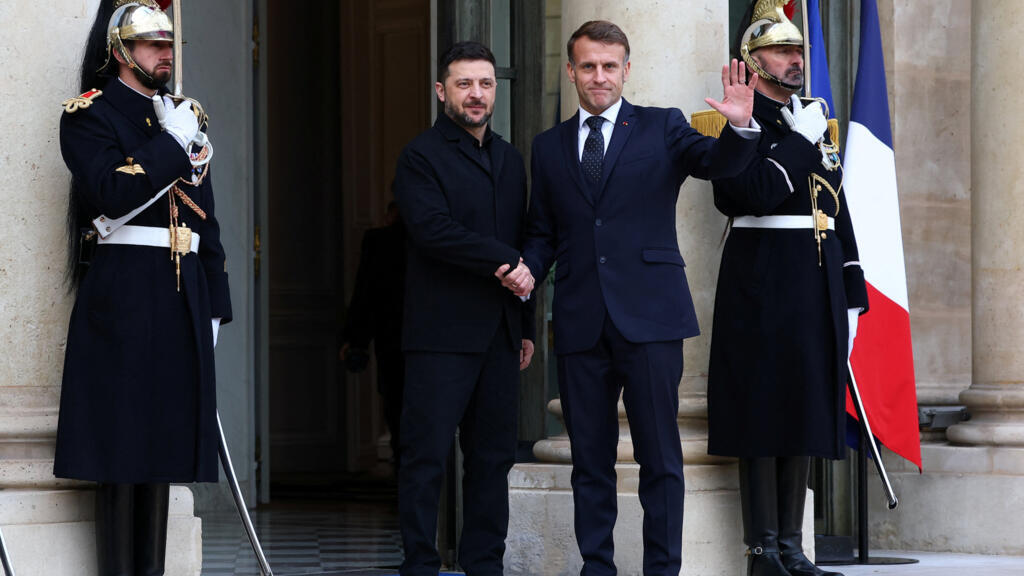
French President Emmanuel Macron said on Monday that a plan between Russia and Ukraine to end hostilities can only be finalised with the involvement of Kyiv and Europeans powers. This came as he hosted Ukrainian President Volodymyr Zelensky in Paris, as part of a diplomatic push to broker a peace deal after nearly four years of war.
President Macron said the talks with Zelensky "could be a turning point" for the future of peace in Ukraine and security in Europe.
The discussions are part of a flurry of diplomatic activity aimed at brokering the terms for a potential ceasefire in the conflict which began with Russia's invasion of Ukraine in 2022.
Zelensky's visit to Paris came on the heels of a meeting between Ukrainian and US officials in Florida on Sunday, which US Secretary of State Marco Rubio described as productive.
The two sides have worked to make revisions to Washington's initial 28-point proposal to halt the war, which was drafted without input from Ukraine's European allies.
It was criticised as being too close a reflection of Moscow's maximalist demands on Ukrainian territory.
The American proposal would have seen Kyiv withdraw from its eastern Donetsk region and the United States de facto recognise the Donetsk, Crimea and Lugansk regions as Russian.

No 'finalised plan' on territories
After talks in Geneva just over a week ago, the United States updated the original blueprint following criticism from Kyiv and Europe, but the current contents remain unclear.
"There is currently no finalised plan on the territorial issues, strictly speaking. It can only be finalised by President (Volodymyr) Zelensky," Macron said at a press conference after the talks in Paris.
For his part, Zelensky said he was expecting "a conversation with the president of the United States on key issues that are quite challenging" in the coming days.
Europe demands more work on US peace plan to end Russia-Ukraine war
He singled out the issues of territory, security guarantees, and Ukraine's reconstruction as the most important in the settlement process.
He also said that Europe must be part of the discussion on Ukraine's reconstruction.
"The issue of money, restoration, without the presence of European partners, it is not easy to accept. It is difficult because the money is in Europe, and I think this is not very fair," Zelensky said.
Tougher sanctions
Macron detailed a tougher stance on sanctions, stating that in the coming weeks, "the level of pressure on the oil and gas companies and the oil and gas industry in Russia will be in the highest since the beginning of the war."
He described this move as a potential "game changer" that aims to further weaken Russia's economy, which remains heavily reliant on energy exports.
Zelensky pushes EU to unlock €140bn in frozen Russian assets
"On the issue of frozen assets, security guarantees, accession to the European Union, and European sanctions, it can only be finalised with the Europeans at the table," Macron said.
During the talks, Macron and Zelensky also called British Prime Minister Keir Starmer, "leaders" from Germany, Poland, Italy, Norway, Finland, Denmark and the Netherlands, as well as EU chief Antonio Costa, EU Commission chief Ursula von der Leyen and NATO secretary-general Mark Rutte, the French presidency said.
Pressure on civilians
The diplomatic push comes as the war – which has killed tens of thousands of civilians and military personnel and displaced millions of Ukrainians – shows no sign of easing.
Zelensky said Russia had stepped up missile and drone strikes on his country to "break" the will of Ukrainians.
"This is serious pressure, not only psychological but also physical pressure on our population," Zelensky said.
"We need to ensure that Russia itself does not perceive anything it could consider as a reward for this war."
During November, Russia captured 701 square kilometres, the second-largest territorial advance of the war after that of November 2024 – not taking into account the initial months of the invasion, when the front line was highly mobile. This is according to the analysis of data from the US-based Institute for the Study of War (ISW) by the French news agency AFP.
(With newswires)