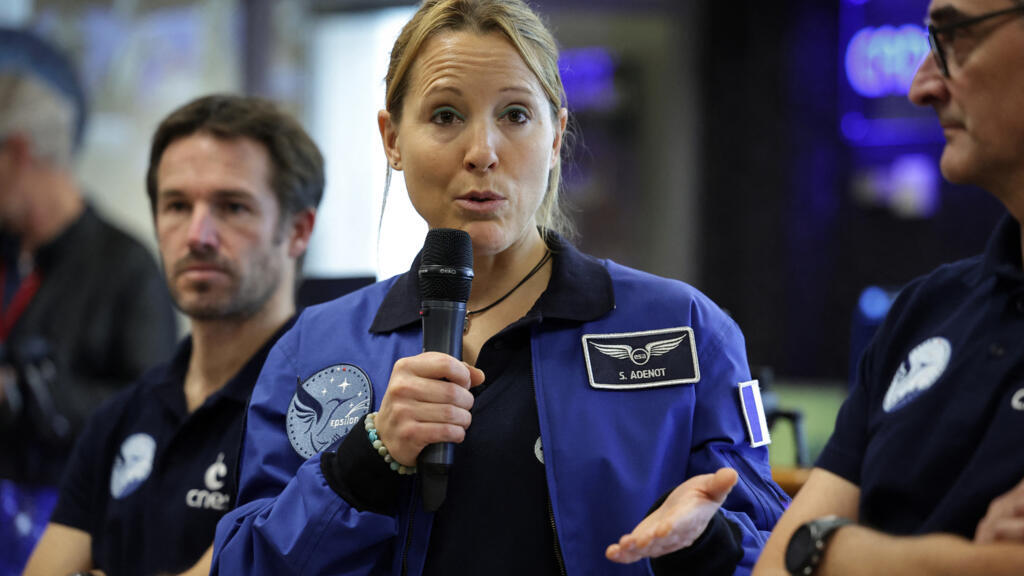
French astronaut Sophie Adenot’s first mission to the International Space Station is being brought forward and extended to nine months after an unprecedented medical evacuation forced a reshuffle of the station’s crew rota.
NASA said Adenot’s Epsilon mission, originally planned for mid-February, could now launch as early as 8 February from Florida. The space agency also confirmed the mission will last nine months instead of the usual six.

The change tightens an already packed training and launch schedule for the 43-year-old test pilot, who is part of the European Space Agency’s (ESA) astronaut corps.
NASA had previously planned the launch “no earlier than 15 February” 2026 aboard a SpaceX Crew Dragon as part of the Crew-12 mission.
After the early return of Crew-11, US planners are now studying options to move the launch forward by several days to maintain a continuous human presence on the station.
French astronaut Thomas Pesquet sets his sights on the Moon after ISS success
Extended stay
The extension to nine months makes the mission one of the longest stays ever assigned to a European astronaut on the ISS.
Adenot has said she is preparing for “a marathon, not a sprint” in microgravity, with a heavier workload of scientific experiments during the longer mission.
The changes follow the first medical evacuation in the history of the ISS, which has been continuously inhabited for more than 25 years.
Four members of NASA’s Crew-11 mission splashed down in the Pacific Ocean off San Diego after their flight was cut short by about a month because of a health problem affecting one astronaut.
NASA has not identified the crewmember or given details of the diagnosis, saying the condition is stable and that the return was a precaution to allow full medical checks on the ground.
Agency doctors cited a “lingering risk and a lingering question” around the diagnosis, leading to a carefully weighed decision rather than an emergency evacuation.

Crew reshuffle
The early departure left the ISS with just three residents and increased pressure to send Crew-12, including Adenot, to restore a full working crew.
Adenot will launch aboard a SpaceX Crew Dragon with NASA astronauts Jessica Meir and Jack Hathaway and Russian cosmonaut Andrey Fedyaev.
Meir has been named commander of the mission. Hathaway will pilot the capsule, while Adenot and Fedyaev will serve as mission specialists.
The flight will make Adenot the second Frenchwoman in space, more than 30 years after Claudie Haigneré’s missions in the 1990s. She will also be the first French astronaut to visit the ISS since Thomas Pesquet’s Alpha mission in 2021.
During her stay, Adenot is expected to oversee dozens of European and French experiments, including work on plant biology, human physiology and technology tests linked to future Moon missions under NASA’s Artemis programme.

International cooperation
Orbiting about 400 kilometres above Earth, the ISS is used for research that cannot be carried out on the ground, including studies of the human body in weightlessness.
Crews are trained for both scientific work and emergencies, including medical situations like the one that led to Crew-11’s early return.
The station is one of the last arenas of structured cooperation between the United States and Russia since the war in Ukraine, with NASA, Roscosmos, ESA, JAXA and the Canadian Space Agency all contributing modules, cargo ships and crew.
Mixed crews continue to rotate through the station, with US spacecraft carrying Russian cosmonauts and Russian Soyuz capsules still transporting NASA astronauts.
In operation since 2000, the ISS has hosted more than 200 people from around 20 countries.
NASA and its partners plan to operate it until the end of the decade, before guiding it to a controlled re-entry over the remote Pacific “spacecraft graveyard” known as Point Nemo in 2031.
(with newswires)