For several centuries, the English Channel has been the natural divide between Britain and mainland Europe. Getting across was possible only by ferry or by air, often in difficult weather conditions. In the late 20th century, Britain and France were finally linked by the 50.5-kilometre Channel Tunnel, a major engineering feat.
Get breaking news anytime, anywhere. Download the TOI app now!

This culminated on 1 December 1990, when British and French tunnelers reached each other 40 metres beneath the seabed after years of digging from opposite ends. This achievement marked the completion of a highly challenging engineering project, and today the Channel Tunnel is the only fixed link between the United Kingdom and continental Europe. The Channel Tunnel, which is often referred to as the "Chunnel," continues to ferry thousands of people annually.
A centuries-old dream finally became reality
The idea of linking Britain and France by an undersea tunnel is more than 200 years old. In 1802, French engineer Albert Mathieu proposed a tunnel beneath the English Channel, with a man-made island to ventilate it. Several other plans were proposed during the 19th and 20th centuries, but security concerns, economic problems, and technological limits repeatedly blocked construction.
In 1986, the British and French governments signed the Treaty of Canterbury to build a rail tunnel between Folkestone in Britain and Coquelles in France. The project included three parallel tunnels: two larger rail tunnels and a smaller central service tunnel for maintenance. The massive TBMs, which weighed hundreds of tonnes, bored through the chalk marl, a relatively stable rock formation.
Engineers first excavated the central service tunnel rather than the railway tunnels. This letslet them study geological conditions, verify alignment, and inject grout into weaker sections of rock before building the larger rail tunnels. The strategy significantly reduced construction risks while improving safety and accuracy.
The historic handshake beneath the sea
The greatest engineering challenge was ensuring that teams digging from opposite sides of the Channel would meet precisely beneath the English Channel. Using advanced surveying, laser guidance, and continuous geological monitoring, British and French engineers carefully calculated the alignment over tens of kilometres without being able to see one another. After nearly six years of planning and excavation, the breakthrough finally occurred on 1 December 1990.
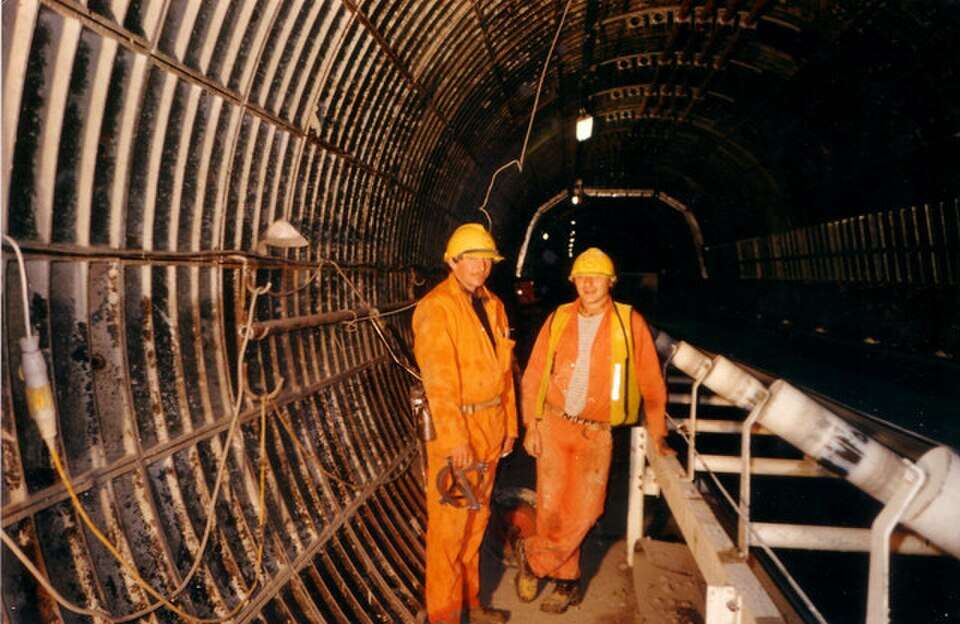
British worker Graham Fagg and French engineer Philippe Cozette were the first to meet underground after the final section separating the service tunnels was removed. The two men shook hands roughly 40 metres beneath the seabed, creating the first direct land connection between Britain and mainland Europe in around 8,000 years. Surprisingly enough, the two tunnelling groups had a misalignment of just a few centimeters when they broke through to each other from opposite ends of the Channel. The success demonstrated the precision of modern surveying and tunnelling technology.
According to MoneyWeek , construction, however, did not end with the famous handshake. Engineers still had to complete the two larger railway tunnels, install tracks, electrical systems, signalling, ventilation equipment, and comprehensive safety infrastructure before the tunnel could open to traffic.
An engineering marvel that transformed European transport
The completed Channel Tunnel stretches 50.5 kilometres, with about 37 kilometres running beneath the English Channel, making it one of the longest undersea rail tunnels ever built. The tunnel comprises two single-track railway tunnels and a central service tunnel linked by cross passages at regular intervals. The service tunnel is vital for maintenance and emergencies because it allows passenger evacuation if necessary and gives emergency and maintenance staff access.
The tunnel carries several types of traffic. Eurostar trains carry passengers from London to Paris, Brussels, and other European cities. Freight trains carry goods between Britain and Europe. In addition, LeShuttle operates shuttle trains that carry cars, coaches, and lorries through the tunnel.
As noted by HISTORY, building the tunnel required an enormous workforce. Around 13,000 workers took part in peak construction, and about 150 kilometres of tunnels were excavated between 1988 and 1991 using some of the world’s largest tunnel boring machines. Engineers also had to design ventilation, fire protection, and drainage systems capable of operating safely beneath the seabed.
Apart from its technological importance, the Channel Tunnel has significantly changed transportation and trade in Europe. The tunnel has made travel from Britain to France much quicker and provides a reliable transport route regardless of sea conditions. By digging from both ends and meeting underground, engineers created a link between Britain and mainland Europe that remains one of the world’s most remarkable rail connections.