Get all your news in one place.
100's of premium titles.
One app.
Start reading
The Conversation
The Conversation
Tesla Monson, Assistant Professor of Anthropology, Western Washington University

Fossil teeth reveal how brains developed in utero over millions of years of human evolution – new research

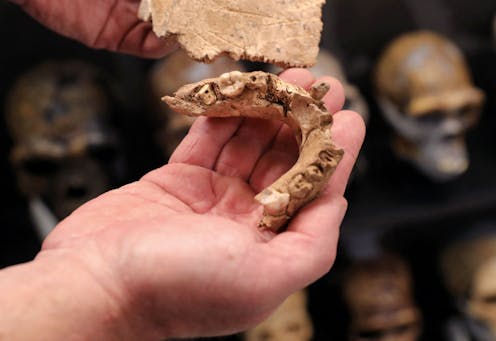
Any hominid fossil find with molar teeth can be plugged into a new equation that reveals its species' prenatal growth rate. Gil Cohen-Magen/AFP via Getty Images

Fossilized bones help tell the story of what human beings and our predecessors were doing hundreds of thousands of years ago. But how can you learn about important parts of our ancestors’ life cycle – like pregnancy or gestation – that leave no obvious trace in the fossil record?

The large brains, relative to overall body size, that are a defining characteristic of our species make pregnancy and gestation particularly interesting to paleoanthropologists like me. Homo sapiens’ big skulls contribute to our difficult labor and delivery. But the big brains inside are what let our species really take off.

Sign up to read this article
Read news from 100's of titles, curated specifically for you.
Already a member? Sign in here
Related Stories
Top stories on inkl right now
One subscription that gives you access to news from hundreds of sites
Already a member? Sign in here
Our Picks
Fourteen days free
Download the app
One app. One membership.
100+ trusted global sources.