Get all your news in one place.
100’s of premium titles.
One app.
Start reading
The Independent UK
The Independent UK
Millie Cooke

Former top judge says ban on antisemitic chants at pro-Palestine marches ‘exceptionally difficult’ to prosecute

A former top judge has said a ban on antisemitic chants at pro-Palestine marches would be “exceptionally difficult” to prosecute.

The Met Police and Manchester Police announced on Wednesday that anyone chanting controversial slogans such as “globalise the intifada” would face arrest, in the wake of the Bondi Beach terror attack and the terror attack at Heaton Park synagogue in Manchester on 2 October.

But asked whether the law allows people using those slogans to be prosecuted in court, former Supreme Court justice Lord Sumption said there are “obvious difficulties”, because in normal circumstances it is necessary to prove the intention of provoking violence against particular groups.

Speaking to BBC Radio 4’s Today programme, he said: “What the law says is that if you hold up placards with threatening, abusive or insulting words with the intention, and this is the important thing, of provoking violence against particular groups or people, that is an offence.

“It’s also an offence to use language which stirs up racial hatred. But the mere holding up of a political slogan, which is essentially what this is, wouldn’t be good enough in normal circumstances.

Former Supreme Court judge Lord Sumption says prosecution over slogans and signs will face ‘obvious difficulties’ (PA)

“I say in normal circumstances because the current circumstances are not normal ... there is an electric atmosphere about Gaza and things that would normally be acceptable may be less acceptable in current circumstances.”

He added: “I think a prosecution based on nothing more than holding up this placard would be exceptionally difficult to justify. But I’m not saying that it’s impossible.”

A former chief constable in Greater Manchester, Sir Peter Fahy, said this ambiguity makes it “extremely difficult” for police chiefs.

He explained: “A lot of this is very nuanced. It’s an intersection of public order law, the law on protest, hate crime law, sometimes even counterterrorism law. So it’s extremely complex.

“The government has made various announcements about changing some of those rules, but I don’t think they’ve been enacted. So for the officers on the front line, it is very confusing.”

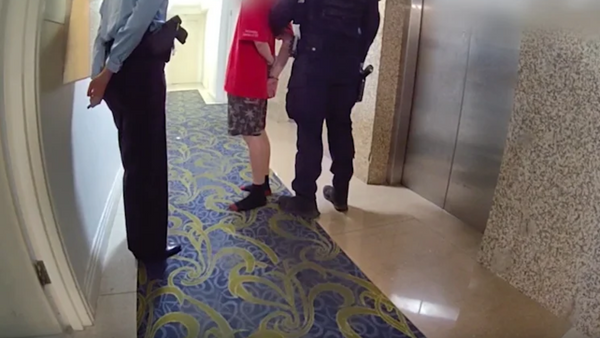
It comes after two people were arrested on Wednesday after shouting slogans calling for “intifada”, the Metropolitan Police said.

The arrests were made during a protest by pro-Palestinian demonstrators outside the Ministry of Justice in Westminster, London.

A third person was arrested for “obstructing” police as they made the first two arrests for the chanting.

The Met later confirmed two further arrests for public order offences, one of which was racially aggravated, bringing the total arrested to five.

The prime minister’s official spokesperson earlier this week said that while “free speech is an important right in this country, that can’t extend to inciting hatred or harassing others”, saying the police will use their powers “more robustly” to tackle the proliferation of antisemitism.

The arrests mark a change in approach from both the Met Police and Greater Manchester Police, who announced earlier on Wednesday that anyone chanting the controversial slogans, such as “globalise the intifada”, would face arrest.

While the move was welcomed by Jewish groups, Ben Jamal from the Palestine Solidarity Campaign said it infringes on the right to protest, describing it as “another low in the political repression of protest for Palestinian rights”.

He said the word intifada “means shaking off or uprising against injustice” and said the “implication that slogans used to support the liberation of the Palestinian people are only open to interpretation by groups who have maintained complicit support for Israel’s oppression of the Palestinian people and denial of their rights is deeply problematic”.

The American Jewish Committee describes the phrase as being “used by pro-Palestinian activists that calls for aggressive resistance against Israel and those who support Israel”.

But its meaning is contested, and protesters claim it is a call to “shake off” colonialism and for a peaceful resistance to Israel’s occupation of the West Bank and actions in Gaza.

The UK’s Chief Rabbi Sir Ephraim Mirvis welcomed the decision as “an important step towards challenging the hateful rhetoric” seen on Britain’s streets.

But the move has also been decried as political repression by campaigners.

During the pro-Palestine protest outside the Ministry of Justice building, police officers walked into the crowd of around 100 people and took individuals away to police vans.

It came after Met commissioner Sir Mark Rowley and GMP chief constable Sir Stephen Watson said circumstances have changed in the wake of the Bondi Beach mass shooting.

In a rare joint statement, they said: “We know communities are concerned about placards and chants such as ‘globalise the intifada’, and those using it at future protests or in a targeted way should expect the Met and GMP to take action.

“Violent acts have taken place, the context has changed – words have meaning and consequence.

“We will act decisively and make arrests.”

Sign up to read this article
Read news from 100’s of titles, curated specifically for you.
Already a member? Sign in here
Related Stories
Top stories on inkl right now
Our Picks
Fourteen days free
Download the app
One app. One membership.
100+ trusted global sources.