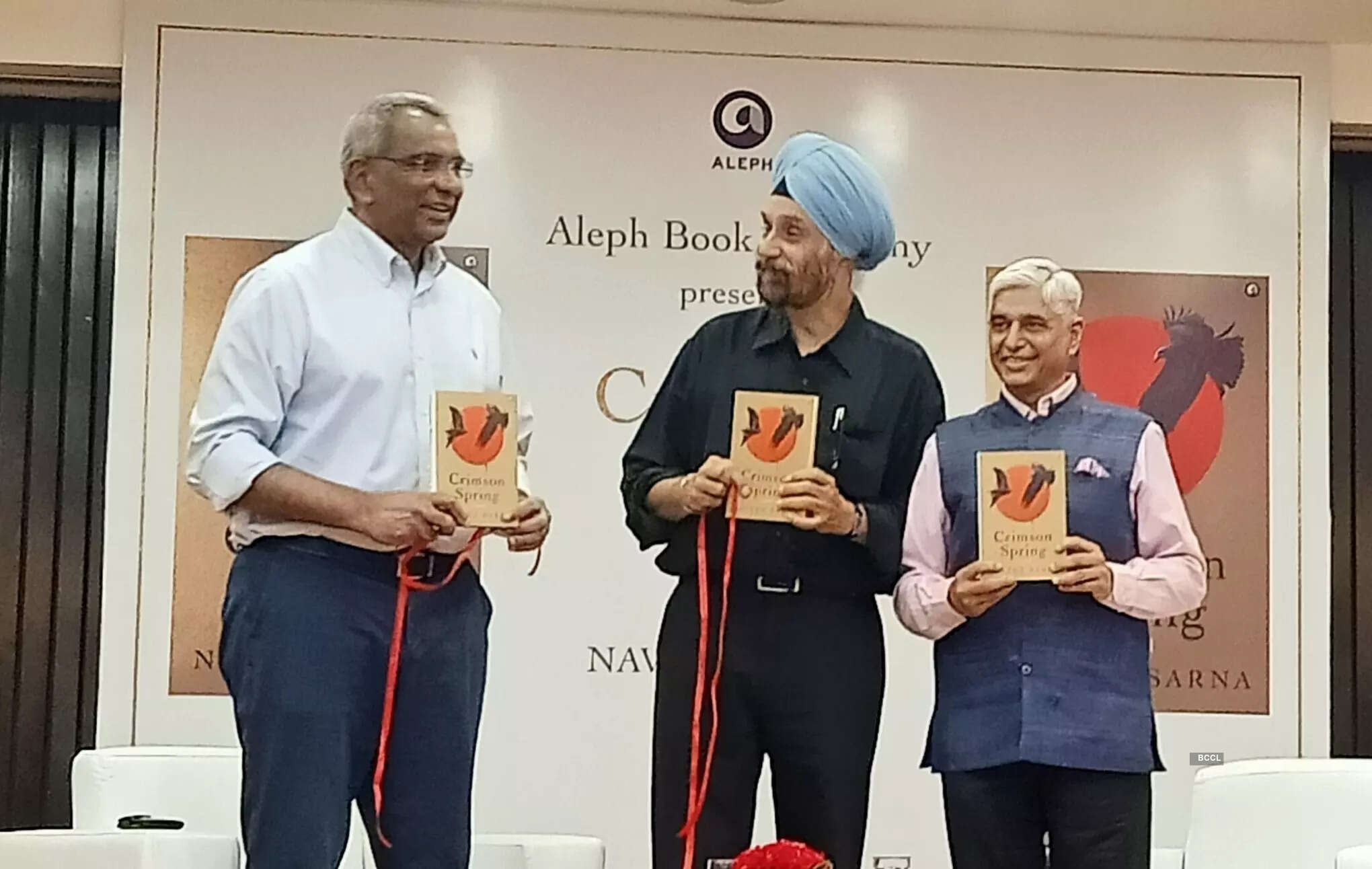
Former diplomat-turned-author Navtej Sarna's new novel 'Crimson Spring' was launched by author Vikas Swarup and publisher David Davidar in a house-full session at the India International Centre, New Delhi on July 11, 2022. Published by Aleph Book Company, 'Crimson Spring' is a historical fiction novel that retells the horrors of the Jallianwala Bagh massacre on April 13, 1919 through nine characters, including two British officers.
After launching the book, author Navtej Sarna and Vikas Swarup, also a former diplomat and author, engaged in an interesting conversation wherein they discussed the 'Crimson Spring' in detail.

Sarna mentioned that the centenary of the Jallianwala Bagh massacre in 2019 had inspired him to pen this novel. "I saw that the best way to enact this subject is to somehow make it a work of fiction, which takes Jallianwala Bagh as the center but then explores various streams that were coming into it and moving out of it. And that's how it ultimately took the shape of the novel," Sarna said. Meanwhile, it is noted that on the centenary of the Jallianwala Bagh massacre in 2019, Sarna released his book 'Khooni Vaisakhi', which is a translation of a Punjabi poem penned by his grandfather Nanak Singh about the horrific incident. Nanak Singh was one of the survivors of the massacre.
Talking about the duration of research and writing for 'Crimson Spring', Sarna said, "I wrote some passages way back in 2012 in my diary, i.e. some 10 years ago. Back then I was reading up not only about Jallianwala Bagh but everything that was happening in Punjab-- the Ghadar movement, the revolutionaries, the freedom movements. I read up on these for some seven to eight years. And the writing process took me roughly six to seven years."
Swarup then asked Sarna about the challenges of writing about historical characters as a fictional account, especially when the latter knew the facts. To this, Sarna replied, "It (historical fiction) is a very exciting area. There are people who take a historical figure and do anything they want with it... But I'm a bit old-fashioned. I think when you are dealing with actual historical characters then you can push the facts but only that much so that you don't distort (them). Because some people may only read that book about Jallianwala Bagh and think it is history. So you can't be unfair to history in that sense. (Instead) You can take more freedom in the characters. You will find that some characters in this book aren't that well-known historical characters-- because they are creatures of fiction! But there are also historical characters like General Dyer, Udham Singh, and others. You can give them a psychological and emotional dimension but stay within the broad reins of who they were. You can't take a person and totally change them if he/she is a historically well-known person..."
He further added, "Having said that, history is a kind of cut and dried subject largely because it deals with facts. And when you deal with facts and human beings, you find gaps because every human being has so much more than what was written down as facts some 100 or 150 years ago-- what his thoughts were, what his fears were, what his dark thoughts were... A novel or work of fiction allows you all those places to move around and explore."
Giving a glimpse of the novel, Sarna then read portions from his new book. He also discussed in detail some of the main characters of the book, including Maya Dei, Udham Singh and General Dyer, how they were impacted by the incident and how, in turn, it impacted the world.
The discussion was followed by a question and answer round with the audience and book signing by the author.
'Crimson Spring' is Sarna's ninth book. Some of his previous books are 'Winter Evenings', 'The Exile', 'Indians at Herod's Gate', among others.
READ MORE: