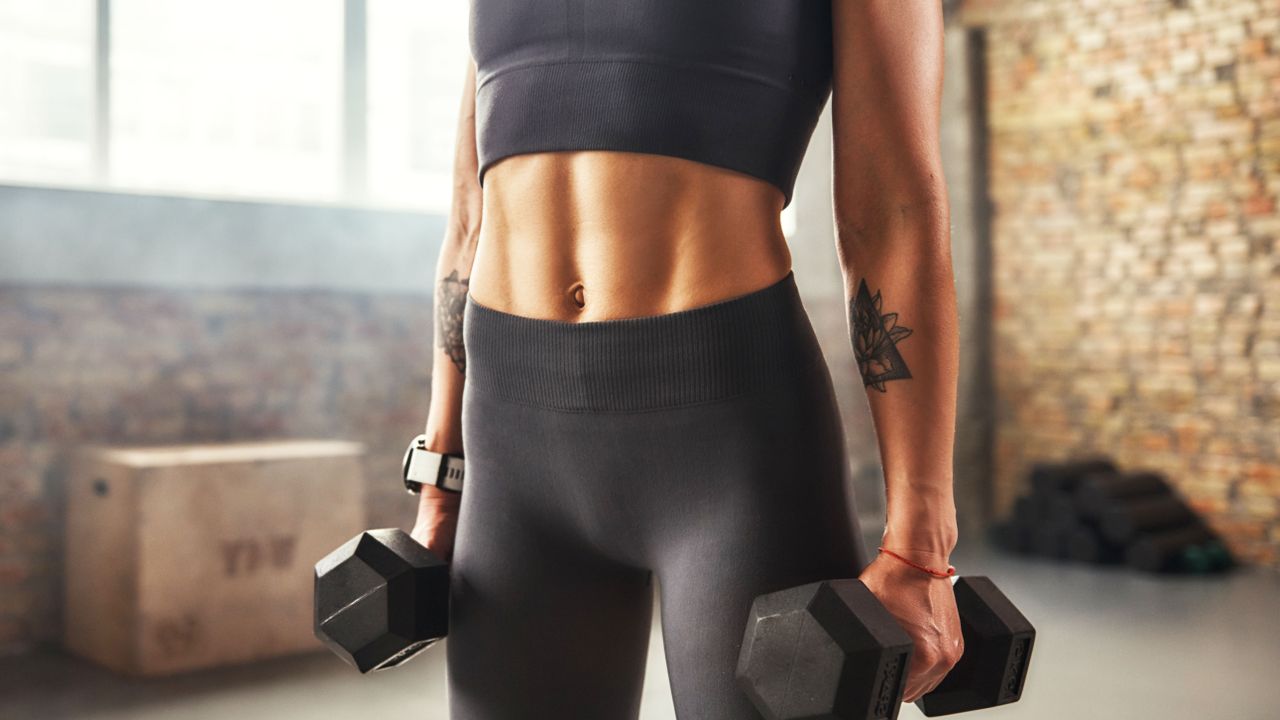
I had my first baby recently, and one of the things that shocked me most about pregnancy was how much strength I lost. Despite maintaining a regular gym routine for the entire nine-month period, I noticed huge weaknesses in my upper body and core once I started working out postpartum.
It should surprise no one that finding time to exercise with an infant has been challenging, so I’ve had to rely on at-home workouts during naps and after bedtime. As I was scrolling through YouTube for inspiration one night, I discovered certified trainer Lindsey Bomgren (aka Nourishmovelove) and her recent 25-minute standing “arms and abs” workout.
Bomgren proudly boasts “no push-ups!” in the workout’s title, and since I’ve been really struggling with push-ups post-pregnancy, omitting them was a strong selling point. So, I grabbed a pair of dumbbells and gave Bomgren’s routine a try.
How to do Lindsey Bomgren’s 25-minute standing arms and abs workout
Bomgren uses several dumbbells, ranging in weight from 15 to 25 lbs. I was more limited in my selection, so I used a set of 10 and 15lb dumbbells (and 3lb dumbbells at one point, more on that below).
The workout begins with a four-minute warm-up, followed by five supersets consisting of an arm and an abdominal exercise. The moves are done for 40 seconds with 15 seconds of rest. You’ll do each superset twice before moving on to the next round. Bomgren wraps things up with a two-minute cool down.
The moves:
- Back flye
- Single-arm row
- Lateral raises
- Dumbbell chop
- Bicep curls
- Squat + standing crunch
- Standing chest fly
- Dumbbell press out
Here’s what I thought of Bomgren’s standing arms and abs workout.
1. The warm-up was effective
I appreciate that most fitness influencers include warm-ups in their workouts, as I’ve been guilty of skipping them in the past to save time (something I’d never suggest to anyone else).
However, I usually find these warm-ups to be rather generic and not really focused on priming the right areas. Bomgren bucks that trend by selecting a few mobilization drills that effectively prep the shoulders, chest, obliques and even forearms, which are all muscle groups that put in a lot of work over the 25-minute routine.
My shoulders are notoriously tight, so taking the time to actually warm them up proved to be incredibly beneficial (who’d have thought?) I didn’t experience my usual pinches or aches, and I felt like I had a better range of motion on the flyes and raises.
If your schedule is tight, resist the urge to skip past the warm-up. It’s time well spent.
2. Bomgren gives great verbal cues and offers modifications
Silence is another trend I’ve noticed among online fitness instructors. Instead of perky banter, they’ll usually let an upbeat soundtrack do all of the motivating.
I don’t necessarily mind it, but that’s because I already know how to do most exercises. If I was a beginner, I’d probably spend a lot of time staring at the screen trying to mimic the instructor, risking a potential injury.
Bomgren not only provides excellent verbal cues throughout the workout, she also includes a second instructor that performs modified versions of the exercises. Even though I was familiar with all of the movements, there were a few instances where her cues got me to self-correct my form.
The inclusion of verbal cues and modifications makes this workout accessible to a much wider range of people. I may skip it if you’re a total newbie or have certain mobility issues, but it should be doable for most fitness levels.
3. I dropped to a lighter weight
Bomgren notes that exercises like lateral raises can be challenging because “the further the weight is from the body, the harder the move is.”
Because the flyes and the lateral raises were programmed back-to-back, I started to fatigue before I reached the end of the second superset. My neck was tightening up and my shoulders were toast, so I had to drop my 10lb weight and pick up my only lighter alternative — 3lb dumbbells.
I thought that might be too light, but I could definitely feel the burn by the time the superset was over. You might want to have a few lighter dumbbell options available in case the same happens to you.
4. I liked repeating the supersets
There are plenty of “no repeat” workouts on YouTube that promise to keep things fresh and interesting.
To be honest, I don’t mind when workouts repeat exercises. I thought performing the supersets twice was a perfect amount, since I “learned” the moves in the first round and then “perfected” them in the second. I also felt that performing them twice really allowed me to reach muscle fatigue, which is something I don’t ever really feel when doing a “no-repeats” workout.
Even if you get bored easily, this workout keeps things moving and doesn’t feel excessively repetitive.

Follow Tom's Guide on Google News and add us as a preferred source to get our up-to-date news, analysis, and reviews in your feeds.