
Get all your news in one place.
100's of premium titles.
One app.
Start reading
The Economic Times
The Economic Times
Neelanjit Das

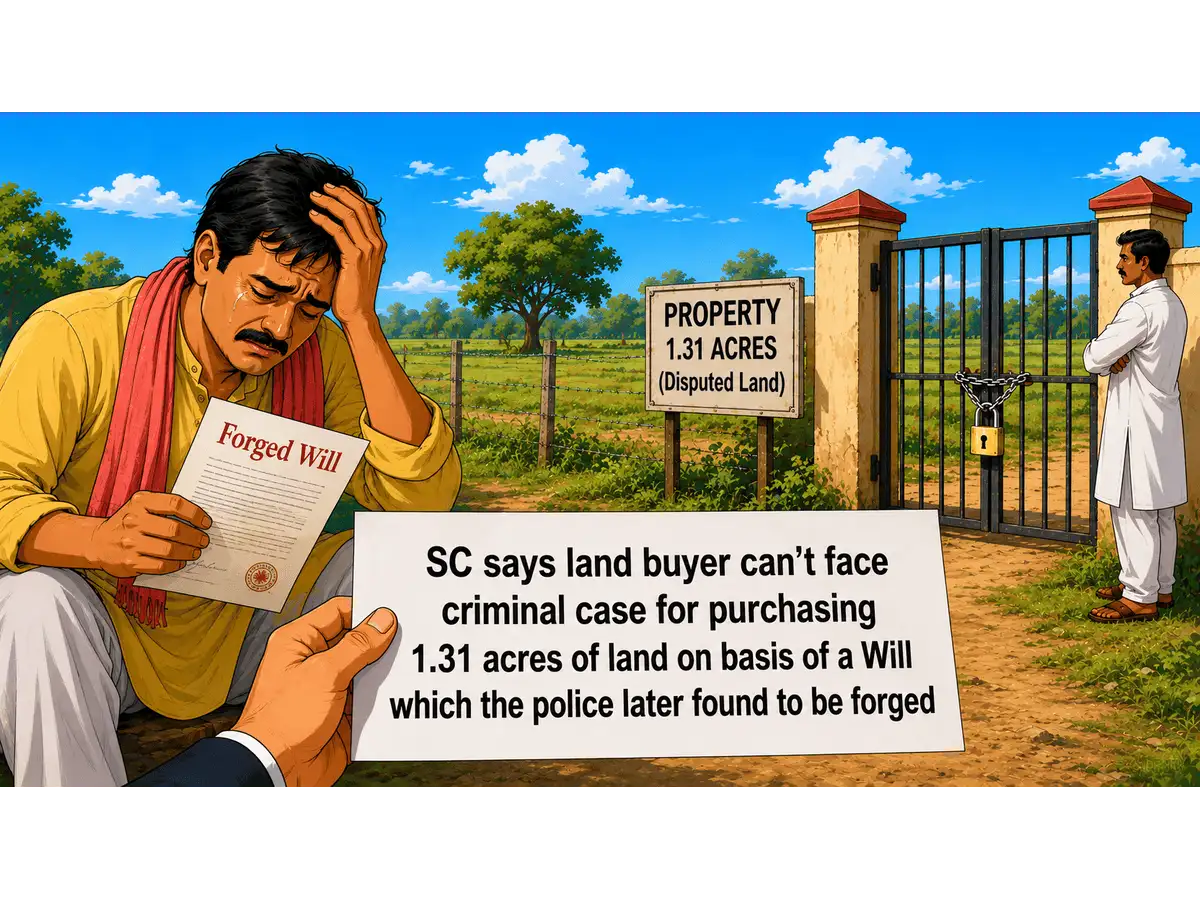
Forged Will row: Buyer should not face criminal case for purchasing land on the basis of Will which police found to be forged; rules SC

When Mr Anand bought 1.31 acres of land from a family, he had no clue that the seller had conspired with a lawyer and other family members to create a fake Will, which was used to sell him the land. But, once the rest of the family found out about this forgery, they filed a police report and an FIR was lodged, pulling him into this criminal case as well.

On April 21, 2026, the Supreme Court stepped in and ruled that a buyer who purchases property based on a Will that turns out to be forged later cannot be held responsible for any criminal charges stemming from the fraudulent sale deed executed by the vendor.

Background of the land and the forged Will

When Ayyasamy Nadar died on September 19, 1988, one of his sons (lets call him Mr B) went to the Karur Police Station and claimed that Nadar had executed a partition deed on December 2, 1959, which allocated the land and properties to him and after his death, his legal heirs inherited them. Balakrishnan, who was Ayyasamy Nadar's first son and Mr B's elder brother, died in 1987.

However, when B tried to transfer the patta for these lands which he claimed his father gave him via the 1959 partition deed, his mother objected. She even took her objections to the Divisional Revenue Officer of Karur, who ordered an inquiry.

During this inquiry, B got to know that his father had also executed a Will on September 12, 1988. B felt confused as this Will was seen to be executed on September 12 while his father died on September 19 and for one month before his death, he was in a comatose condition. B suspected the Will to be forged by his brothers and others for getting the land, which he contended was given to him by his father via the partition deed of 1959.

The inquiry also found that about six years before B's complaint, five people had approached him and his family with an offer to purchase the property at a very low price, which was rejected outright.

Now, B alleged that his brother Raja had joined hands with these five persons (A2 to A6) and got hold of the attesting witnesses to create a fabricated Will and on its basis, sold the property measuring about 1.31 acres, to A-2 to A-6 by sale deed dated December 18, 1998.

Also read: Probate granted to Will but criminal court finds the Will to be forged: Affected party can apply for revocation of probate

When B saw that his claimed lands were sold to these five individuals based on the suspected forged Will, he went to the Karur Police Station and filed a FIR (Criminal). The police immediately started investigating the case.

Once the investigation wrapped up, the police filed a report under Section 173(2) CrPC before the relevant Court, determining that the accused had committed offences punishable under Sections 467, 468, 471, and 420 IPC read with Section 120-B IPC. The case was officially registered as C.C. No.419 of 2018 by the Judicial Magistrate No.II of Karur.

The Investigating Officer concluded in the final report that A-1 to A-9, following a criminal conspiracy, created the forged Will dated September 12, 1988, and presented it as a genuine document for executing the sale deeds in favour of A2 to A-6.

A-7 was an advocate practising in Karur, whereas A-8 and A-9 were stated to be the clients of A-7. The conspiracy was allegedly hatched in the office of A-7, where the forged Will was created. It was also alleged that, on A-7's instruction, A-8 and A-9 witnessed the forged Will.

Also read: Son challenges late father’s Will giving property to aunt and late grandmother; wins case in HC as court allows Will forgery probe to continue

After the police submitted the charge-sheet, A-3 and A-6 approached the Madras High Court, filing separate petitions under Section 482 CrPC seeking quashing of the proceedings pending before the trial Court. They argued that they were bona fide buyers for consideration.

Their argument was that before entering the registered transaction for buying the land in question, they had verified A-1's possession and title and then went ahead with the purchase.

A-6, i.e., the appellant in this case, claimed that he was about 25 years of age in 1998, when the sale deed was executed; that he had been studying in Australia, and had no involvement or knowledge about the alleged forgery in the Will.

The High Court held that the issues raised in the petition involved disputed questions of fact and that the extreme step of quashing the criminal proceedings was not justified given the facts and circumstances of the case. Accordingly, the quashing petition filed under Section 482 CrPC was dismissed by the High Court through a final order dated August 11, 2022.

Unhappy with the decision, A6 filed an appeal in the Supreme Court and won the case on April 21, 2026.

Why did the land buyer succeed before the Supreme Court?

Asha Kiran Sharma, Partner, King Stubb and Kasiva, said to ET Wealth Online that the Supreme Court intervened because the case against the buyer did not satisfy the fundamental ingredients of criminal liability.

Sharma says that while the Madras High Court had taken the view that the matter involved disputed questions of fact requiring trial, the Supreme Court adopted a stricter legal lens and examined whether, even if the prosecution’s case was accepted at face value, any offence was made out against the buyer. It found a complete absence of material linking him to the alleged forgery or conspiracy.

The buyer was merely a purchaser under a registered sale deed, who had paid consideration after verifying the seller’s possession and title. Crucially, there was no evidence to suggest that he had knowledge of the forged Will or had participated in its fabrication.

The Supreme Court also noted that at the relevant time he was a young student studying in Australia, which further weakened any inference of involvement in a conspiracy.

Importantly, Sharma says that the Supreme Court clarified that offences such as cheating require fraudulent inducement of the complainant, which was entirely missing in this case since there was no direct dealing between the buyer and the complainant. In fact, the Court went a step further to observe that if the Will were indeed forged, the buyer himself would be a victim of the fraud rather than a perpetrator.

Sharma says: "On this reasoning, the continuation of criminal proceedings against him was held to be an abuse of process and was accordingly quashed."

If a buyer ends up benefiting from a transaction rooted in fraud, does that make him part of the fraud?

Shraddha Nileshwar, Head - Will & Estate Planning at 1 Finance, said to ET Wealth Online that the Supreme Court held that criminal liability requires proof that the buyer had knowledge of the forgery or actively participated in the conspiracy. Being a downstream beneficiary is not sufficient.

The Court found no material linking the buyer to the forged Will and, relying on Mohammed Ibrahim v. State of Bihar (2009), reaffirmed that a purchaser cannot be accused of cheating the original title-holder. If anything, it is the buyer who is defrauded when a seller misrepresents title.

However, the reality is harsher. Nileshwar says that Indian investigative agencies frequently array all connected parties as accused in property fraud cases and leave it to the courts to eventually sift between the innocent from the guilty.

Nileshwar says: "A bona fide buyer can spend years, as happened here over two decades, entangled in criminal proceedings before getting relief."

Supreme Court order and discussion

The Supreme Court said that the land buyer did not have any idea about the Will which the police later found to be forged and was also in Australia during this time.

As reported by Livelaw, the Court said that in such a scenario of fraudulent transfer of property, the buyer cannot be called as accused, as they "would be the persons aggrieved because in such circumstances, their title over the property in question would land in dispute, having been acquired from the vendor who used the so called fabricated will to execute the registered sale deeds."

The Supreme Court said that when any incriminating material evidence is not found linking the buyer (A6) to the Will forgery or conspiracy, he can't face criminal action.

The Supreme Court said that A6 being a purchaser of the property for a valuable consideration, cannot, in the present case, be considered to be the person who offered fraudulent inducement to Mr B (complainant) or made him deliver some property or part with valuable security so as to bring his acts within the purview of fraudulent inducement and cheating to gain property punishable under Section 420 IPC [corresponding Section 318(4) of the Bharatiya Nyaya Sanhita, 2023].

The Supreme Court said that admittedly, there is no privity of contract between the A6 and Mr B (complainant). Neither the FIR nor the impugned order discloses availability of any tangible material to substantiate the allegation that the appellant had conspired in the preparation of the alleged forged Will, or that he executed the registered sale deed dated 18th December, 1998 knowing that the signatures on the Will were forged.

So, on this ground, the criminal case against A6 was dropped. However, the Supreme Court made clear that the proceedings shall continue against the other accused persons.

Sign up to read this article
Read news from 100's of titles, curated specifically for you.
Already a member? Sign in here
Related Stories
Top stories on inkl right now
One subscription that gives you access to news from hundreds of sites
Already a member? Sign in here
Our Picks
Fourteen days free
Download the app
One app. One membership.
100+ trusted global sources.






