
Get all your news in one place.
100's of premium titles.
One app.
Start reading
The Conversation
The Conversation
Christopher R. Moore, Research Professor and Director of the Southeastern Paleoamerican Survey (SEPAS) at the South Carolina Institute for Archaeology and Anthropology, University of South Carolina

Forensic evidence suggests Paleo-Americans hunted mastodons, mammoths and other megafauna in eastern North America 13,000 years ago

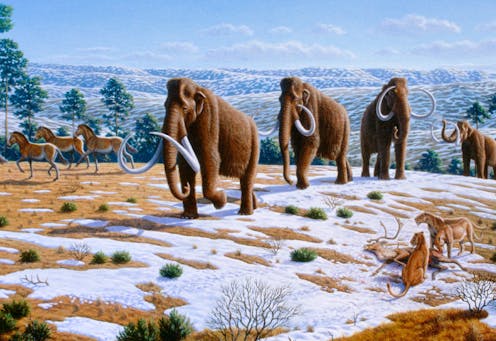
Animals that shared the landscape with humans disappeared as the ice age ended. Mauricio Antón/Wikimedia Commons, CC BY

The earliest people who lived in North America shared the landscape with huge animals. On any day these hunter-gatherers might encounter a giant, snarling saber-toothed cat ready to pounce, or a group of elephantlike mammoths stripping tree branches. Maybe a herd of giant bison would stampede past.

Obviously, you can’t see any of these ice age megafauna now. They’ve all been extinct for about 12,800 years. Mammoths, mastodons, huge bison, horses, camels, very large ground sloths and giant short-faced bears all died out as the huge continental ice sheets disappeared at the end of the ice age. What happened to them?

Sign up to read this article
Read news from 100's of titles, curated specifically for you.
Already a member? Sign in here
Related Stories
Top stories on inkl right now
One subscription that gives you access to news from hundreds of sites
Already a member? Sign in here
Our Picks
Fourteen days free
Download the app
One app. One membership.
100+ trusted global sources.







