Get all your news in one place.
100's of premium titles.
One app.
Start reading
The Conversation
The Conversation
Barbara Catinella, Professor and Senior Principal Research Fellow, International Centre for Radio Astronomy Research (ICRAR), The University of Western Australia

For making stars, it’s not just how much gas a galaxy has that matters – it’s where it’s hiding

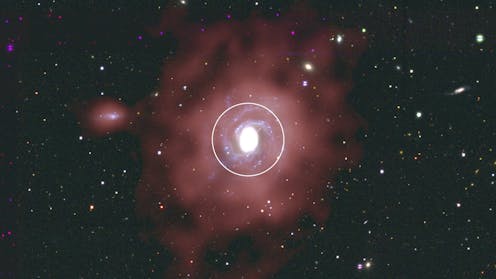
One of the galaxies mapped by WALLABY: the red shade shows the atomic hydrogen gas content of the galaxy, overlaid on an optical image showing the stars. Much of it is typically found beyond the stellar disk (thin white line), where star formation takes place. Legacy Surveys / D. Lang (Perimeter Institute) / T. Westmeier

Galaxies are often described as vast star factories, churning out new suns from clouds of gas. For decades, astronomers have assumed that the more raw material a galaxy holds, the more stars it should be able to make.

But our latest study, published this month in the Publications of the Astronomical Society of Australia (PASA), challenges that assumption. We found that when it comes to forming stars, it’s not just the amount of gas in a galaxy that matters – it’s where that gas is located.

Sign up to read this article
Read news from 100's of titles, curated specifically for you.
Already a member? Sign in here
Related Stories
Top stories on inkl right now
One subscription that gives you access to news from hundreds of sites
Already a member? Sign in here
Our Picks
Fourteen days free
Download the app
One app. One membership.
100+ trusted global sources.