Get all your news in one place.
100's of premium titles.
One app.
Start reading
The Conversation
The Conversation
Environment
Isabella Reeves, PhD Candidate, Flinders University

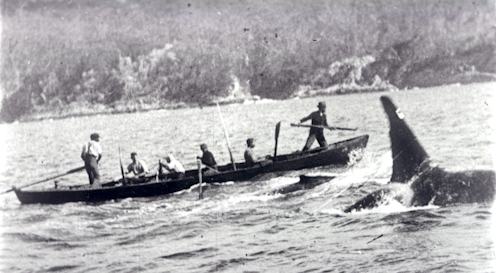
For generations, killer whales and First Nations hunted whales together. Now we suspect the orca group has gone extinct

Whalers and Old Tom on the hunt Charles Eden Wellings/WIkimedia Commons, CC BY-SA

For generations, the Thaua people worked with killer whales to hunt large whales in the water of Twofold Bay, on the southern coast of New South Wales. Killer whales – commonly known as orcas – would herd their giant prey into shallower waters where hunters could spear them. Humans would get the meat, but the killer whales wanted a delicacy – the tongue.

After colonists dispossessed the Thaua, Europeans began capitalising on this longstanding partnership. From around 1844, commercial whalers worked with employed Thaua and killer whales to hunt these giants. The pods of killer whales would find a prized baleen whale, herd it closer to shore and signal the whalers, who lived in the town of Eden.

Sign up to read this article
Read news from 100's of titles, curated specifically for you.
Already a member? Sign in here
Related Stories
Top stories on inkl right now
One subscription that gives you access to news from hundreds of sites
Already a member? Sign in here
Our Picks
Fourteen days free
Download the app
One app. One membership.
100+ trusted global sources.