Get all your news in one place.
100's of premium titles.
One app.
Start reading
Newslaundry
Newslaundry
National
Kalpana Sharma

Fog of war or media smokescreen? When truth became a casualty in the Iran vs US-Israel conflict

The unprovoked attack by Israel and the US on Iran that began on February 28 shows no signs of abating at the time of writing. Instead, it has sucked the entire world into a time of uncertainty.


In this “fog of war”, the biggest crisis, as always, is reliable information. In India, we have experienced this several times, most recently when the government launched attacks on our neighbour Pakistan in May last year with Operation Sindoor. There are no independent sources of information. So, the media basically becomes a megaphone for whatever the government wants to convey.  

Any questioning is considered “anti-national”, and this democratic country has laws to deal with such people. Hence, even if there is no direct censorship, the media, especially television news, resorts to self-censorship at best or becomes part of the band of cheerleaders at worst, not just amplifying what the government wants conveyed but also dramatising and exaggerating it. 

In the current conflict in West Asia, the media is facing a greater challenge, especially Western media, as I wrote in my last column. It has a few reporters on the ground in Iran. It relies on other “sources” and casts doubt in different ways on any official pronouncement coming out of Iran.

In contrast, we are led to believe that reports on the destruction in Israel caused by Iranian missiles and drones are factual.

This article in Columbia Journalism Review gives us a different picture. It is particularly interesting because it reflects much of what is happening in the media in India, even when the country is not at war.

According to this article, Israeli military censors control all information coming out of that country. There is pre-censorship of reports about operations conducted by the Israeli military. And the media is expected to report only what is officially conveyed by the Israeli military command.

Here is one example of censorship that might seem obvious until you think about it: 

“The censor doesn’t acknowledge what it has censored but, at times, an observer can make educated guesses about the censor’s work. Take, for example, this piece published by Walla, an Israeli outlet, in August of 2025, during an earlier round of conflict with Iran. The article states that Prime Minister Benjamin Netanyahu’s office at the Kirya, a military headquarters in Tel Aviv, is unusable and requires renovations. The article mysteriously does not state what caused its sudden deterioration.”

The author also cites a 2024 analysis of Israeli media and reports that of around 20,000 articles submitted to Israeli censors, 1,600 were banned and 6,000 were partially censored.

Much like India, there is widespread self-censorship in the country’s media.  According to Gideon Levy, a columnist with the newspaper Haaretz and a critic of Israeli PM Netanyahu, most journalists are obeying the rules. 

To quote from the CJR article:

“Levy told me that military censorship has never been as effective in pushing the government line as the Israeli press’s self-censorship. ‘They are really serving like the PR people of the army,’ Levy said of Israeli journalists. These days, the fact that any piece of reporting was approved by the censor is presented ‘as if it’s a source of pride,’ he observed. ‘Which is pathetic.’ This form of self-censorship reached a peak, Levy said, during the war in Gaza. ‘You couldn’t see anything from Gaza in the Israeli media. Not the children, not the suffering. Nothing. They just didn’t cover Gaza.’ But ‘nobody asked the media not to show it’.”

That last sentence is the most troubling. When the media chooses not to show even that which it has not been specifically asked to show, and surely, in India, we can think of many parallels, as I have repeatedly highlighted in this space.

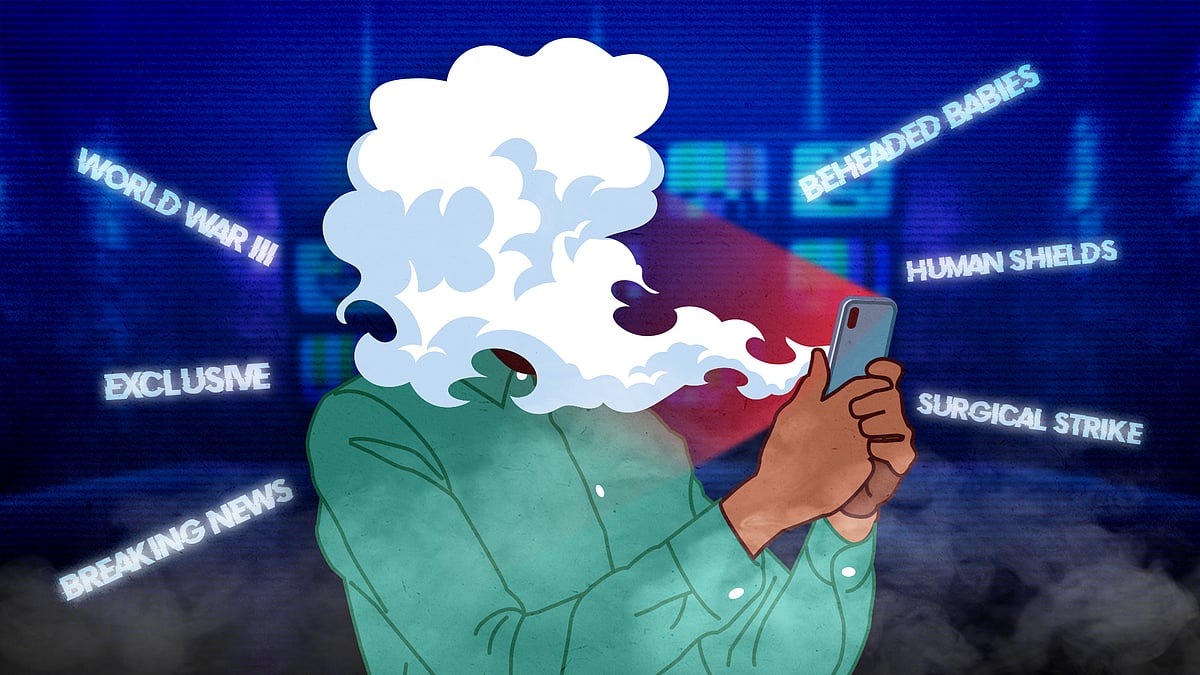
We are burdened today with an overload of information, not least because US President Donald Trump has mastered the art of always being in the news.  If he is not speaking to the media directly, he is posting on his social media platform, Truth Social.

The latest announcement of a five-day ‘pause’ in the war (although there was no ‘pause’ either of Israel striking places in Iran and continuing its efforts to eliminate Iran’s leadership, or of the Iranians hitting back) is a case in point. The media here and around the world have focused almost entirely on his post: Are the Iranians negotiating with the US, even though they say they are not? Or are the Americans bluffing? 

The average reader is left perplexed and essentially uninformed. Who do you believe? A president who uses social media to make important official announcements? Or the Iranians, whose announcements come from official platforms and who insist they are not negotiating with the US? And given the reality of censorship in Israel and Iran, how do you assess the extent of the damage in both countries during this war?  

A surprising admission during this time of misinformation overload came from Shashank Joshi, the defence editor of The Economist, a conservative magazine not known for sensationalism.

In a post on X, Joshi admitted that the story that Hamas had beheaded children during the attack on Israel on October 7, 2023, was not verified. 

He wrote: “Some of these reports have turned out to be untrue, and yes, I was wrong to be as confident in what was reported as first-hand evidence as I was, particularly given the fog of war in those initial post Oct 7th days.” 

And yet not only did The Economist carry the story, but many other Western media outlets did as well. It’s a story that refuses to die, with most recently Trump, in the context of the war on Iran, repeating that they (meaning the Iranians) beheaded babies. 

Stories like the one about Hamas beheading babies linger because the media that reported such a story do not bother to ensure that the verified version, which puts a lie to this claim, gets as much prominence. If the Western media, which makes such a big deal about publishing only “verified” news, had done due diligence in the immediate aftermath of October 7, surely such a false and terrible story would not have continued doing the rounds.

Unfortunately, the belated mea culpa by The Economist does not alter the damage that has already been done, as this false story has fed into the Islamophobia that continues to prevail around the world.  

5 elections. 2 independent newsrooms. Zero corporate ads. Support our ground reports from the 2026 Assembly polls. Click here to contribute.

Newslaundry is a reader-supported, ad-free, independent news outlet based out of New Delhi. Support their journalism, here.

Sign up to read this article
Read news from 100's of titles, curated specifically for you.
Already a member? Sign in here
Related Stories
Top stories on inkl right now
One subscription that gives you access to news from hundreds of sites
Already a member? Sign in here
Our Picks
Fourteen days free
Download the app
One app. One membership.
100+ trusted global sources.