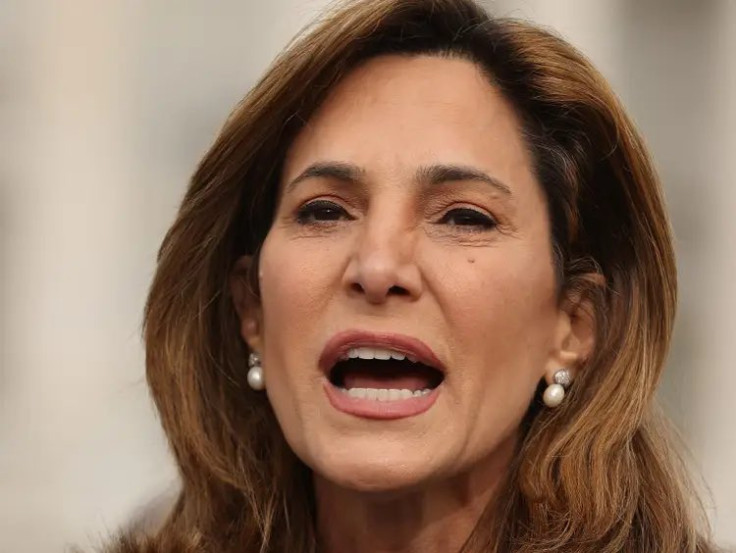
Rep. María Elvira Salazar has spent years building her political identity as a Republican voice for Miami's immigrant communities, a defender of tougher border enforcement and one of Donald Trump's strongest allies among Hispanic voters. But now she is delivering a message that few elected Republicans have been willing to make so directly: the president's immigration strategy may have gone too far.
The unusual part of Salazar's break with Trump is not only the criticism itself. It is how carefully she has framed it.

In a bilingual campaign advertisement recorded outside the White House, Salazar speaks directly to Trump:
"Mr. President, some of your immigration enforcement efforts have gone too far."
She then warns him that "the same Hispanics who helped you get to the White House in 2024 feel betrayed today."
But Salazar also avoids making Trump the sole target. Instead, she tells him: "Be careful what your advisers are telling you about immigration policy." That distinction is the center of her political strategy: challenge the policy while preserving the possibility that Trump himself can change course, and of course, not alienate her MAGA voters.
¡EL DURO MENSAJE DE MARIA ELVIRA A TRUMP!
— apolitiKO | YouTube (@apolitikoyt) September 17, 2026
"Sr. President, algunos de sus esfuerzos de aplicación de la inmigración han ido demasiado lejos....Los mismos hispanos que le ayudaron a llegar a la Casa Blanca en 2024 se sienten traicionados hoy" pic.twitter.com/d4CheQNhtU
Salazar represents Florida's 27th Congressional District, a Miami-area district where Hispanic voters are central to Republican electoral strength. The area includes large Cuban, Venezuelan, and other Latin American communities, many of whom have historically prioritized issues such as communism, economic opportunity, public safety, and immigration.
Trump's gains among Hispanic voters, particularly in South Florida, transformed the region's political landscape. Miami-Dade County, once considered a Democratic stronghold, shifted sharply toward Republicans in recent presidential elections.
However, the latest ICE operations in the city, the White House decisions on Venezuela and Cuba, and the detention by immigration agents of Luis Galeano, a Nicaraguan journalist attacked by the Daniel Ortega regime, have eroded the support for the Republican party.
That political reality explains why Salazar's message focuses less on opposing enforcement and more on the consequences of how enforcement is carried out.
Salazar's warning comes as Republicans confront signs that their recent gains with Latino voters may be facing new pressure.
Her public criticism of Donald Trump's immigration strategy comes as she prepares for a reelection fight against Democrat Eliott Rodriguez, a familiar face in South Florida politics who is attempting to turn the district's changing Latino electorate into an opportunity for Democrats. Rodriguez, a longtime Miami television journalist and former news anchor, is challenging Salazar for Florida's 27th Congressional District, a heavily Hispanic seat that includes areas such as Little Havana, Westchester and parts of southern Miami.
A Hart Research/TelevisaUnivision poll of Latino voters in 17 competitive House districts found Democrats recovering ground after Trump's historic gains in 2024, with 58% of respondents supporting Democratic congressional candidates compared with 35% supporting Republicans. The survey also found that 11% of Latino voters who said they backed Trump in 2024 had shifted toward Democratic candidates, although the economy remained a larger concern than immigration for many voters.
In Florida, where Trump made some of his biggest gains among Hispanic voters, polling has also shown a more complicated picture: a UnidosUS survey found Trump's approval among Florida Hispanic voters at 44%, higher than his standing among Latinos nationally but still underwater, with 51% disapproving of his performance.
The stakes are particularly high in Miami-Dade, where Hispanics make up roughly 62% of registered voters and 76% of registered Republicans, making Latino support essential to the GOP coalition in the county. For Salazar, the immigration debate is therefore not only about policy but about protecting a Republican coalition built among Cuban, Venezuelan and other Latino voters who helped move South Florida toward the GOP in recent elections.