Get all your news in one place.
100's of premium titles.
One app.
Start reading
The Times of India
The Times of India
World
TOI World Desk

Floating Amazon Forest Islands: Study reveals how matupás sustain life; local knowledge shapes science

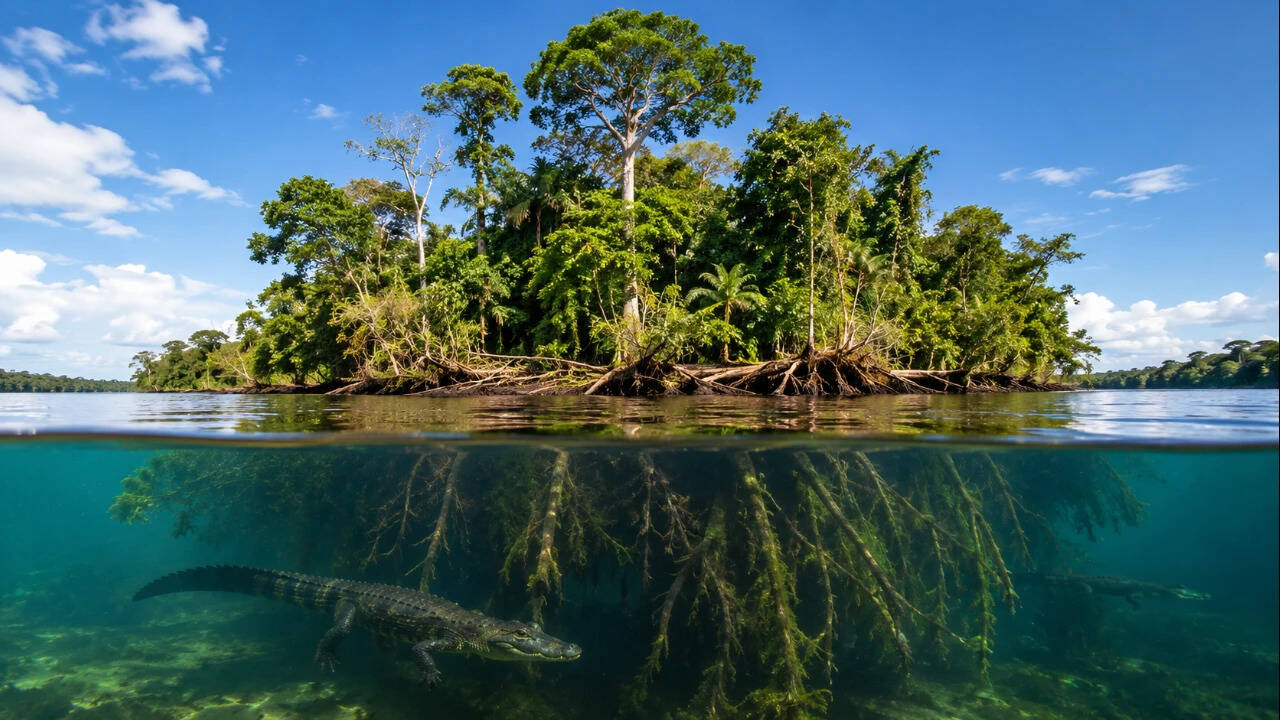
In the flooded lakes of the Brazilian Amazon, some rainforest islands have spent their entire lives floating. The trees, which may grow up to 12 meters (about 39 feet) tall, have their root system firmly established in a raft of vegetation that is about 3 meters (approximately 10 feet) deep and floats on the water surface below. Matupás are considered to be important fishing grounds by local communities due to the presence of arapaima, one of the largest freshwater fish species. The local inhabitants also appreciate the fertile soil on the islands, which can be utilized for gardening or growing crops, an idea which had not been documented in the scientific literature until 2015.

Get breaking news anytime, anywhere. Download the TOI app now!

Scientists in Brazil released a peer-reviewed paper in the journal PLOS ONE in 2015 about the matupa, or Amazon’s floating forests, which had not been studied scientifically enough before. Instead of depending solely on aerial photographs and occasional trips to the islands, the scientists chose to go to the people who had been studying these islands since birth, the riverbank communities.

Matupás form from decades of accumulated vegetation

A matupá starts off merely as a collection of aquatic plants entwining themselves and floating on top of the lake surface in the floodplain. However, as time goes by, through decades, this entanglement starts to accumulate sediment and decomposed organic matter, forming a substrate thick enough to allow more complex forms of vegetation to develop from the simpler forms such as grasses and herbs to bushes and finally to complete trees. These islands are able to grow into several hectares in size, with a root ball as deep as 3 meters or 10 feet thick and a forest canopy as high as 12 meters or 40 feet high. Since the whole system is buoyant and not anchored to the lake bed, a matupá rises and falls with the water level, rather than drying out or fully flooding.

Where matupás grow in the Amazon basin

This type of island is seen in the várzea lakes, which are the nutrient-rich floodplains formed by the white-water rivers carrying sediments from the Andes. It is the flow of such sediments that ensures the fertility of the várzea ecosystems and is also responsible for ensuring that matupás can create the necessary organic substratum required for the trees to grow. The study of this kind was conducted at the Reserve of Sustainable Development of Amanã in the state of Amazonas, where matupás are a familiar element of the environment, as shown by the research published in PLOS ONE in 2015.

Researchers interviewed 45 residents across five communities

The research centered on semi-structured interviews with 45 residents across five riverine villages within the Amanã Sustainable Development Reserve. Drawing on residents' extensive firsthand experience, the researchers traced how matupás form, which species live on them, and why they matter to the surrounding communities.

Residents report caimans using the islands as nesting ground

One of the most interesting facts that emerged from this survey was the extent to which local wildlife has adapted to the floating islands. Residents described caimans nesting directly on the floating vegetation, since a mature matupá's buoyancy keeps their eggs safe from the flooding that would otherwise submerge a nest on the lakebed.

The matupás offer the local population more than just wildlife habitat. Community members regularly dig up the islands' decomposed organic soil for their vegetable patches, with some of the larger, more established matupás sturdy enough to grow crops directly on their surfaces.

Local folklore ties the islands to a giant anaconda

The matupás also have cultural significance apart from ecological significance among the communities where research was carried out. Some people associate the islands with the story of the cobra grande, an anaconda believed to be living under the waters of the islands, which is locally revered as the spirit protector of the rivers and lakes and considered the mother of the waters. Regardless of whether the islands created this legend or not, it goes to show the extent to which the matupás have become significant within the context of these communities.

A landscape hidden in plain sight

Though matupás are significant not only for their sheer size but also due to their important role in nature, very little scientific research had been conducted prior to the study in question; this was due to the difficulty associated with investigating them, both through traditional fieldwork and their patchy distribution in distant lakes. As a result of drawing on the riverside communities' knowledge as scientific data, the researchers were able to build a much clearer picture of the life cycle of these floating forests, which spend most of the year adrift on the floodplain's rising and falling waters.

Sign up to read this article
Read news from 100's of titles, curated specifically for you.
Already a member? Sign in here
Related Stories
Top stories on inkl right now
One subscription that gives you access to news from hundreds of sites
Already a member? Sign in here
Our Picks
Fourteen days free
Download the app
One app. One membership.
100+ trusted global sources.