
Get all your news in one place.
100’s of premium titles.
One app.
Start reading
Tom’s Hardware
Tom’s Hardware
Technology
Hassam Nasir

Flabbergasted GPU repair wizard highlights dangers of liquid metal after leak kills entire RTX 5070 Ti — user-applied TIM spread to every crevice of the PCB, physically cracking and shorting out the core

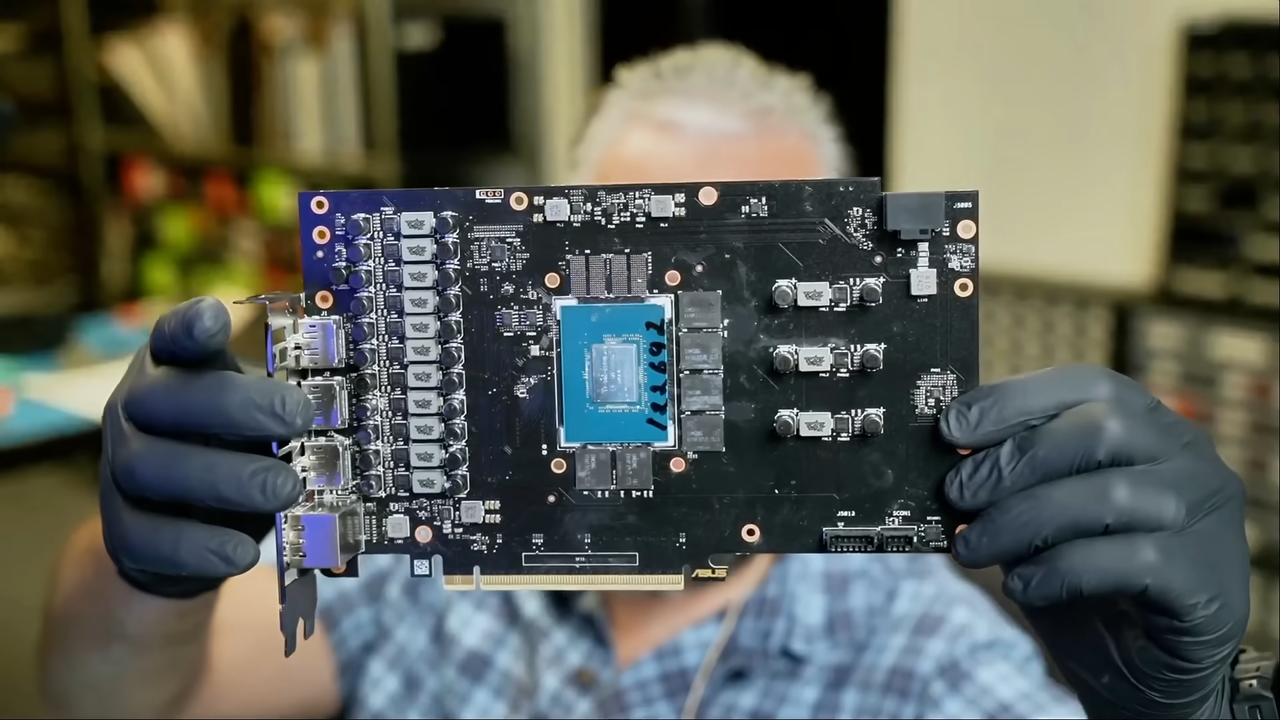
Liquid metal damage on an RTX 5070 Ti.

Most GPUs today still ship with conventional thermal paste, but some higher-end cards — such as the Founder's Edition RTX 5090 — use liquid metal to maximize the cooling potential on the core. Unfortunately, if the application isn't perfect from the factory, it can lead to devastating outcomes, which is exactly what happened with an RTX 5070 Ti that landed on the desks of repair wizards Northridge Fix.

Go deeper with TH Premium: GPUs
We're looking at an Asus TUF RTX 5070 Ti in the video above; this card doesn't come with liquid metal out of the box. It was the owner who decided to apply it themselves and, unfortunately, didn't do a great job since it ended up ruining the entire board. The TIM (thermal interface material) appears to have spread everywhere, leaking out from the core and spilling over onto surrounding components.

When liquid metal comes into contact with tiny surface-mounted componentry like capacitors, it will create microbridges that can short those parts. The leak can eventually reach the main power rails in worst-case scenarios, too. Not only that, but some liquid metal TIM can slowly eat away at metals like aluminum and weaken solder joints. Eventually, ICs in the affected area might even get knocked out of place.

In the video, we see that the liquid metal has somehow reached into every nook and cranny of the PCB, and it's impossible to spot without a microscope. The owner said they cleaned off as much as they could, but clearly, there was enough left on the board to frustrate the technician. About halfway through the cleaning process, the repairman declared that only a miracle can save this GPU at this point.

(Image credit: NorthridgeFix on YouTube)

From the looks of it, liquid metal had gotten underneath the GPU core as well, which shorted it internally, as we can see a physical edge crack in the video. This is unfixable because you'd need to replace the chip, and that's just one part of the problem. The memory modules are affected, too, and the 1.8V power rail is shorting to ground, which means that liquid metal reached a ground pad and destroyed critical circuitry as well.

Even if the GPU core hadn’t been directly contaminated by liquid metal, the short on the 1.8 V power rail would have destroyed it regardless. So, in the end, this becomes a cautionary tale about letting enthusiasm override judgment. If the owner had just used regular, silicone-based thermal paste, he'd have a working GPU — applying liquid metal to a card not designed for it, even if you can create your own seal, is too risky.

(Image credit: NorthridgeFix on YouTube)

Even large manufacturers producing $4,000 GPUs sometimes struggle with getting the application right. Besides, non-factory-applied liquid metal jobs rarely help lower the temperatures in a meaningful way in the first place. You'll certainly lose your warranty if you try to do it anyway, which is why Asus refused to accept the RMA request for this broken RTX 5070 Ti. Unfortunately, not even NorthridgeFix could fix it.

Sign up to read this article
Read news from 100’s of titles, curated specifically for you.
Already a member? Sign in here
Related Stories
Top stories on inkl right now
One subscription that gives you access to news from hundreds of sites
Already a member? Sign in here
Our Picks
Fourteen days free
Download the app
One app. One membership.
100+ trusted global sources.