The Fitbit Air and Fitbit Charge 6 are two of the best fitness trackers in 2026. But is one better than the other? That truly depends on your budget, the number of smart features, and the type of user experience you desire.
To help you better understand the differences between 2023's Fitbit Charge 6 and 2026's Fitbit Air, I've compared the two across five categories, including cost, design, health and fitness tracking features, smart features, and battery life.

The Fitbit Air is my favorite distraction-free fitness tracker in 2026, with no screen, buttons or notifications to slow you down. Battery life is good for up to a week, and health and fitness tracking performance proved reliable in testing. However, it lacks onboard GPS, so you'll need to carry a smartphone for location data when working out outdoors.

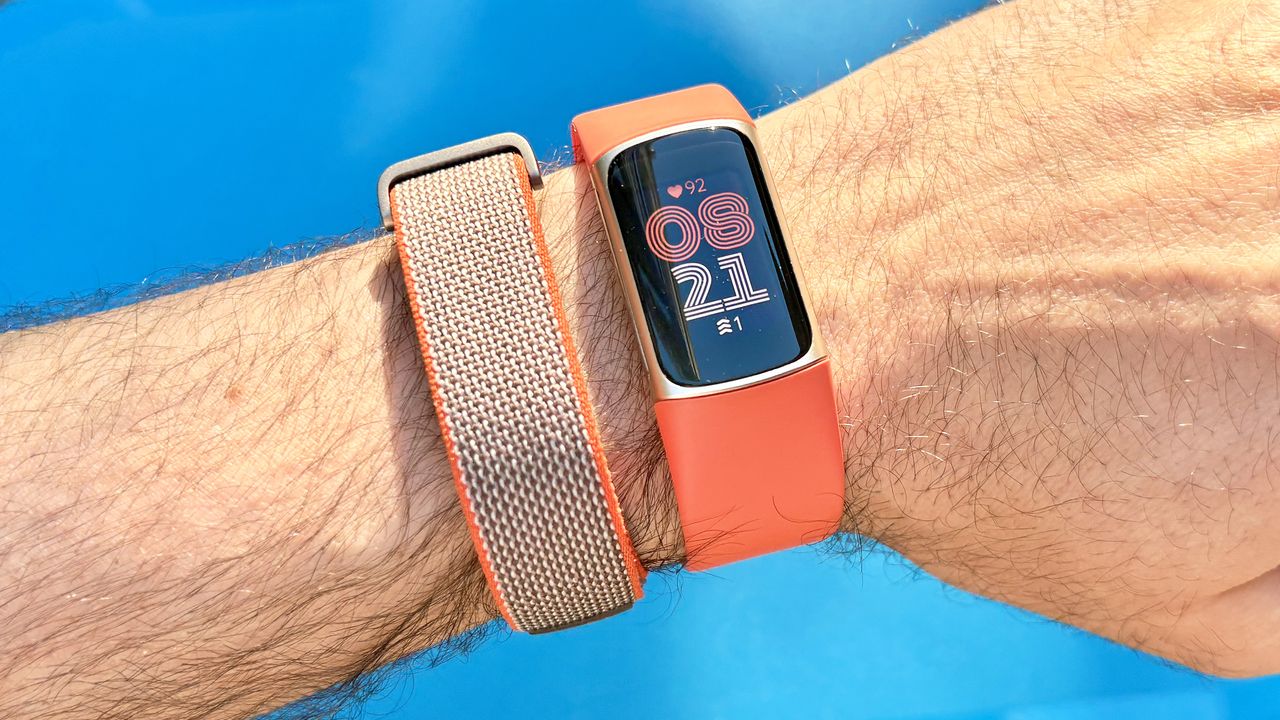
The Fitbit Charge 6 may have debuted in 2023, but it's still one of the most well-rounded fitness wearables money can buy in 2026 thanks to reliable tracking performance, excellent battery life, and just the right amount of smart features. Easy-wearing, it also boasts onboard GPS, so you don't need a smartphone for location-based fitness insights.
Fitbit Air vs Fitbit Charge 6: Specs compared
Fitbit Air |
Fitbit Charge 6 |
|
|---|---|---|
Price |
$99 |
$159 |
Launch date |
May, 2026 |
Sept, 2023 |
Compatibility |
Android, iOS |
Android, iOS |
Dimensions |
34.9 x 17 x 8.9 mm |
11.4 x 22.9 x 10.2 mm |
Weight w/ strap |
12 g |
15 g |
Display |
n/a |
1.04-inch AMOLED |
Sensors |
Heart rate, SpO2, Skin temp, Accelerometer, Gyroscope |
Heart rate, SpO2, ECG, Skin temp, Accelerometer, Gyroscope, NFC |
GPS |
No |
Yes |
Battery life |
Up to 7 days |
Up to 6 days |
Water resistance |
50 meters |
50 meters |
Fitbit Air vs Fitbit Charge 6: Cost
The newer Fitbit Air is $99, while 2023's Fitbit Charge 6 is $159. However, the latter goes on sale frequently. For example, you can pick up the Charge 6 right now for just $99 via Amazon. That said, the Fitbit Air is consistently cheaper than the Charge 6, so it wins this category.
Winner: Fitbit Air
Fitbit Air vs Fitbit Charge 6: design
Both fitness trackers are lightweight, comfortable wearables with modest footprints. While the Fitbit Air is screen-free and button-free, providing a no-distractions health and fitness tracking experience, the Charge 6 offers a small 1.04-inch AMOLED touchscreen and haptic side buttons.
Does this make the Charge 6 a better tracker than the Air? That depends on whether you prefer a more-connected device capable of mirroring phone notifications and displaying stats, or one designed with a set-it-and-forget-it mentality.
Either way, the Charge 6 and Air each proved to be well-built in our testing, with respectable water resistance ratings of 50 meters. The Air is, of course, a bit more understated due to the lack of a screen; it's also a bit smaller. These factors don't necessarily make it a better-designed device, though.
Winner: draw
Fitbit Air vs Charge 6: Health and fitness tracking
The Fitbit Air proved to be a competent fitness tracker when pitted head-to-head against other popular wearables, like versus the Fitbit Inspire 3. However, it lacks onboard GPS, so you need to carry your paired phone to ensure metrics like distance, pace, and elevation gain are recorded accurately.
Not a fan of jogging with a bulky smartphone in your pocket? I feel you. In that case, the GPS-sporting Fitbit Charge 6 is going to be the better tracker for you.
The Charge 6 has other advantages over the Fitbit Air, most notably, the ability to record ECGs. When it comes to tracking workouts, both devices support over 40 modes with automatic detection and tracking for basic workouts like walks, runs, and bike rides.
Of course, thanks to its screen, users can manually start a workout on the Charge 6 with just a few taps, while Fitbit Air users will need to make a trip to the Google Health app on their paired phone.
Winner: Fitbit Charge 6
Fitbit Air vs Fitbit Charge 6: Smart features
This one isn't even close. When it comes to support for smart features, the Fitbit Charge 6 blows the Fitbit Air out of the water. However, the Charge 6 doesn't offer anywhere near the level of smarts you'll get from the best smartwatch models in 2026, like the Apple Watch Series 11 or Google Pixel Watch 4.
Still, the Charge 6 has NFC, so you can tap-to-pay using Google Wallet. It also supports a small selection of handy Google apps, like Google Maps and YouTube Music. There's no onboard music storage, but you can control media playback from your paired device.
The Charge 6 additionally mirrors smartphone notifications for both Android and iOS users.
Winner: Fitbit Charge 6
Fitbit Air vs Fitbit Charge 6: Battery life
The Fitbit Charge 6 is rated to last up to six days per charge on average, while the Fitbit Air is billed for up to seven days per charge. In my testing, both ratings proved accurate, making the Fitbit Air the winner of this category.
Winner: Fitbit Air
Verdict
When choosing between the Fitbit Air and the Fitbit Charge 6, the ultimate question to ask yourself is, "Do I want a screen-free and distraction-free fitness tracker or a more connected device?"
Put another way, the Fitbit Air is a wearable that you simply, well, wear and let it do its thing; the Charge 6 is one you interact with via a small touchscreen and haptic buttons.
Both are reliable, comfortable, and long-lasting. Of course, the Charge 6 has the advantage of onboard GPS, which is why I ultimately prefer it to the Air, along with NFC. But if you're not big on outdoor workouts or using tap-to-pay from this wrist, this may not matter much to you.
Overall winner: Draw