
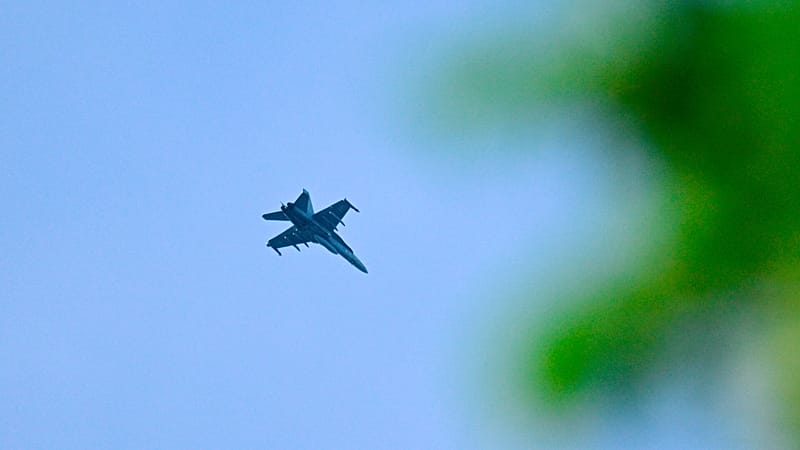
Finland's air force said on Friday that Swedish and Finnish fighter jets had been scrambled to identify Russian fighter jets flying over the Gulf of Finland.
The air force said that the two Nordic countries' Quick Reaction Alert (QRA) jets had been scrambled on Thursday.

They had identified a Russian detachment consisting of a Tu-134 transport aircraft, MiG-31 fighter jets and Su-30 fighter jets "in international airspace over the Gulf of Finland."
According to the military it was the first joint operational "identification mission" for the two air forces.
Swedish Prime Minister Ulf Kristersson commented on the operation on X, saying that "the Baltic Sea has never been as vulnerable as it is now - but it has also never been better protected than it is right now."
Tensions over the Baltic Sea have risen sharply in recent years and Nordic jets are regularly scrambled to intercept Russian aircraft.
In the wake of Russia's 2022 invasion of Ukraine, Sweden and Finland both dropped decades of military non-alignment and joined NATO.
The incident came on the same day that the Danish Defence Intelligence Service (DDIS) said that the risk of Russian military action against NATO countries was growing and an outright invasion was "highly unlikely" but possible.
"There is a low but growing risk that Russia will launch a limited military attack against one or several NATO countries bordering Russia," Thomas Ahrenkiel, the head of the DDIS, told a press conference at which he presented an updated assessment of the threat from Russia.
He said that the agency still considered it "highly unlikely that Russia would see any interest in invading a NATO country, but we cannot rule it out".
In the DDIS assessment, the agency said that Russia would likely carry out more so-called "hybrid attacks" against targets in the West.
It noted that in the past such attacks had "mainly been aimed at creating fear and weakening public support for aid to Ukraine".
But they had now started to include actions meant to stop support from reaching Ukraine, such as sabotage against defence companies or railway transports carrying military equipment, the agency said.
The DDIS said it thought Russia would intensify such attacks, which could also include "destructive cyber attacks that cripple critical societal functions."
Europe on alert
European countries have been on high alert for any Russian interference, with fears that Moscow could target Kyiv's Western backers as the Kremlin's invasion of Ukraine drags on into its fifth year.
In November, NATO military officials said a new US anti-drone system had been deployed to the alliance’s eastern flank.
And following a violation of Polish airspace, NATO Secretary General Mark Rutte announced the formation of the Eastern Sentry programme, which aims to deter further Russian incursions.
Some European officials described the incidents as Moscow testing NATO’s response, which raised questions about how prepared the alliance is against potential threats from Russia.
The Kremlin has dismissed allegations that Russia is behind some of the unidentified incursions in Europe as "unfounded."