
Get all your news in one place.
100’s of premium titles.
One app.
Start reading
LiveScience
LiveScience
Aristos Georgiou

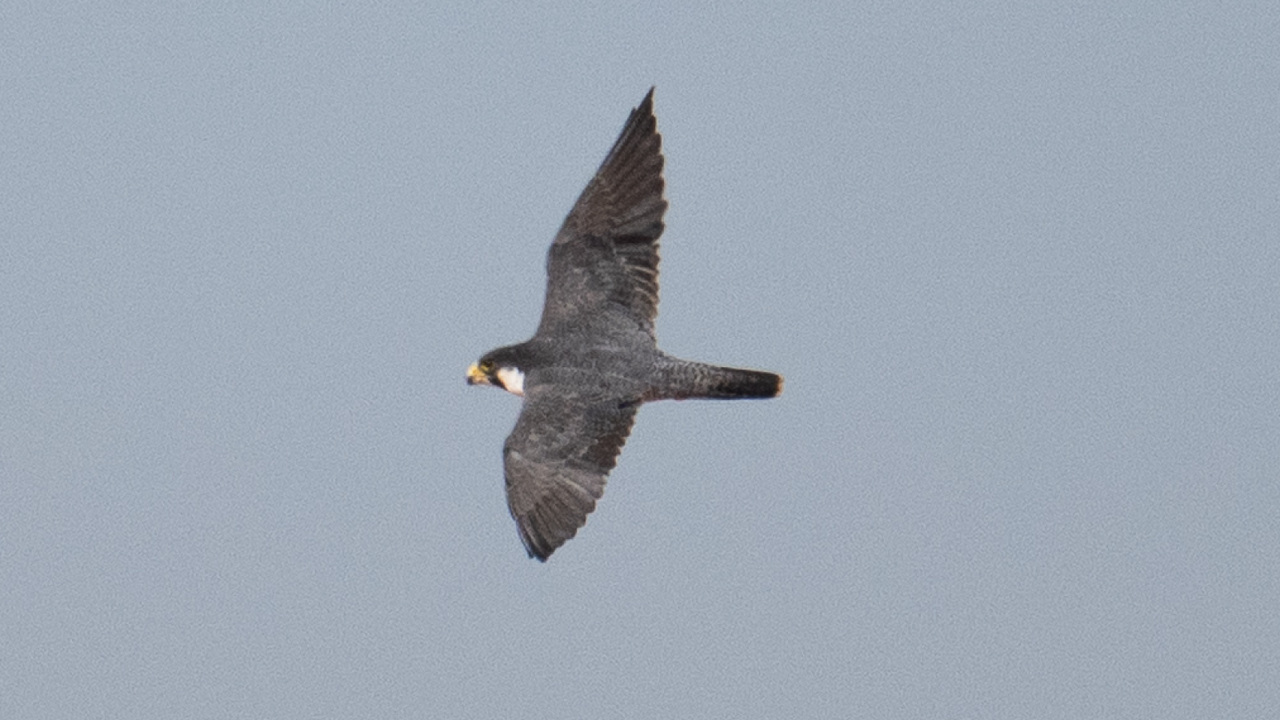
Extraordinary photo captures first appearance of Siberian peregrine falcon in Australia's arid center

The Siberian peregrine falcon captured on camera while in flight.

A wildlife researcher has made a historic sighting of a Siberian peregrine falcon in central Australia, a region where this subspecies has never been recorded before, the Australian Wildlife Conservancy (AWC) announced Tuesday (Feb. 3).

The falcon's appearance in the region may be linked to a large and unusual rainfall event in 2024, which created temporary wetlands that attracted congregations of prey bird species, as well as predators, the AWC said in a statement.

AWC wildlife ecologist Tim Henderson spotted the bird of prey in the skies above the Newhaven Wildlife Sanctuary near the remote town of Alice Springs in February 2025 and managed to capture a photo of it. Experts have since analyzed the image and confirmed that it is a Siberian peregrine falcon (Falco peregrinus calidus).

This arid region of Australia is a far cry from where the Siberian subspecies breeds — in the Arctic tundra of Eurasia thousands of miles away.

But in 2024, Australia experienced a relatively high amount of rainfall. The national average was 596 millimeters (23 inches) — 28% above the 1961-1990 average — making it the eighth-wettest year since national records began in 1900, according to the government’s Bureau of Meteorology Annual Climate Statement 2024. Several regions experienced above average rainfall, including the Northern Territory — the federal territory in which the wildlife sanctuary is located — which recorded its fourth-wettest year since 1900.

The Newhaven Wildlife Sanctuary, in particular, experienced a significant rainfall event in 2024, with 316 mm (12 inches) falling in March alone, and 637 mm (25 inches) recorded in total for the year, according to a study published in the journal Pacific Conservation Biology authored by Henderson that documents the impacts on the local ecosystem and the falcon sighting.

A sand dune in the Newhaven Wildlife Sanctuary. (Image credit: © Evan Gaulke)

This rainfall was "the most we've had in a year since 2001, and the 5th wettest year on record," Henderson said in the statement. "This filled the wetlands and created temporary water sources that were able to support large congregations of prey species, resulting in high raptor diversity including the Falcon, the Goshawk and more."

The peregrine falcon (Falco peregrinus) is widely considered the world's fastest airborne animal, with speeds reaching more than 199 mph (320 km/h) during dives. It is found worldwide, except in Antarctica, and is capable of traveling long distances, sometimes migrating between continents. The Siberian subspecies tends to travel south following the Northern Hemisphere summer, but these birds are considered "rare migrants or vagrants" to Australia, Henderson told Live Science in an email.

"The Siberian subspecies will sometimes turn up along the coastlines of northern and eastern Australia and will usually generate some buzz within local birding communities," he said.

Up to a dozen sightings may be reported in Australia per year across social media, online bird observation databases and other platforms, according to Henderson.

"They are detected even less frequently the further inland you go," he said. However, this could be because coastal areas are more populous, so more bird-watchers are likely to spot one, he added.The latest sighting represents the farthest inland the Siberian subspecies has been documented in Australia to date, according to Henderson.

Given the high speeds that peregrine falcons are capable of reaching — they are sometimes referred to as the world's fastest animal — the ecologist was surprised to capture the bird on camera.

"I'm honestly amazed that the image didn't come out blurry," Henderson said in the statement. "The bird was moving far too quickly to identify in the field, but it looked different to the usual peregrine falcons we see in Australia and I've made a habit of snapping photos to review later. Especially with peregrines, there's always that chance a rare subspecies might appear — as was the case here!"

Sign up to read this article
Read news from 100’s of titles, curated specifically for you.
Already a member? Sign in here
Related Stories
Top stories on inkl right now
One subscription that gives you access to news from hundreds of sites
Already a member? Sign in here
Our Picks
Fourteen days free
Download the app
One app. One membership.
100+ trusted global sources.