
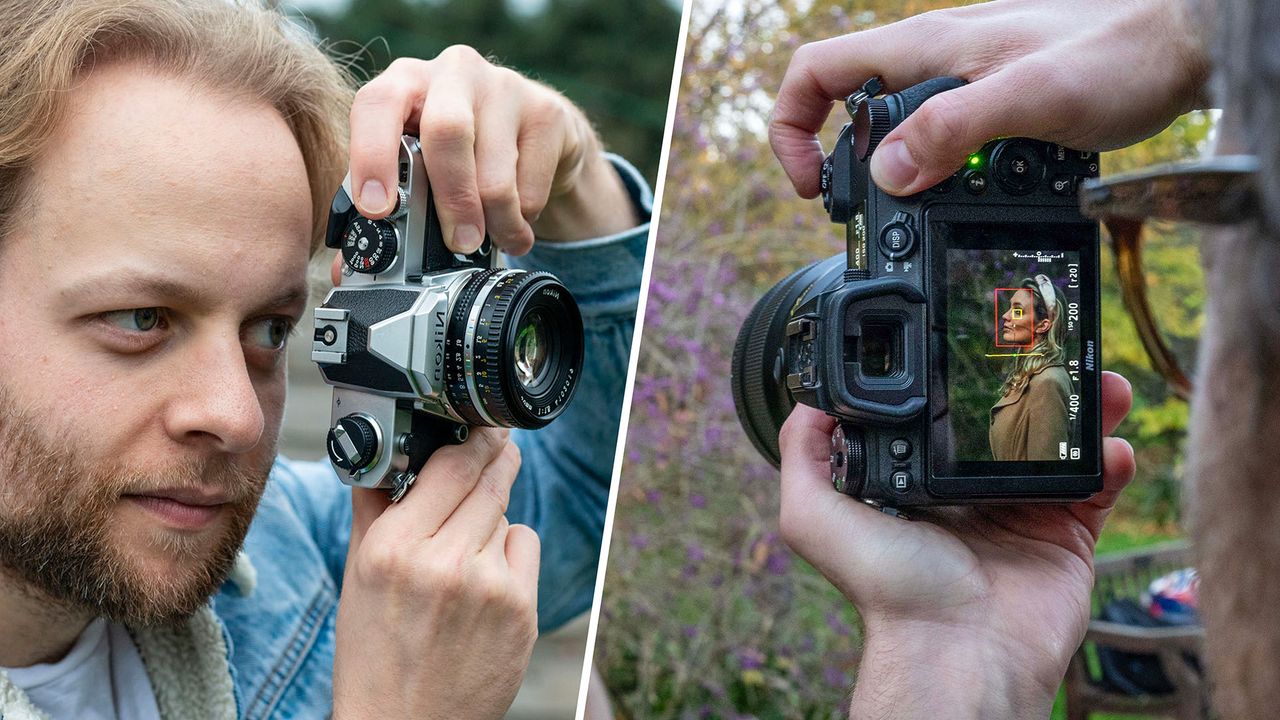
Having grown up in an analog era of photography, where I had to imagine what the result might be as I squeezed the shutter release button, being gifted digital cameras with backplate LCDs and electronic viewfinders – with which I could not just frame but instantly review the outcome – changed the way I took pictures overnight.
Being freed from the restriction of a roll of 36 exposures encouraged me to experiment more, free from the worry and expense of ‘wasting’ film.

But while an LCD screen validated my ideas or enabled me to adapt them while my subject was still in front of me, I’m not sure I’m a ‘better’ photographer for having gone digital. It has, however, enabled me to get more shots that are keepers – and perhaps that is better.
The recent backlash regarding Panasonic removing the eye-level viewfinder from its ZS300 / TZ300 compact, when the earlier TZ200 / 100 had one, had me wondering whether I’d prefer, instead, to keep a viewfinder – and alternatively ditch the LCD.
Or have I got so used to using an LCD for photo composition and review, sometimes at arm’s reach, that I could no longer do without such a digital aid?
Common sense and experience would dictate that if I was once restricted to an optical viewfinder – and I still enjoy using DSLRs with large and bright finders – then I would be happy enough to go back to an LCD-free approach to photography.
And, if that were the case, I wouldn’t be alone.
Indeed, the wallet-busting Leica M11-D rangefinder and the pocket-money Camp Snap 2 compact at the other end of the scale have deliberately opted to go screen-free. Whether to provide their owners with a ‘purer’ photography experience, or simply as a means of weaning kids off screens so they can be more present and in the moment.
And then there’s the inexorable rise, seemingly against all odds, in the popularity of the disposable film camera.
Expanding year on year, this is a market estimated to be worth $1.23 billion in the US by 2030 – fuelled by millennials and Gen Zers who have never previously known analog photography, rather than their parents.
Okay, but aside from my being able to review shots at the time I capture them, an LCD monitor is also incredibly useful if I ever need to shoot from an awkward angle, such as above a crowd or low to the ground.
That said, I’d often lie on the ground with my film camera to achieve a composition that gave the subject a towering stature or presence. So, the lack of screen was hardly a deal breaker in the analog era.
But what if I was restricted to just using an EVF in the digital era? On the plus side, it means there is no chance of visibility being compromised in bright sunlight by screen glare. I can also still review adjustments to exposure in real time, with my eye pressed up against it and free from peripheral distraction.
Whether you primarily shoot with a viewfinder or LCD, having both options at your creative disposal is the approach that most photographers would favor in 2026. However, if I had to pick just one, I’d surprise myself by choosing an LCD.
Does that mean, like most of us, I’m now screen-addicted? Shooting without one is something I’m happy to do occasionally by choice. But permanently? I would feel like I’m operating with one hand tied behind my back.
How about you? Let me know in this poll…
You might also like…
Looking for the finest EVF on the market? Sony's high-end cameras like the Sony A7R VI have a 9.44 million-dot viewfinder. And for the best back screen, look to the Hasselblad X2D II 100C with its 2.36 million-dot, 1,400-nit, true HDR touchscreen.