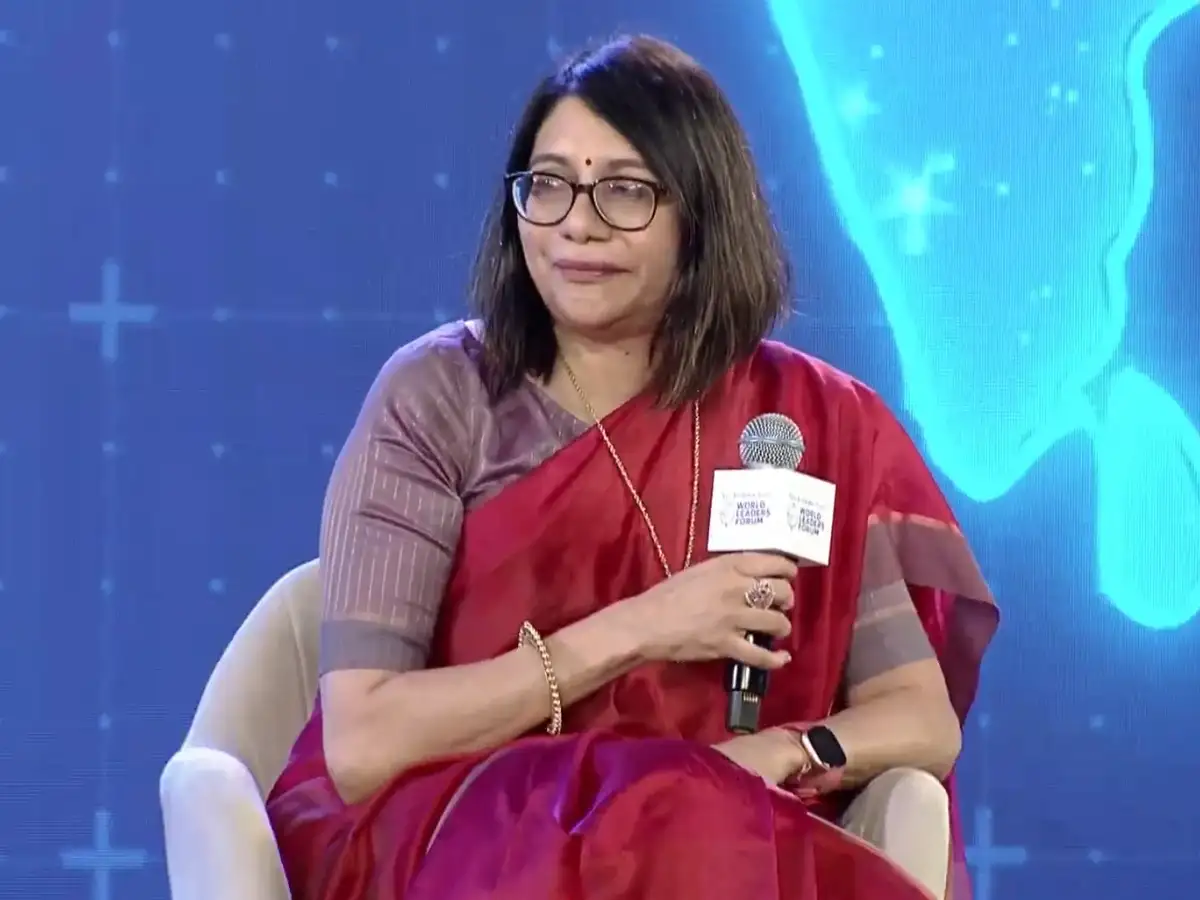
The next phase of India's digital economy would be driven by the country's small enterprises, farmers and workers in Tier-2, Tier-3 and rural India, with artificial intelligence reaching beyond large corporations to unlock broader economic value, Google India MD Preeti Lobana highlighted on Friday.
Speaking at the ET World Leaders Forum 2026, she said, “The heartbeat of India lives in Tier-2, Tier-3, rural India,” stressing that AI should not benefit only large enterprises or a select group of users, but reach the “torso and the long tail” of the Indian economy.

Lobana said India's core of small enterprises, farmers and workers would be critical to powering the country's $1 trillion digital economy.
Also read: ET World Leaders Forum 2026: Smriti Irani on politics, power and the price of being a woman
“I would link it to a figure... how India's core of small enterprises, farmers and workers powered the $1 trillion digital economy,” she said, while discussing Google's India outlook for 2030.
Google works extensively with large enterprises that have scale, capabilities and financial resources. However, the bigger opportunity lies in using AI to empower India's broader economic base and ensure that its benefits are widely distributed.
“The most critical thing is that AI reaches everyone, and they are benefiting as well, not just the chosen ones,” she said.
India Inc moves beyond AI experiments
While expanding AI access across the wider economy will be critical, demand among India's large enterprises is already strong, Lobana highlighted, adding that companies are moving beyond experimentation and proof-of-concepts towards actual deployment.
“We are way past the era of experiments and proof of concepts,” she said, citing Tata Steel as an example as the company deployed 300 specialised AI agents in nine months, with applications including shop-floor safety and invoicing.
AI adoption is also gaining traction across retail, manufacturing and financial services.
For this adoption to translate into a larger economic impact, India will need massive compute capacity, security protocols, foundational models, application layers and cutting-edge infrastructure, Lobana said.
AI as a force multiplier for cybersecurity
Lobana also highlighted cybersecurity as a key area where AI can act as a “force multiplier”.
A bad actor needs to be right only once to breach an individual or enterprise, while defenders need to be right all the time to protect critical data and users, she said.
Google is approaching the challenge across three areas — users, enterprises and the open web. On Android, the company uses AI to prevent billions of potentially harmful outreach attempts, while its enterprise solutions can allow sensitive documents to run in secure, disconnected environments.
As AI infrastructure expands, sovereignty will also become increasingly important for India, she said, pointing to investments by Indian companies and technology infrastructure providers, as well as the government's focus on building future AI capabilities through the India AI Mission.
“Sovereignty is about having control and choice,” Lobana said.
For India, the larger challenge is therefore not simply building AI capabilities, but ensuring that those capabilities reach the country's broader economic base.
“Not for the chosen one, AI for all,” Lobana said in her closing remarks at ET WLF 2026.