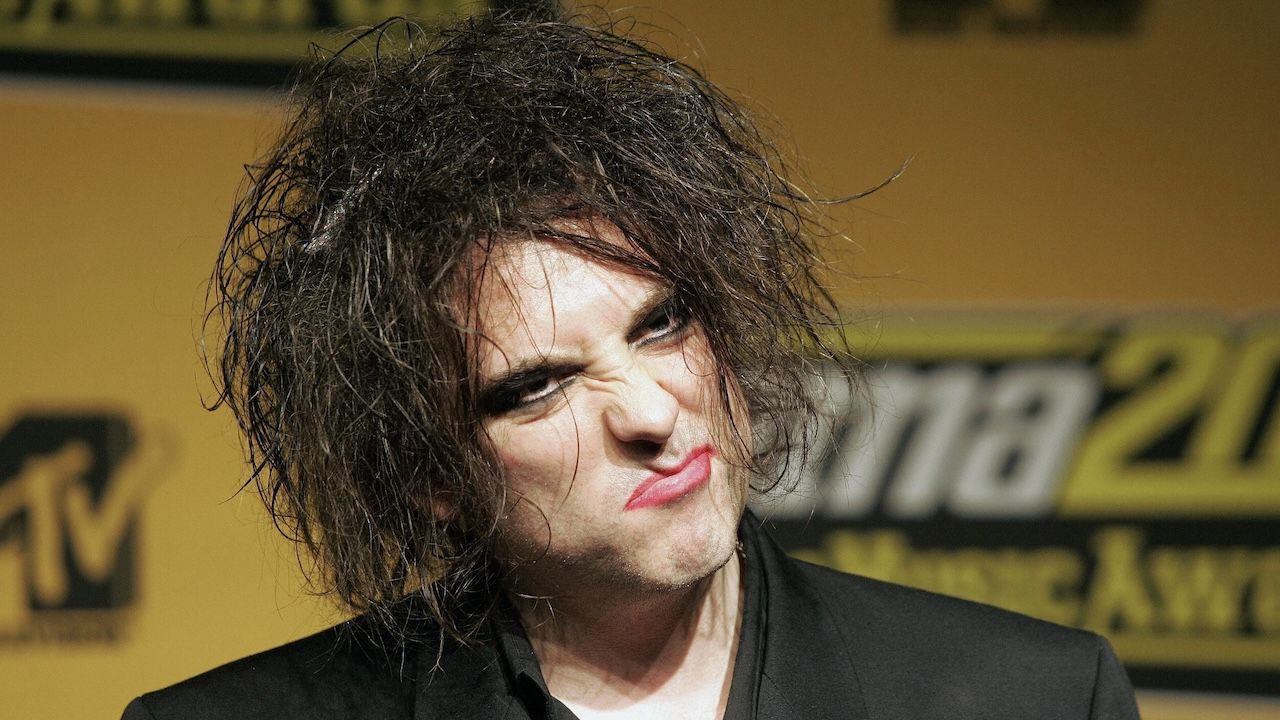
Robert Smith originally intended that The Cure's 11th album, 2000's Bloodflowers, would be his group's final studio collection. Smith turned 40 during the making of the record, and considered this an appropriate point at which to bring the curtain down on his band, and try something new, specifically a solo record. For Smith, Bloodflowers represented the completion of a Cure 'trilogy', following on from 1982's Pornography, and 1989's Disintegration, and its release would see his band exiting stage left on a high note.
Happily, for fans of Smith's unique, truly original and highly influential band, there would be much more to come from The Cure. Interviewed in 2002, Smith revealed that he thought that his group had "turned into a very good band" since the millennium, and admitted, "I never thought that I'd make an album with The Cure that was as good as Bloodflowers."
The following year, Smith renewed his commitment to the band by signing a three-album deal in America with ARTISTdirect Records imprint, I AM, the label launched by producer Ross Robinson. Though Robinson is best known for his work with game-changing rock and metal bands - Korn, Sepultura, Slipknot and At The Drive-In among them - the Texan producer revealed that The Cure had been his "favorite band for years and years". And as an affirmation of his excitement about the signing, he pledged to co-produce the band's next record with Smith.
Such was Smith's enthusiasm for what would become his band's twelfth album, that he demoed no fewer than 37 songs for potential inclusion, which the group and their new producer collectively whittled down to 20 to record at London's legendary Olympia studios, which had previously hosted The Beatles, Jimi Hendrix, The Who and Led Zeppelin among many others.
"We convinced [Robinson] that the doom and gloom of London is more conducive to making our music than sunny California," Smith said, somewhat mischievously.
"I started writing really heavy songs, because, when you’re working with Ross, he’s bound to want dark and moody," The Cure's frontman told Rolling Stone. "What became very apparent is that he liked all kinds of things we did. He’s really into the melodic side of the band and the pop side of the band."
The group - completed at the time by guitarist Perry Bamonte, bassist Simon Gallup, keyboard player Roger O'Donnell, and drummer Jason Cooper - commended recording at Olympia in late 2003. It didn't take long for their new producer's famously 'idiosyncratic' and onfrontrational working methods to surface.
"On the first day we were in the studio, we set up and started playing a song," Smith told Spin in 2004. "He let us play through it for an hour or so, and then he came out and he just started kicking things over, and he went absolutely mental. He’s talking like, 'You’re the Cure, what the fuck are you doing?'
"The band as a band is never usually confronted, because it’s usually just me saying to them, This is the last album, try to pull something out. And suddenly we had this bloke running around, kicking thing over, going, 'For fuck’s sake, don’t any of you realize?' And it was so incredible having something like that. I loved it. I was like almost crying with happiness. And I knew at that moment that it was going to work."