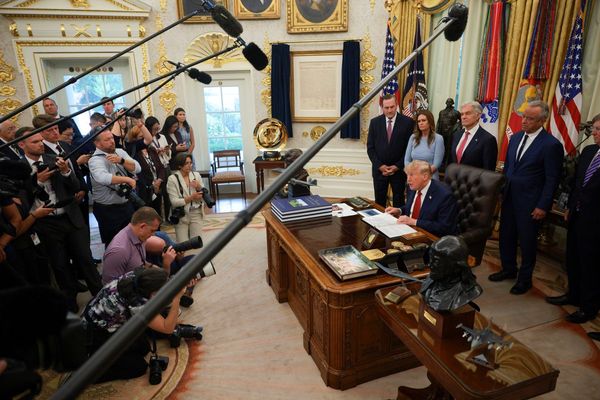
Speaking to reporters for the first time since he took charge of the Trump administration's cost-cutting initiative, Elon Musk yesterday portrayed the project as an effort to restore democracy by disempowering "a large unelected bureaucracy" that defies "the will of the people." Musk, who delivered comments and took questions alongside President Donald Trump in the Oval Office, also presented the efforts of his so-called Department of Government Efficiency (DOGE) as both necessary and sufficient to address the nation's looming fiscal crisis. As became clear when Musk got into the details of what DOGE is trying to do, both of those characterizations are highly misleading.
The main thrust of Musk's efforts is applying sound business practices to federal expenditures, which is laudable and long overdue. But that has very little to do with confronting a "fourth, unconstitutional branch of government," as Musk put it (although that spin may appeal to Trump, given his longstanding complaints about a "deep state" conspiracy against his agenda). And contrary to what Musk claimed, tackling "waste, fraud, and abuse" cannot possibly generate enough savings to eliminate the annual budget deficit, which was nearly $2 trillion in fiscal year 2024, let alone reduce the ever-climbing national debt, which currently exceeds $36 trillion, including $29 trillion in debt held by the public.
"We've got a $2 trillion deficit," Musk said. "If we don't do something about this deficit, the country's going bankrupt….Interest payments alone on the national debt exceed the Defense Department budget, which is shocking [because] we spend a lot of money on defense. And if that just keeps going, we're essentially gonna bankrupt the country….It's not optional for us to reduce the federal expenses; it's essential. It's essential for America to remain solvent as a country. And it's essential for America to have the resources necessary to provide things to its citizens and not simply be servicing vast amounts of debt."