
Get all your news in one place.
100’s of premium titles.
One app.
Start reading
LiveScience
LiveScience
Kristina Killgrove

Elaborate 2,700-year-old tomb in Greece contains burial of a woman with an upside-down crown

A partially excavated human skeleton with a greenish bronze crown around the skull.

Archaeologists in Greece have uncovered the grave of an ousted noblewoman whom they are calling "The Lady with the Inverted Diadem." The seventh-century-B.C. burial is notable for the elaborate bronze crown placed upside down on the woman's head, which may have signified a final end to her power.

The noblewoman's grave was unearthed at an ancient cemetery that was recently discovered in east-central Greece, about 60 miles (95 kilometers) northwest of Athens, during construction work, according to a Nov. 27 translated statement from the Greek Ministry of Culture. The 40 graves recovered thus far appear to be the burials of people of high social status who died in the Archaic and Classical periods (800 to 323 B.C.).

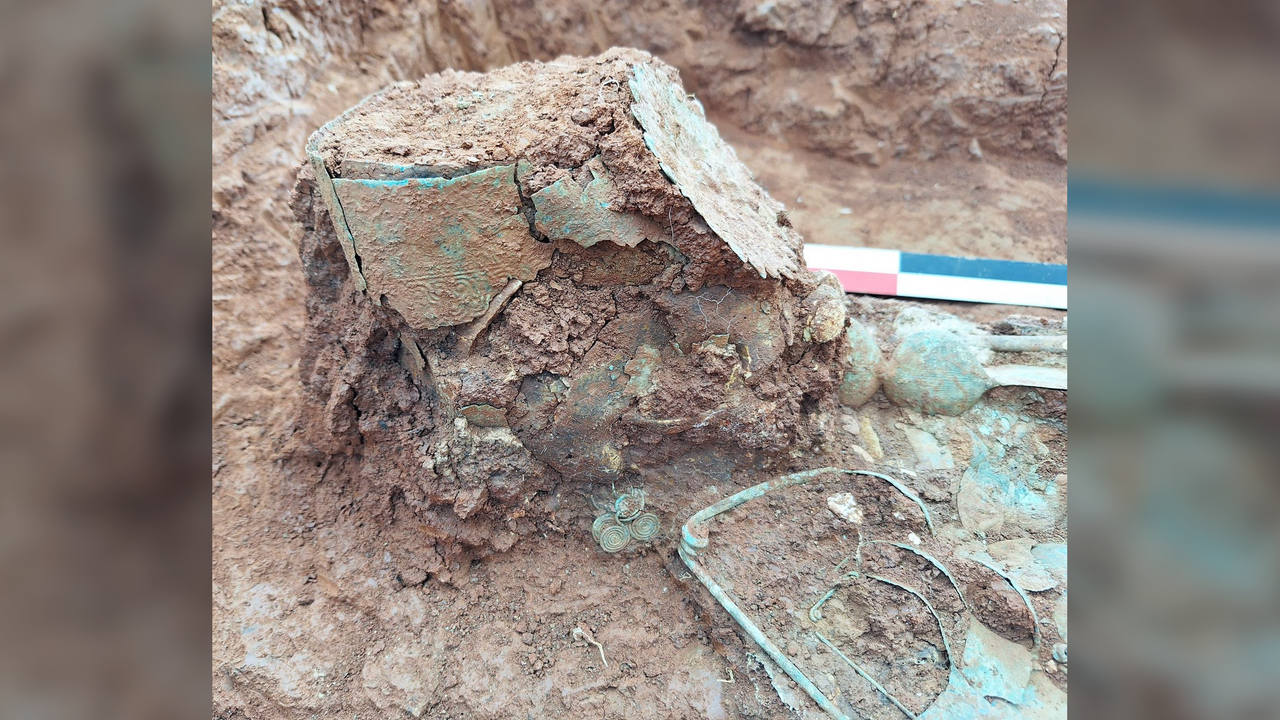
One grave stood out above the rest, according to the statement. Within the burial of a woman who was about 20 to 30 years old when she died, archaeologists discovered numerous bronze grave goods, including a pin with geometric-style horses, a necklace with a vase-shaped amulet, bone and ivory beads, copper earrings, a bracelet and several spiral rings.

(Image credit: Greek Ministry of Culture)

The woman's bronze diadem, in particular, caught the archaeologists' attention. It featured a large rosette on the front and a scene of facing pairs of male and female lions on the back. But the crown had been placed upside down on the woman's head so that the lions appeared to be lying down.

Lions symbolized royal power and authority, according to the statement, as can be seen in earlier iconography from the southern Greek city of Mycenae, where the so-called Lion Gate was a potent symbol of the king's power in the 13th century B.C.

An inverted crown, though, symbolizes the resignation or fall of a ruler. Therefore, this woman may have lost her privileged position during a time of social and political upheaval in the mid-seventh century B.C., according to the statement. That difficult time in Greek history was eventually resolved by the lawmaker Solon's reforms that laid the foundation for Athenian democracy in the early sixth century B.C..

Archaeologists also found the burial of a 4-year-old child near the woman. The child was crowned with a bronze diadem with small rosettes and dates to the same time period as the woman, suggesting they may have been related in some way.

Research at the site is ongoing and may reveal more graves in the near future.

Archaeology Fragments Quiz: Can you work out what these mysterious artifacts are?

Sign up to read this article
Read news from 100’s of titles, curated specifically for you.
Already a member? Sign in here
Related Stories
Top stories on inkl right now
One subscription that gives you access to news from hundreds of sites
Already a member? Sign in here
Our Picks
Fourteen days free
Download the app
One app. One membership.
100+ trusted global sources.