Even though women hold more qualifications than men, they are still generally paid less than their male counterparts, starting from their entry into the workforce. In 2017, women with university and vocational qualifications earned on average 70% of men’s salaries in countries of the Organisation for Economic Co-operation and Development (OECD).
Most research in this area understandably concentrates on issues related to career, professional quotas, or parenthood. Recently, a study by France’s statistics agency Insee showed that 68% of the gender wage gap in full-time, equivalent jobs can be explained by the fact that women and men rarely occupy the same positions.
But the choice of different professions (we sometimes talk about “occupational segregation”) can largely be explained by the specialisations pursued in university and vocational education. According to research, the latter appear highly gendered and rarely balanced between men and women. For example, the percentage of women among new bachelor-level admissions in science, technology, engineering and mathematics (STEM) is only 30%, whereas it is 77% for health and social welfare.
Drawing on a large French public database, our research shows that what we study goes a long way in determining differences observed on the labour market.
Limited data
As early as 1984, American researchers Thomas Daymont and Paul Andrisani suggested including educational choices in equations analysing the wage gap between women and men in the United States. However, this was easier said than done. Indeed, students tend to gradually specialise in their discipline, and masters degrees that follow may carry thousands of different names. For example, there are stark contrasts between social law, business law and criminal law.
This lack of data means there has been little research on the relationship between education choices and occupation. However, each year, several tens of thousands of master graduates are surveyed upon their entry into the professional world by France’s Ministry for Higher Education, Research and Innovation. This is the data that we used for our research.
Seemingly well-balanced
Gendered educational choices appear to hamper income equality early on. Three years after graduation, female graduates earned lower wages than men and were more often on temporary, part-time contracts. They were also less likely to hold executive-level positions.
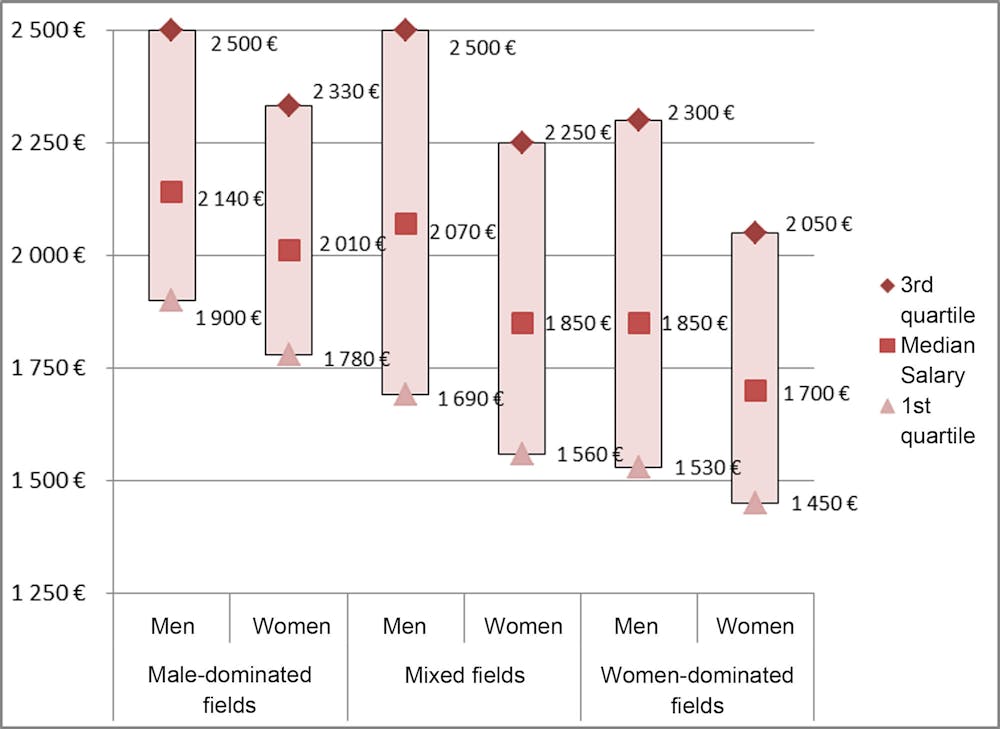
The proportion of women in each sector appears to be related to salary levels. MENESR-DGESIP-SIES; data, survey into career prospects for Master’s graduates in 2013, 30 months after graduating, Provided by the author
Moreover, gender wage gaps appear to be correlated to the number of women in each specialisation. The median salary in male-dominated specialisations remains higher than in gender-balanced groups, which is itself higher than in female-dominated groups. Half of women from male specialisations earn over 2,000 euros per month, versus only a quarter from female-dominated specialisations.
We were also surprised by the complicated structure of many academic subjects. Take management science: despite being popular with men and women alike, the subject still conceals significant wage gaps. Nearly 640 euros per month on average separates people who graduate from the human resources pathway (highly female-dominated) and those from the financial one (highly male-dominated).
Two branches of public policy
The masters specialisation alone accounts for two thirds of the differences between men and women in securing full-time employment, and over a third of the gap in accessing the most prestigious roles. There is a majority of female students in specialisations leading to areas where employment opportunities are poorer, such as the public sector, NGOs and the social sector.
What are the takeaways for public policy? We could slash income inequality in two ways. First, target the labour market directly by revaluing female-dominated jobs. Second, take action in the university and higher education system.
Innovative research on this topic suggests avenues for action based mainly on a quota system or the role of models. The work that we are undertaking with economist Anne Boring aims to document how trajectories determining the choice of studies are formed for male and female students. Our objective is now to reconstitute the entire university path to understand the phases that create the gendered distribution for specialisations at the most detailed level.

The authors do not work for, consult, own shares in or receive funding from any company or organization that would benefit from this article, and have disclosed no relevant affiliations beyond their academic appointment.
This article was originally published on The Conversation. Read the original article.