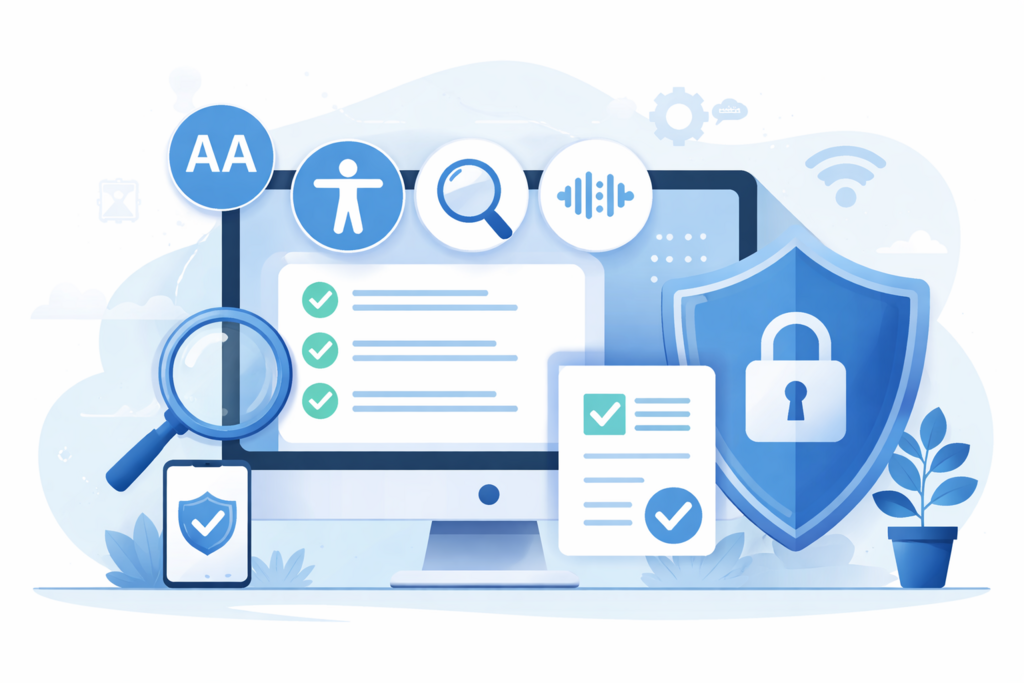
Accessibility has rapidly moved from a secondary checkbox to a front-line requirement in enterprise security procurements. Nowhere is this shift more visible than in email encryption RFPs, where buyers are expanding their evaluation criteria beyond cryptographic strength and key management capabilities. Echoworx’s positioning around WCAG 2.2 Level AA conformance reflects a broader market reality: usability and accessibility are becoming inseparable from security in modern enterprise environments.
Across both public and private sectors, procurement teams are under growing pressure to demonstrate that the digital tools they deploy are usable by all employees and customers, including those with disabilities. As a result, accessibility audits are increasingly embedded directly into vendor selection processes, transforming what was once a compliance afterthought into a competitive differentiator.
Accessibility is now appearing in nearly every enterprise RFP
Security vendors are reporting a clear pattern. Questions about accessibility, screen reader compatibility, keyboard navigation, and color contrast are now routinely appearing alongside traditional encryption requirements. This is particularly pronounced in the UK public sector and European markets, where WCAG alignment has become a baseline expectation rather than an optional enhancement.
The implications are significant. Encryption platforms historically focused almost exclusively on cryptographic robustness and policy enforcement. While those remain essential, buyers are now evaluating the full user journey, including how recipients interact with secure portals, how employees trigger encryption, and whether workflows remain usable under assistive technologies.
Echoworx’s publication of Accessibility Conformance Reports based on the VPAT 2.5Rev template reflects this new reality. By documenting how its Secure Web Portal and M365 add-in align with WCAG 2.2 Level A and AA criteria, the company is addressing a procurement trend that many vendors are only beginning to fully appreciate.
WCAG 2.2 Level AA is becoming the practical benchmark
Within enterprise buying cycles, WCAG 2.2 Level AA has effectively emerged as the operational standard for most large organizations. While Level AAA remains aspirational in many contexts, Level AA is widely viewed as the threshold that demonstrates meaningful accessibility commitment without creating unrealistic implementation burdens.
For encryption platforms, achieving this level of conformance is not trivial. Secure messaging environments often include dynamic content, authentication flows, and document rendering components that must all remain accessible under assistive technologies. Each interface, from web portals to Outlook add-ins, introduces its own testing and remediation requirements.
What procurement teams increasingly value is transparency. Rather than vague accessibility claims, buyers want structured ACR documentation that clearly outlines testing methodology, known limitations, and ongoing maintenance plans. The shift toward living accessibility documents, updated as products evolve, is becoming a best practice expectation.
Evaluation rigor is expanding beyond automated scans
Another important development is the growing sophistication of accessibility validation itself. Enterprises are no longer satisfied with purely automated testing outputs. Instead, they expect a combination of automated tools, manual keyboard navigation checks, screen reader validation, and visual inspection against WCAG criteria.
This mirrors the methodology used in Echoworx’s conformance reporting, where automated analysis using tools such as WAVE is supplemented by manual testing and contrast analysis. The multi-layered approach reflects a maturing buyer mindset that recognizes accessibility as a functional user experience requirement, not merely a technical checkbox.
For security teams, this creates a new collaboration dynamic. Accessibility is no longer owned solely by UX or compliance departments. It increasingly intersects with security architecture, particularly in areas like secure portals, authentication workflows, and encrypted message retrieval experiences.
AI-driven procurement support is entering accessibility evaluations
At the same time accessibility requirements are tightening, the tools enterprises use to evaluate vendors are also evolving. Echoworx has begun aligning its client education ecosystem with OpenAI-powered workflows through resources such as the Cybersecurity RFP & Vendor Comparison Tool available in the ChatGPT OpenAI Bot Store.
This integration reflects a broader procurement trend toward AI-assisted vendor analysis. Rather than manually assembling accessibility checklists and scoring frameworks, enterprise teams can now generate structured comparison models interactively. For complex security categories like email encryption, where usability, compliance, and cryptography intersect, this kind of guided evaluation environment can significantly streamline early-stage research.
The practical impact is subtle but important. Buyers are becoming more methodical, more documentation-driven, and more cross-functional in how they assess vendors. AI-supported RFP tooling is accelerating this shift by helping teams surface the right questions earlier in the process, including those related to accessibility readiness.
Why accessibility now influences competitive positioning
The elevation of accessibility within encryption RFPs is ultimately being driven by risk management. Organizations recognize that secure communication tools that are difficult to use create downstream problems, including user workarounds, support burden, and potential compliance exposure.
In the United Kingdom, accessibility and secure communications requirements are tightening in parallel, particularly across government departments, financial services, and regulated suppliers. Procurement teams are increasingly aligning email encryption evaluations with WCAG 2.2 Level AA expectations, not only to satisfy Equality Act obligations but also to meet broader digital service standards embedded in UK public sector frameworks. This is creating a more structured buying environment where vendors must demonstrate both cryptographic strength and documented accessibility conformance. As UK organizations continue modernizing under NIS2 alignment and post-Brexit regulatory pressures, encryption platforms that can clearly evidence compliant migration pathways and inclusive user experiences are gaining measurable advantage in competitive RFP cycles.
This does not mean accessibility alone wins deals. Rather, it has become part of the baseline credibility threshold. Vendors that combine strong encryption architecture with transparent accessibility conformance are better aligned with the direction enterprise procurement is heading.
The broader trajectory for secure communications
Looking ahead, accessibility is likely to become even more tightly integrated into security platform design. As secure messaging workflows expand across mobile, web, and embedded enterprise applications, the expectation of inclusive usability will only intensify.
For enterprise buyers, the message is clear. Encryption strength remains essential, but it is no longer sufficient on its own. Platforms must demonstrate that secure communications are also usable, navigable, and accessible across diverse user populations.
The growing visibility of WCAG-aligned reporting, combined with AI-assisted evaluation tools and more disciplined procurement frameworks, signals that the encryption market is entering a more holistic phase of maturity. Vendors that recognize this convergence early are positioning themselves for the next wave of enterprise security modernization.
With this knowledge at hand, it is time to explore how accessibility-ready encryption platforms are evolving in enterprise environments.