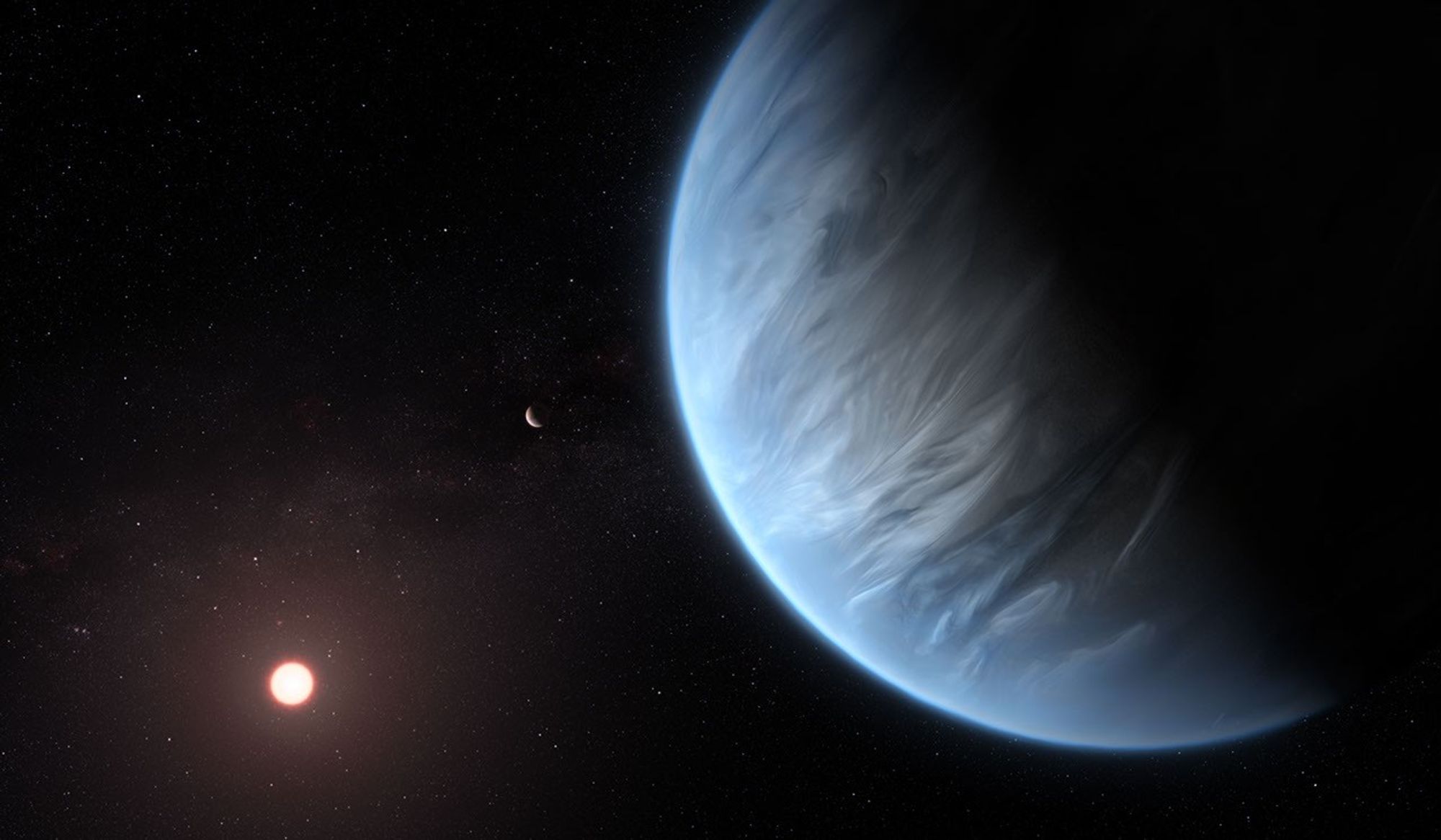
Recently, a team of University of Cambridge-led astronomers made global headlines after announcing they'd found the "strongest evidence yet" of life beyond our solar system. Their claims were based on the detection of sulfur-based gases in an alien planet's atmosphere — gases typically linked to biological processes on Earth. However, a quick independent analysis of the data now casts doubt on the validity of these findings.
Jake Taylor of the University of Oxford in the U.K., who studies atmospheres of exoplanets, used a basic statistical test to identify telltale signs of gas molecules in the atmosphere of the exoplanet at hand, K2-18b. Taylor did this in such a way that the test didn't assume which gases might be present. Instead of the distinct bumps that typically indicate the presence of detectable gas molecules, Taylor saw the data appearing consistent with a "flat line," according to the new study, which was posted to the preprint archive on April 22 and has yet to be peer reviewed. What this means is the data is likely too noisy — or the signal too weak — to draw definitive conclusions.